Multi-Agent Systems vs Single-Agent AI: What to Deploy
YlogX Team · 2026-08-31
A practical guide to choosing between single agent and multi agent AI systems, orchestration patterns, and a decision framework for enterprises.

Multi-agent systems get disproportionate attention relative to how often enterprises actually need them. This guide explains why single-agent architecture should be the default starting point when scoping AI consulting work for a new agentic AI initiative, when multi-agent systems genuinely earn their added complexity, the common orchestration patterns available once you do need one, and a simple decision framework for making the call on your own use case.
Key Takeaways
Single-agent architecture should be the default. It is easier to build, debug, and govern than a multi-agent system.
Multi-agent systems earn their complexity only when a task genuinely benefits from specialization across distinct sub-goals.
Every additional agent adds governance overhead, since each may need its own guardrails, monitoring, and ownership.
The Default Should Be Single-Agent
A single agent handles one goal end to end, retrieving whatever context it needs and calling whatever tools the task requires, all within one reasoning process. This is the right starting point for the large majority of enterprise use cases, and not simply because it is simpler to build. A single agent is also easier to debug, since there is one reasoning path to trace when something goes wrong, and easier to govern, since it requires only one set of guardrails and one owner rather than a coordinated set across multiple agents. Enterprises new to agentic AI specifically benefit from this simplicity, since it lets the organization build confidence in agentic AI generally, and in its own governance processes specifically, before taking on the added coordination complexity a multi-agent system introduces.
The instinct to reach for a multi-agent architecture often comes from an assumption that more sophisticated tasks require more agents, treating agent count as a proxy for capability. In practice, a well designed single agent with strong retrieval and a clearly scoped set of tools can handle considerably more complexity than that assumption suggests. The decision to add agents should follow from a specific, observed limitation of the single-agent approach, not from a general sense that a more advanced use case warrants a more elaborate architecture. For the underlying architecture concepts a single agent relies on, retrieval, reasoning, and tool use, see AI consulting services: GraphDB vs. vector search for agentic AI.
There is also a cost dimension to this default that is easy to overlook during early architecture discussions. Every additional agent typically means an additional set of model calls, an additional retrieval pass, and additional infrastructure to maintain, all of which add up in both engineering time and ongoing operating cost. A single agent that solves the problem adequately is not just simpler to govern, it is meaningfully cheaper to run in production at scale, which matters once a use case moves from a low volume pilot to a system handling real enterprise traffic.
When Multi-Agent Systems Actually Earn Their Complexity
Multi-agent systems make sense when a goal genuinely decomposes into distinct sub-goals that benefit from different tools, different guardrails, or different expertise. A common example splits a customer request into a retrieval agent focused on gathering relevant account and policy data, and a drafting agent focused on composing an appropriate response, each with different permissions since the retrieval agent needs broad read access while the drafting agent should have no write access at all. Another common case involves a task with genuinely independent parallel work streams, where separate agents can proceed simultaneously rather than a single agent working through steps sequentially, meaningfully reducing total processing time for time sensitive workflows.
A less obvious but equally valid reason to split work across agents is regulatory or organizational separation of duties. In some regulated contexts, the entity that gathers sensitive data and the entity that acts on it are required to be functionally separate, with distinct oversight and audit requirements. Structuring this as two agents with clearly different permissions, rather than one agent handling both roles, can make the resulting system considerably easier to audit and certify, even in cases where a single agent could technically have handled the full task.
The test that distinguishes a good multi-agent use case from an unnecessary one is whether the sub-goals genuinely require different guardrails, different tools, or different specialized reasoning, rather than simply being different steps in what is still fundamentally one linear task. A workflow that just has several sequential steps does not need multiple agents. It needs one agent with a well structured plan. Multi-agent architecture earns its cost specifically when specialization, not merely sequencing, is the actual requirement.
Orchestration Patterns for Multi-Agent Systems
Once a multi-agent architecture is genuinely justified, the coordination pattern between agents matters as much as the agents themselves.
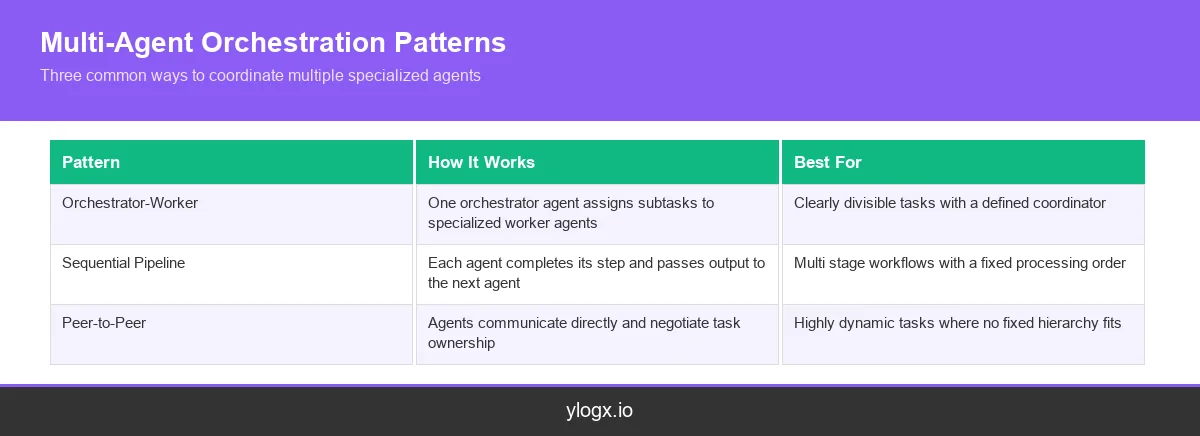
An orchestrator-worker pattern, where a coordinating agent assigns subtasks to specialized workers and assembles their results, is the most common and generally the easiest to govern, since the orchestrator provides a single point where overall behavior can be monitored and constrained. A sequential pipeline, where each agent completes its stage and hands off to the next, fits workflows with a genuinely fixed processing order and is straightforward to reason about, though it introduces latency since stages cannot run in parallel. A peer-to-peer pattern, where agents communicate directly and negotiate task ownership without a fixed coordinator, offers the most flexibility for highly dynamic tasks but is also the hardest to govern and debug, since there is no single point where the overall interaction can be observed and constrained. Most enterprise deployments should start with orchestrator-worker unless a specific requirement rules it out.
Governance Overhead of Multi-Agent Systems
Every additional agent in a system multiplies governance surface area, not just engineering complexity. Each agent may need its own tool permissions, its own monitoring, and in some cases its own named owner accountable for its behavior, covered in more depth in our guide to agentic AI governance and risk controls. A failure in a multi-agent system can also be harder to diagnose, since the root cause might lie in any individual agent's reasoning or in the coordination logic between them, which means monitoring has to capture not just each agent's individual behavior but the handoffs and communication between agents as well. Reliable data engineering becomes even more important in a multi-agent system, since inconsistent or poorly governed data reaching one agent can propagate errors into every downstream agent that depends on its output, compounding a data quality problem that would have stayed contained within a single agent's reasoning.
This overhead is not a reason to avoid multi-agent systems where they are genuinely justified, but it is a reason to treat the decision deliberately rather than defaulting to the more elaborate architecture. An enterprise should be able to articulate specifically which guardrails and which monitoring apply to each agent in a multi-agent system before launch, in the same way a single-agent deployment requires, multiplied across every agent involved.
A Decision Framework
Question | If Yes | If No |
Does the task genuinely decompose into sub-goals needing different tools or permissions? | Consider multi-agent | Stay with single-agent |
Can sub-tasks run in parallel with a meaningful time benefit? | Multi-agent may help | Single-agent is simpler |
Has a single agent been tried and shown a specific limitation? | Multi-agent may be justified | Build and test single-agent first |
Can your team govern and monitor multiple agents individually? | Multi-agent is feasible | Invest in governance capacity first |
Working through this framework before committing to an architecture avoids the most common mistake enterprises make with agentic AI: building a multi-agent system's complexity to solve a problem a single, well scoped agent could have handled from the start. Review our case studies for examples of how this decision has played out across different enterprise use cases, or contact YlogX to talk through your specific requirements.
Conclusion
Default to single-agent architecture, and reserve multi-agent systems for cases where sub-goals genuinely require different tools, permissions, or specialized reasoning, not simply for tasks that feel sophisticated enough to warrant a more elaborate build. When a multi-agent system is justified, start with an orchestrator-worker pattern for the clearest governance story, and budget for the added monitoring overhead every additional agent introduces. The discipline of proving a single agent insufficient before adding more, rather than assuming complexity from the outset, is what keeps an agentic AI program both cost effective and governable as it scales.
Frequently Asked Questions
Should enterprises default to single-agent or multi-agent architecture?
Single-agent. It is easier to build, debug, and govern, and should be the starting point unless a specific limitation justifies additional agents.
When does a multi-agent system make sense?
When a task genuinely decomposes into sub-goals requiring different tools, permissions, or specialized reasoning, not simply different sequential steps.
What is an orchestrator-worker pattern?
A coordination pattern where one orchestrator agent assigns subtasks to specialized worker agents and assembles their results, the most common and governable pattern.
Does a multi-agent system always perform better than a single agent?
No. Added agents introduce coordination and governance overhead. A well scoped single agent often outperforms an unnecessarily complex multi-agent system.
What governance changes are needed for multi-agent systems?
Each agent may need its own tool permissions, monitoring, and ownership, and monitoring must also capture the handoffs and communication between agents.
Which orchestration pattern is easiest to govern?
Orchestrator-worker, since the orchestrator provides a single point where overall behavior can be monitored and constrained.
What is a peer-to-peer multi-agent pattern?
A pattern where agents communicate directly and negotiate task ownership without a fixed coordinator, offering flexibility but the hardest pattern to govern.
How do I know if my use case needs multiple agents?
Try a single agent first. Only add agents once a specific, observed limitation shows that specialization would solve a problem the single agent cannot.
Can multi-agent systems run tasks in parallel?
Yes, when sub-tasks are genuinely independent, which can meaningfully reduce processing time for time sensitive workflows.
Where can I get help deciding between single-agent and multi-agent architecture?
Review our case studies for examples across different use cases, or contact our team to discuss your specific requirements.