AI Consulting Services: GraphDB vs. Vector Search for Agentic AI
YlogX Team · 2026-07-17
AI consulting services help enterprises choose GraphDB or Vector Search for Agentic AI. Learn GraphRAG benefits and scalable AI architectures.
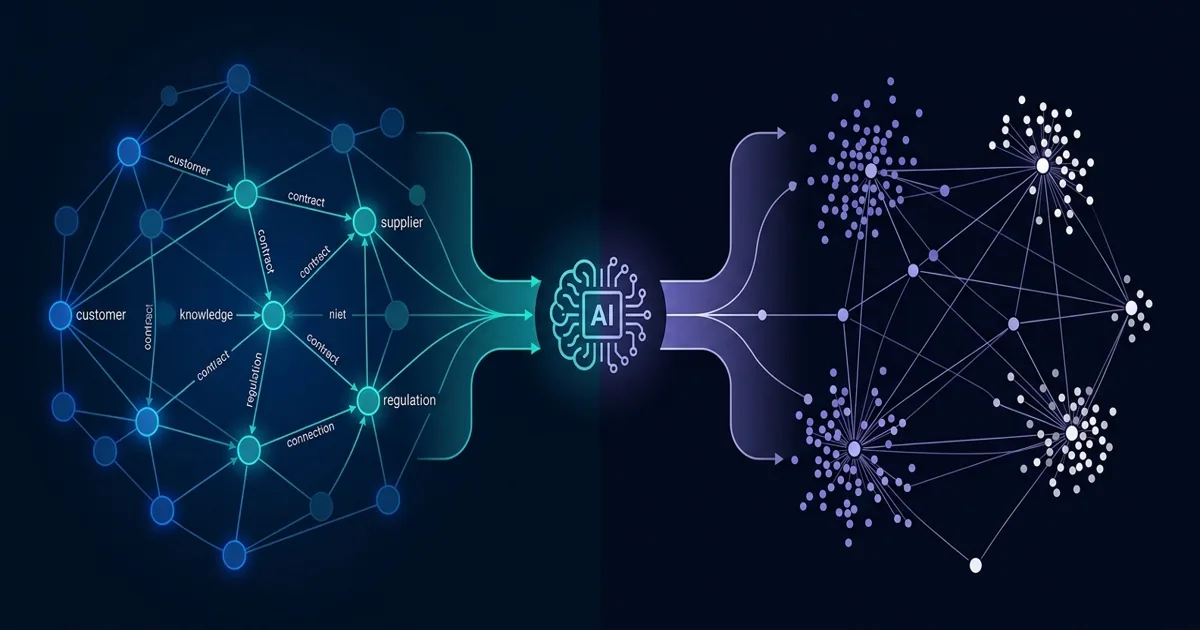
AI consulting services are helping enterprises rethink one of the most consequential decisions in modern AI architecture: how intelligent agents retrieve, reason over, and act on enterprise knowledge. As organizations move beyond conversational AI toward autonomous systems capable of planning and multi-step reasoning, the retrieval layer has become a defining factor in AI performance. This blog explores the strengths and limitations of Graph Databases (GraphDB) and Vector Search, explains why hybrid GraphRAG architectures are emerging as the enterprise standard, and shows how AI consulting from YlogX helps organizations design scalable, production-ready Agentic AI systems.
Key Takeaways
Vector Search excels at semantic similarity retrieval across unstructured data but struggles with relationship-aware reasoning and complex enterprise dependencies.
Graph Databases model connected entities and relationships, enabling multi-hop reasoning, explainability, and contextual intelligence essential for Agentic AI.
GraphRAG architectures combine both technologies to reduce hallucinations, improve retrieval quality, and deliver measurable business value at enterprise scale.
Why Enterprise AI Needs Better Knowledge Retrieval
Limitations of Traditional RAG
Traditional Retrieval-Augmented Generation (RAG) systems rely entirely on vector similarity to fetch relevant content from a knowledge base before generating a response. While this approach works well for straightforward question-answering tasks, it has critical gaps in enterprise environments. It cannot follow chains of relationships across data entities, understand hierarchical business context, or explain why a particular result was returned. These limitations become acute when AI agents need to reason across interconnected systems such as customer records, compliance policies, and supply chain dependencies simultaneously.
Why AI Agents Need Contextual Reasoning
Agentic AI systems do not simply retrieve and respond. They plan sequences of actions, make decisions under uncertainty, and interact with multiple data sources in pursuit of a goal. This requires retrieval architectures that understand context, relationships, and causality, not just semantic similarity. According to the Stanford AI Index Report 2025, enterprise AI adoption is accelerating rapidly, with organizations investing in advanced architectures that can support robust, reliable, and explainable AI outcomes. Without relationship-aware retrieval, even the most capable language models will produce incomplete or misleading responses in complex enterprise scenarios.
Understanding Vector Search
How Vector Search Works
Vector Search converts data such as documents, product descriptions, or customer queries into high-dimensional numerical representations called embeddings. When a query arrives, the system identifies the most semantically similar embeddings in the database and retrieves the corresponding content. This approach is language-agnostic, fast at scale, and highly effective for unstructured data such as text, images, and audio. It powers many modern enterprise search engines, recommendation systems, and RAG pipelines used in production today.
Strengths of Semantic Retrieval
The primary strength of Vector Search lies in its ability to match intent rather than exact keywords. A query about 'contract renewal procedures' can retrieve relevant policy documents even if those documents never use that exact phrase. This semantic flexibility makes Vector Search valuable for knowledge management, customer support automation, and content discovery applications. It also integrates naturally with large language models, making it the dominant retrieval method in first-generation RAG systems deployed across enterprises today.
Limitations in Enterprise AI Applications
Despite its strengths, Vector Search has meaningful limitations in enterprise AI environments. It treats each document as an isolated unit without understanding the relationships between entities such as suppliers, products, regulations, and customers. It cannot perform multi-hop reasoning, meaning it cannot follow a chain of logic such as identifying which suppliers serve which customers in a region affected by a specific regulatory change. It also provides limited explainability, making it difficult for compliance teams to audit why a particular result influenced an AI decision.
Understanding Graph Databases (GraphDB)
What Is a Knowledge Graph?
A Knowledge Graph is a structured representation of entities and the relationships between them. In an enterprise context, entities might include customers, products, employees, regulations, facilities, and transactions. Relationships might capture dependencies such as 'customer A purchased product B under contract C regulated by policy D.' Unlike relational databases that store data in rigid tables, Knowledge Graphs allow AI systems to navigate complex, interconnected data structures dynamically. Neo4j highlights that knowledge graphs significantly improve AI explainability and enterprise decision intelligence, making them increasingly central to Agentic AI architectures.
How GraphDB Enables Relationship-Based Reasoning
GraphDB enables multi-hop reasoning by allowing AI agents to traverse multiple relationship edges in a single query. For example, an AI agent conducting financial risk analysis can start with a customer entity, traverse relationships to their active contracts, identify the counterparties in those contracts, link those counterparties to known risk classifications, and return a consolidated risk profile in one operation. This type of connected reasoning is impossible with Vector Search alone. It enables AI agents to generate responses that are grounded in structured business logic rather than surface-level semantic similarity.
Benefits for Agentic AI
For Agentic AI systems, GraphDB delivers three critical advantages. First, it supports multi-step planning by providing AI agents with a structured map of how business entities relate to each other. Second, it dramatically improves explainability because every retrieved result can be traced back through a defined relationship path. Third, it strengthens governance by making it possible to audit exactly which data nodes and relationships influenced an AI decision. These properties align directly with what McKinsey State of AI research identifies as the foundation of high-ROI AI programs: scalable architectures, strong data foundations, and robust governance frameworks.
GraphDB vs. Vector Search: A Feature-by-Feature Comparison
The table below summarizes the key differences between Graph Databases and Vector Search across dimensions that matter most for enterprise Agentic AI deployments.
Choosing between GraphDB and Vector Search depends on how your enterprise AI solution retrieves, connects, and reasons over data. The comparison below explains how each technology performs across the capabilities that matter most when AI consultants design scalable Agentic AI solutions.
Data Structure
Vector Search represents information as high-dimensional embeddings, making it ideal for semantic retrieval across unstructured enterprise content. GraphDB stores information as connected nodes and relationships, providing a richer representation of business knowledge.
Retrieval Method
Vector Search retrieves results based on semantic similarity between embeddings. GraphDB retrieves information through graph traversal and relationship pattern matching, enabling AI systems to understand how enterprise data is connected.
Relationship Awareness
Vector Search identifies similar content but has limited understanding of relationships between business entities. GraphDB natively models relationships, making it well suited for customer, product, supplier, and knowledge graph applications.
Semantic Understanding
Vector Search excels at understanding natural language and semantic meaning. When combined with NLP, GraphDB adds contextual intelligence, enabling AI consulting services USA to build more accurate and explainable enterprise AI solutions.
Multi-Hop Reasoning
Vector Search is designed for semantic retrieval and cannot naturally perform multi-hop reasoning. GraphDB enables AI agents to traverse multiple connected entities, supporting complex business workflows and autonomous decision-making.
Explainability
Vector Search provides limited insight into why information was retrieved. GraphDB offers transparent reasoning paths, making AI decisions easier to explain, validate, and audit.
Scalability
Vector Search scales efficiently across large collections of documents and other unstructured data. GraphDB scales effectively for highly connected enterprise datasets where relationships are essential to decision-making.
Governance
Auditing retrieval decisions can be challenging with Vector Search alone. GraphDB supports traceable relationships and stronger governance, making it suitable for regulated industries.
Typical Enterprise Use Cases
Vector Search is commonly used for semantic search, document retrieval, recommendation engines, and Retrieval-Augmented Generation (RAG). GraphDB is widely used for fraud detection, compliance monitoring, customer 360, supply chain optimization, and risk analysis delivered by an AI consulting company.
Suitability for Agentic AI
Vector Search is highly effective for semantic retrieval but has limitations when AI agents require reasoning across interconnected enterprise data. GraphDB provides the connected intelligence needed for Agentic AI, making it the preferred choice for AI consultants building enterprise-scale AI architectures.
Why GraphRAG Is Emerging as the Enterprise Standard
Combining Semantic Search with Relationship Intelligence
GraphRAG is an architectural pattern that integrates Knowledge Graphs with vector-based retrieval to deliver richer, more accurate AI responses. Rather than choosing between semantic search and relationship reasoning, GraphRAG leverages both simultaneously. The vector layer retrieves semantically relevant documents while the graph layer provides structured relationship context to enrich and ground the final response. Microsoft Research's GraphRAG project demonstrates that this combined approach significantly improves contextual understanding, multi-hop reasoning quality, and response accuracy compared to conventional RAG architectures.
Reducing Hallucinations
One of the most significant enterprise AI concerns is hallucination, where AI systems generate plausible but factually incorrect responses. GraphRAG directly addresses this by grounding AI responses in verifiable relationship paths within the knowledge graph. When an AI agent retrieves information supported by explicit graph relationships rather than approximate vector similarity alone, the probability of fabricating unsupported facts decreases substantially. This is especially valuable in regulated industries where AI errors carry legal, financial, or safety consequences.
Improving Explainability and Trust
Enterprise AI systems must be explainable to gain the trust of compliance teams, regulators, and business leaders. GraphRAG makes every AI response traceable because each answer can be linked back to specific nodes, relationships, and data sources in the knowledge graph. This auditability supports regulatory compliance, reduces liability, and enables AI leaders to demonstrate responsible AI practices. According to Gartner, knowledge graph technologies are becoming increasingly important for enterprise AI initiatives that require explainability, trusted decision-making, and connected intelligence.
Enterprise Use Cases
Financial Services
In financial services, GraphRAG enables AI agents to perform multi-hop risk analysis by connecting customer profiles, transaction histories, counterparty relationships, and regulatory obligations. This supports fraud detection, credit risk modeling, and regulatory reporting with far greater accuracy and auditability than vector-only retrieval systems can provide.
Healthcare
Healthcare organizations can use Knowledge Graphs to connect patient records, clinical guidelines, drug interactions, and provider networks. Agentic AI systems built on GraphRAG can assist clinicians by retrieving contextually relevant treatment pathways that respect complex clinical dependencies, improving diagnostic support and care coordination outcomes.
Manufacturing
In manufacturing, GraphDB allows AI agents to traverse supplier relationships, component dependencies, and production constraints simultaneously. This enables predictive maintenance, quality control, and supply disruption analysis grounded in the actual structure of the production ecosystem rather than isolated document retrieval.
Supply Chain
Supply chain AI benefits enormously from relationship-aware retrieval. GraphRAG architectures allow AI systems to model multi-tier supplier networks, logistics dependencies, inventory levels, and demand signals as a connected graph, enabling agents to identify ripple effects across the supply chain and generate actionable recommendations with full traceability.
Retail
Retail enterprises can apply GraphRAG to connect product catalogs, customer purchase histories, promotional campaigns, and inventory data. AI agents built on this architecture can deliver personalized recommendations that account for complex behavioral relationships and real-time inventory constraints, going well beyond what semantic search alone can achieve.
Insurance
Insurance carriers can use Knowledge Graphs to model policyholder relationships, claims histories, fraud indicators, and regulatory requirements. Agentic AI systems operating on GraphRAG architectures can perform claims analysis, fraud pattern detection, and compliance checks with explainable reasoning trails that satisfy audit and regulatory requirements.
When Should Enterprises Choose Vector Search?
Vector Search is the right primary choice when the enterprise AI use case involves large volumes of unstructured text, where semantic similarity is the dominant retrieval need and relationship complexity is low. Ideal scenarios include internal document search, customer support chatbots answering FAQ-style queries, content recommendation engines, and first-generation RAG deployments where speed and simplicity take priority. Vector Search is also well-suited as a starting point for enterprises building AI capabilities incrementally before investing in full Knowledge Graph infrastructure.
When Does GraphDB Deliver Greater Value?
GraphDB delivers superior value when the AI use case requires multi-hop reasoning, explainability, or governance across interconnected enterprise data. Organizations dealing with compliance-sensitive workflows, complex fraud detection, multi-tier supply chain analysis, clinical decision support, or financial risk modeling will find that graph-based retrieval provides a structurally stronger foundation. GraphDB also becomes essential when enterprise AI systems must demonstrate auditability to regulators or when business logic cannot be adequately captured through document embeddings alone.
Why AI Consulting Services Matter for Enterprise AI Architecture
Business Requirement Assessment
Effective AI consulting services begin with a thorough assessment of business requirements rather than technology preferences. Understanding the types of reasoning the AI system must perform, the data structures involved, and the governance obligations the organization faces allows experienced practitioners to recommend retrieval architectures that align with real business outcomes. This requirements-first approach prevents costly rearchitecting later in the AI development lifecycle.
Selecting the Right Retrieval Strategy
Many enterprises default to Vector Search because it is faster to deploy and widely supported by existing LLM toolchains. However, for complex Agentic AI applications, this choice can result in systems that fail to meet accuracy, explainability, or governance requirements. Expert artificial intelligence consulting helps organizations evaluate when Vector Search is sufficient, when GraphDB is necessary, and when a GraphRAG hybrid is the optimal path forward. This strategic guidance accelerates deployment timelines while reducing technical debt.
Building Scalable GraphRAG Architectures
Designing a production-ready GraphRAG architecture requires expertise across knowledge graph modeling, vector database selection, LLM integration, and enterprise data engineering. YlogX generative AI capabilities span the full stack from knowledge graph design and vector store configuration to RAG pipeline optimization and production deployment. This end-to-end capability ensures that GraphRAG architectures are not only technically sound but also aligned with the organization's data strategy and AI roadmap.
Governance, Security, and AI Lifecycle Management
Enterprise AI systems operating in regulated environments require governance frameworks that cover data access controls, model monitoring, audit trail maintenance, and responsible AI practices. Experienced AI consultants integrate governance into the architecture from the start rather than treating it as an afterthought. This includes designing knowledge graphs with appropriate access controls, implementing explainability layers, and establishing monitoring pipelines that detect retrieval drift or model degradation over time. Explore how YlogX data engineering services support scalable, governed AI data foundations for enterprise environments.
Conclusion
No single retrieval architecture fits every enterprise AI challenge. Vector Search delivers speed and semantic flexibility for unstructured data retrieval, while Graph Databases provide the relationship intelligence and explainability that Agentic AI systems require for complex, multi-step reasoning. The strongest foundation for enterprise Agentic AI is a GraphRAG architecture that combines both, delivering retrieval accuracy, reduced hallucinations, and traceable reasoning at scale. Organizations that invest in the right AI architecture today will build systems that are more accurate, more trustworthy, and better positioned for long-term enterprise value. Planning an Agentic AI initiative for your enterprise? Connect with YlogX AI consulting experts to design a scalable retrieval architecture aligned with your business goals and accelerate your AI and digital transformation with confidence.
FAQ
1: What is a Graph Database (GraphDB)?
A Graph Database stores data as interconnected nodes and relationship edges rather than tables or documents. It enables AI systems to navigate complex entity relationships, supporting multi-hop reasoning and explainable decision-making across interconnected enterprise data such as customers, contracts, and regulatory obligations.
2: What is Vector Search?
Vector Search converts data into high-dimensional numerical embeddings and retrieves results based on semantic similarity. It is highly effective for unstructured text, document retrieval, and recommendation systems. It powers most first-generation RAG pipelines used in enterprise AI applications today.
3: What is the difference between GraphDB and Vector Search?
Vector Search retrieves results by semantic similarity across unstructured data, while GraphDB retrieves results by traversing structured relationship networks. Vector Search lacks relationship awareness and explainability, whereas GraphDB excels at multi-hop reasoning, auditability, and contextual intelligence for complex enterprise AI scenarios.
4: Which is better for Agentic AI, GraphDB or Vector Search?
For Agentic AI, GraphDB generally delivers greater value because autonomous agents require multi-step reasoning, explainability, and structured relationship intelligence. However, GraphRAG architectures that combine both technologies offer the strongest enterprise foundation, balancing semantic flexibility with relationship-aware contextual reasoning.
5: What is GraphRAG?
GraphRAG is an architectural pattern that integrates Knowledge Graphs with vector-based retrieval to improve AI response quality. It reduces hallucinations by grounding answers in verifiable relationship paths while retaining semantic search flexibility. Microsoft Research has demonstrated that GraphRAG significantly outperforms conventional RAG in complex reasoning tasks.
6: Why do AI agents need knowledge graphs?
AI agents require knowledge graphs to perform multi-step planning, follow relationship chains across business entities, and generate explainable responses. Without structured relationship intelligence, agents rely solely on approximate semantic similarity, which is insufficient for complex enterprise workflows involving compliance, risk, or interconnected operational dependencies.
7: Can GraphDB and Vector Search work together in enterprise AI?
Yes, combining GraphDB and Vector Search in a GraphRAG architecture is the recommended approach for enterprise Agentic AI. The vector layer handles semantic retrieval while the graph layer provides structured relationship context, together delivering higher accuracy, reduced hallucinations, and auditable reasoning suited to complex enterprise AI accelerator solutions.
8: How do expert AI consultants help enterprises build Agentic AI systems?
Expert AI consultants assess business requirements, evaluate retrieval strategy options, design scalable GraphRAG architectures, and integrate governance frameworks from the start. This strategic guidance prevents costly technical debt, accelerates deployment, and ensures Agentic AI systems meet accuracy, explainability, and compliance requirements for long-term enterprise AI transformation.
9: What industries benefit most from GraphRAG architectures?
Financial services, healthcare, manufacturing, supply chain, retail, and insurance organizations benefit most from GraphRAG architectures. These industries deal with deeply interconnected data, regulatory compliance requirements, and multi-step reasoning demands that make relationship-aware AI retrieval essential for producing accurate and auditable AI-driven business outcomes.
10: How do I get started with AI architecture consulting for Agentic AI?
]Start by assessing your current data infrastructure, AI use case requirements, and governance obligations. Engaging experienced practitioners with deep expertise in data science and machine learning capabilities helps enterprises define the right retrieval strategy and design a production-ready Agentic AI architecture tailored to specific business needs.