Why Artificial intelligence consulting services Now Require Governance and Control
YlogX Team · 2026-06-22
Artificial intelligence consulting services now require governance, observability, and control layers. Learn why enterprise AI success depends on…
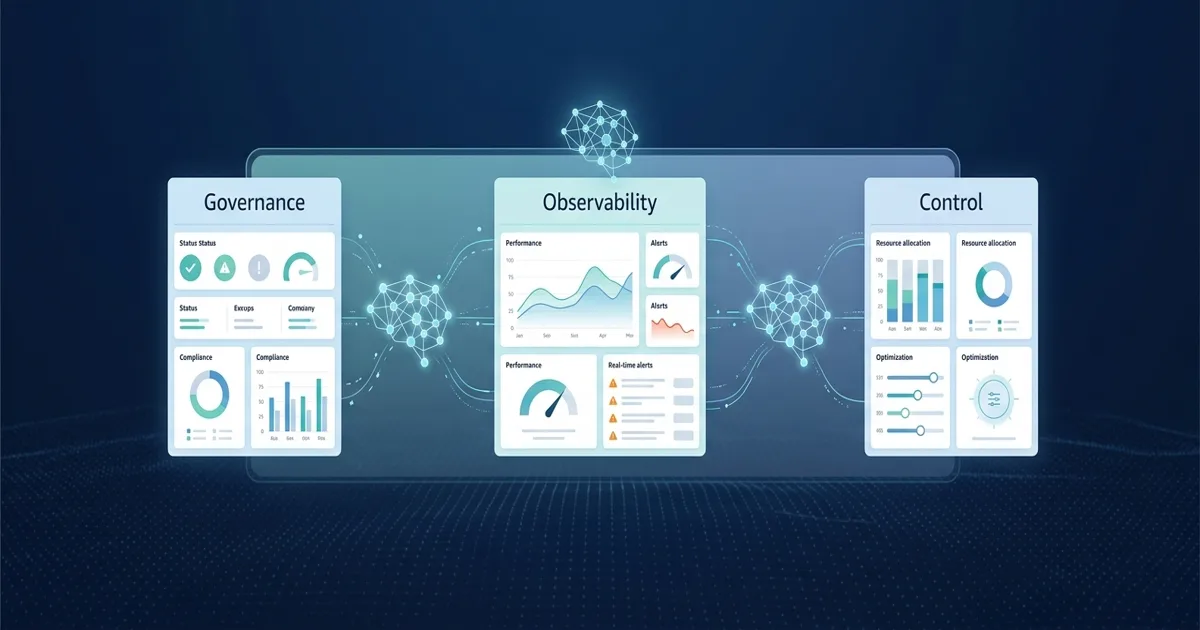
Artificial intelligence consulting services have entered a new era. Organizations are no longer asking whether to adopt AI. They are asking how to keep AI systems reliable, compliant, and aligned with business goals as they scale. Model development and deployment are just the beginning. Without structured governance, observability, and control layers, enterprise AI initiatives face mounting risks that can undermine performance, trust, and long-term value.
This blog explores why modern AI consulting services must go beyond implementation to include comprehensive frameworks for oversight, monitoring, and operational management. Whether you are evaluating an AI consulting firm or building your internal AI strategy, understanding these layers is critical for sustainable outcomes.
Key Takeaways
Governance frameworks ensure AI systems remain accountable, compliant, and aligned with enterprise objectives as they scale.
Observability platforms provide real-time visibility into AI model performance, accuracy, and behavioral drift before issues affect business outcomes.
Control layers help organizations manage operational risk, enforce policies, and maintain human oversight across complex AI environments.
The Expanding Role of Artificial Intelligence Consulting Services
For years, AI consulting focused primarily on identifying use cases, developing models, and deploying solutions. That approach served organizations well during the early adoption phase. However, as AI systems grow more complex and more consequential, the scope of artificial intelligence consulting services has fundamentally expanded.
Today, enterprise AI environments include generative AI applications, machine learning pipelines, agentic workflows, and real-time decision engines. Each of these systems introduces new layers of complexity. A single model operating without governance oversight can produce inconsistent outputs, violate compliance requirements, or drift silently from intended behavior. The consequences can range from regulatory penalties to significant business disruptions.
According to research published by Gartner, a large portion of AI projects that fail to deliver value do so because of inadequate data quality, poor governance, and lack of operational monitoring. This shift in understanding has made governance, observability, and control foundational to responsible AI adoption rather than optional additions.
Leading AI consulting firms now integrate these capabilities into every stage of the AI lifecycle, from strategy and architecture through deployment and continuous operation. Organizations working with a forward-thinking AI strategy and implementation partner gain access to structured frameworks that address both technical and organizational dimensions of AI governance.
Why AI Governance Is No Longer Optional
AI governance refers to the policies, processes, roles, and accountability structures that guide how AI systems are developed, deployed, and managed. Without these structures, organizations struggle to maintain consistency, demonstrate accountability, or respond effectively to regulatory requirements.
Regulatory landscapes are shifting rapidly. Frameworks like the EU AI Act and sector-specific guidelines in finance, healthcare, and insurance are introducing compliance requirements that directly impact how organizations build and operate AI systems. An AI consulting company that does not address governance is leaving clients exposed to significant legal and reputational risk.
Governance also supports business trust. Executives and board members need assurance that AI systems behave as intended, that risks are identified and managed, and that decisions made or influenced by AI can be explained and defended. This is especially important when AI touches sensitive areas like credit scoring, clinical support, or employee performance evaluation.
Effective AI governance includes:
Clearly defined ownership and accountability for each AI system
Documented policies for model development, validation, and approval
Risk classification frameworks that distinguish high-risk from low-risk applications
Audit trails and version control for models and data pipelines
Alignment with enterprise data governance and security policies
For organizations in Kochi and across India, AI strategy consulting Kochi providers like YlogX help enterprises design governance structures that match their regulatory context, organizational maturity, and AI ambition.
Observability: Seeing Inside Your AI Systems
Observability in AI goes beyond basic monitoring. While traditional system monitoring checks whether a service is running, AI observability examines whether the AI system is performing correctly, producing accurate outputs, and behaving consistently with its intended design.
Model drift is one of the most common and costly challenges in production AI environments. Over time, the statistical properties of input data change, causing model predictions to become less accurate. Without observability tools in place, this degradation can go undetected for weeks or months. By the time the problem surfaces through business outcomes, the cost of remediation is significantly higher.
Comprehensive observability for enterprise AI includes:
Real-time monitoring of model inputs, outputs, and prediction confidence scores
Data drift detection that flags when incoming data deviates from training distributions
Performance dashboards that track accuracy, latency, and throughput over time
Alerting systems that notify teams when predefined thresholds are breached
Logging and tracing capabilities for agentic and generative AI workflows
For generative AI applications, observability takes on additional dimensions. Organizations need visibility into output quality, factual consistency, content safety, and latency. Without these capabilities, deploying large language models or generative AI assistants at scale becomes an operational liability.
As highlighted by McKinsey and Company, enterprises that build strong AI monitoring capabilities are significantly more likely to realize the intended business value from their AI investments compared to those that rely on manual oversight alone.
Partnering with experienced AI consulting services providers ensures observability is designed into the architecture from the start rather than retrofitted after problems emerge. Explore how YlogX approaches enterprise AI solutions to understand what a structured observability foundation looks like in practice.
Control Layers: Managing AI Risk at Scale
Control layers are the operational mechanisms that give organizations the ability to manage, adjust, and if necessary halt AI systems based on defined rules and real-time conditions. As AI moves deeper into business-critical processes, these controls become essential infrastructure rather than optional safeguards.
Control frameworks in AI consulting typically cover three dimensions. First, access controls determine who can interact with AI systems, models, and underlying data. Second, operational controls define thresholds, guardrails, and circuit breakers that limit harmful or unintended AI behavior. Third, change management controls govern how models are updated, retrained, and promoted through deployment environments.
Agentic AI systems, which can autonomously execute multi-step workflows and interact with external tools, introduce particularly complex control requirements. Without robust control mechanisms, an agentic AI system could take unintended actions that have real-world consequences across systems, databases, or customer touchpoints.
Organizations that work with a capable artificial intelligence consulting firm benefit from pre-designed control architectures that can be adapted to their specific risk profiles and operational requirements. These firms bring experience across industries, helping clients avoid common pitfalls and design controls that are both effective and operationally sustainable.
Building a Responsible AI Foundation with the Right Partner
Governance, observability, and control are not separate initiatives. They are interdependent layers that together form a responsible AI foundation. Organizations that invest in all three layers are better positioned to scale AI safely, respond to regulatory changes, and maintain stakeholder confidence over time.
Selecting the right AI consulting company is therefore not just about technical capability. It is about finding a partner that understands the full operational lifecycle of enterprise AI and can help build the organizational structures, technical platforms, and cultural practices needed to sustain AI at scale.
At YlogX, our approach to artificial intelligence consulting services is built around end-to-end enterprise AI transformation. From initial strategy and architecture through implementation, governance design, and ongoing optimization, we support organizations at every stage of their AI journey. Our team works closely with enterprise decision-makers to design AI environments that are secure, observable, and operationally controlled. To discuss your AI strategy and governance needs, connect with the YlogX team today.
Conclusion
Artificial intelligence consulting services must now deliver more than models and deployments. As enterprise AI systems grow more complex and more consequential, governance, observability, and control have become foundational requirements. Organizations that build these layers into their AI strategy from the start will be better positioned to scale confidently, meet compliance demands, and earn lasting stakeholder trust. Choosing an experienced AI consulting firm that prioritizes responsible AI infrastructure is one of the most important decisions enterprise leaders can make on their AI transformation journey.
FAQ
1: What is AI governance and why does it matter for enterprise AI?
AI governance refers to the policies, roles, and accountability structures that guide how AI systems are developed and operated. It ensures AI remains compliant, explainable, and aligned with business objectives, reducing regulatory risk and building confidence among executives and stakeholders.
2: How do AI consulting firms help organizations implement governance frameworks?
Experienced AI consulting firms assess organizational maturity, regulatory exposure, and existing AI systems to design tailored governance frameworks. They define ownership models, approval workflows, risk classification policies, and audit mechanisms that make AI oversight practical and sustainable for enterprise teams.
3: What is model drift and how can observability help prevent it?
Model drift occurs when production data patterns shift away from training distributions, causing AI predictions to become less accurate over time. Observability tools detect these changes early through continuous monitoring, alerting teams before drift affects business outcomes or customer experiences.
4: Why is observability important for generative AI applications?
Generative AI outputs are probabilistic and context-dependent, making consistent quality harder to guarantee. Observability provides visibility into output accuracy, content safety, latency, and factual consistency, allowing teams to identify degradation and maintain quality standards across large-scale generative AI deployments.
5: What are AI control layers and what do they include?
AI control layers are operational mechanisms that govern how AI systems behave, who can access them, and how changes are managed. They typically include access controls, behavioral guardrails, circuit breakers, and change management processes that reduce operational risk across the entire AI environment.
6: How does AI governance support regulatory compliance in industries like finance and healthcare?
Governance frameworks document model development decisions, data lineage, and validation results, creating the audit trails regulators require. For organizations seeking enterprise AI solutions aligned with compliance requirements, structured governance is the foundation for meeting sector-specific obligations in finance, healthcare, and insurance.
7: What challenges arise when AI systems lack proper oversight and monitoring?
Without oversight, organizations face model drift, inconsistent outputs, unexplainable decisions, security vulnerabilities, and compliance failures. These issues erode stakeholder trust, increase remediation costs, and can result in regulatory penalties, making structured monitoring and governance essential for any production AI environment.
8: How do agentic AI systems increase the need for control frameworks?
Agentic AI can autonomously execute multi-step workflows and interact with external systems, amplifying the potential impact of unintended behavior. Organizations exploring the latest AI operational best practices recognize that robust control mechanisms are critical to managing agentic AI safely and responsibly at scale.
9: What should organizations look for when selecting an AI consulting company?
Organizations should evaluate whether an AI consulting company covers the full AI lifecycle, including strategy, governance, observability, and control. Industry experience, transparent methodologies, and the ability to align AI architecture with business and regulatory requirements are key indicators of a capable long-term partner.
10: How does YlogX approach AI governance and observability for enterprise clients?
YlogX designs end-to-end enterprise AI environments that integrate governance policies, observability platforms, and operational controls from the architecture phase. Working across industries including finance, healthcare, and manufacturing, YlogX helps organizations build AI foundations that are secure, transparent, and built for sustainable long-term scale.