Agentic AI Governance and Risk Controls for Regulated Industries
YlogX Team · 2026-08-27
How to govern agentic AI in regulated industries: guardrails, audit trails, industry specific risk controls, and a deployment checklist.

Agentic AI governance is not the same discipline as traditional AI model governance, and treating it as an extension of an existing model risk framework is how regulated enterprises end up with gaps they only discover after an agent has already taken an action nobody approved. This guide covers what changes when governance has to account for autonomous, multi step actions, how requirements differ by regulated industry, and what a defensible governance program looks like before an agent goes live.
Key Takeaways
Agentic AI governance has to cover a sequence of autonomous actions, not just a single model output, which changes what monitoring and audit trails need to capture.
Governance requirements differ meaningfully by regulated industry, and a generic governance policy rarely satisfies sector specific requirements.
Guardrails enforced at the system level, not through prompt instructions, are the only guardrails that reliably hold under real production conditions.
Why Agentic AI Needs Its Own Governance Model
Traditional AI governance was built around a single point of risk: a model produces a prediction or a classification, and a human reviews or acts on it. Agentic AI breaks that model, because an agent can take a sequence of actions autonomously, calling multiple tools and systems along the way, before a human ever sees the result. Governance built for a single output cannot adequately cover a chain of actions where risk can be introduced at any step, not just the final one. Gartner has recognized this gap directly, extending its AI TRiSM model specifically to address agentic systems and introducing guardian agents, a runtime enforcement layer that monitors and constrains other agents' actions in production rather than relying solely on a pre deployment review. Our broader take on this shift is covered in why AI consulting services now require governance and control, and the underlying architecture that makes agent actions traceable in the first place is covered in AI consulting services: GraphDB vs. vector search for agentic AI.
This distinction matters most in regulated industries, where the cost of an ungoverned autonomous action is not just an operational inconvenience but a potential compliance violation. A traditional model that produces a biased prediction is a serious problem. An agent that autonomously acts on that prediction, sending a communication, denying a claim, or modifying an account, compounds the problem by removing the human review step that used to catch it before any real world consequence occurred. Governance for agentic systems has to be designed with this compounding risk in mind from the start.
Governance Requirements by Regulated Industry
Generic AI governance policies rarely hold up against sector specific regulatory expectations. What counts as an adequate control in one industry may fall well short in another, and enterprises evaluating an agentic AI initiative need to map their governance program against their specific regulatory context rather than adopting a one size fits all policy.
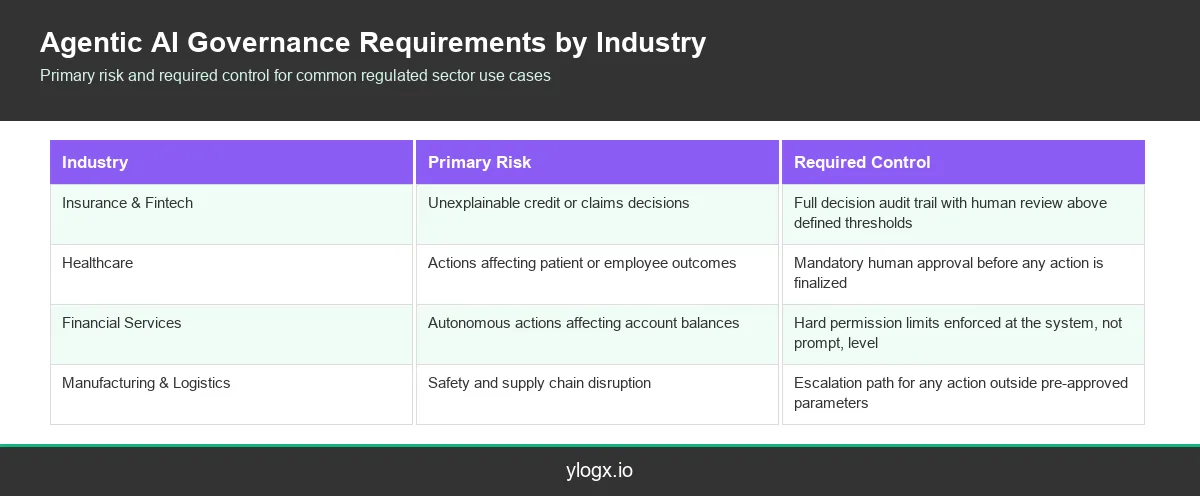
Agentic AI governance requirements by industry, covering primary risk and required control
In insurance and fintech, the primary concern is explainability. A denied claim or a declined credit application driven by an autonomous agent has to come with a documented, defensible reasoning trail a compliance team can produce on request. In healthcare, the bar is higher still. Any action affecting a patient or an employee outcome typically requires mandatory human approval before the action is finalized, not just after the fact review. In financial services more broadly, hard permission limits enforced at the system level, not the prompt level, are essential for any agent with access to account balances or transactions. Manufacturing and logistics carry a different profile focused on safety and supply chain continuity, where a clear escalation path for any action outside pre approved parameters protects against a single autonomous decision cascading into a larger operational disruption.
Building Guardrails That Actually Hold
A guardrail described only in an agent's prompt instructions is a suggestion, not a control. Prompt based instructions can be reasoned around, missed under unusual context, or simply fail to generalize to a situation the instruction writer did not anticipate. A guardrail enforced at the system level, through hard permission boundaries on what tools an agent can call and what parameters it can pass to them, holds regardless of how the agent reasons about a given situation. This distinction is not academic. It is the difference between a control a regulator or auditor can verify independently of the AI system's own behavior, and one that relies entirely on trusting the model to follow instructions correctly every time.
In practice, building guardrails that hold starts with classifying every action an agent can take by risk level and reversibility. A low risk, easily reversible action can run autonomously. A higher risk or difficult to reverse action should require human approval, enforced as a hard gate the agent cannot bypass regardless of how confident its own reasoning is. This classification exercise, done thoroughly before launch, is one of the highest value governance activities a regulated enterprise can undertake, since it turns an abstract governance policy into a specific, testable set of system level controls.
Audit Trails and Explainability for Autonomous Decisions
An audit trail for an agentic system has to capture more than a traditional model's audit trail. It needs the full sequence of reasoning steps and tool calls that led to an action, not just the final output, so that a compliance review or a regulator's inquiry can reconstruct exactly what happened and why. This aligns directly with the NIST AI Risk Management Framework, which emphasizes traceability across the full AI lifecycle rather than a single evaluation checkpoint. Enterprises that only log final outputs discover, usually during an actual incident review, that they cannot answer the specific question a regulator or an internal audit team asks: not just what the agent decided, but the exact chain of reasoning and data it relied on to get there.
Explainability requirements also extend to the retrieval layer an agent depends on. If an agent retrieves data through data engineering pipelines with unclear lineage, no audit trail at the reasoning layer can fully compensate for an inability to explain where the underlying data came from or how current it was at the time of the decision. Governance for agentic AI in regulated industries has to extend backward into the data pipeline, not stop at the agent's own reasoning boundary.
A Governance Checklist Before Deployment
Before deploying an agent in a regulated context, confirm each of the following is documented and tested, not just described in a policy.
Every autonomous action is classified by risk level and reversibility, with human approval required above a defined threshold.
Tool permissions are enforced at the system level, verified independently of the agent's own reasoning.
Full reasoning and tool call logs are captured for every interaction, not just final outputs.
A named owner reviews flagged and escalated interactions on a defined cadence.
Data lineage for every source the agent retrieves from is documented and current.
An agentic AI initiative that has not been checked against every item on this list should not be considered production ready in a regulated context, regardless of how well it performs against a narrow set of test scenarios. Enterprises evaluating an AI consulting partner for a regulated agentic AI use case should ask directly how the partner addresses each of these areas, and review case studies for evidence of prior regulated industry work specifically.
Conclusion
Agentic AI governance in regulated industries has to account for autonomous, multi step actions, not just a single model output, and requirements vary meaningfully by sector. Build guardrails enforced at the system level, capture full reasoning trails for every action, and check your program against the deployment checklist above before any agent goes live. To discuss a regulated agentic AI use case, contact YlogX to talk through your specific requirements.
Frequently Asked Questions
How is agentic AI governance different from traditional AI governance?
Traditional governance reviews a single model output. Agentic AI governance has to cover a full sequence of autonomous actions and tool calls, which introduces risk at every step.
What is a guardian agent?
A runtime enforcement mechanism, part of Gartner's extended AI TRiSM model, that monitors and constrains other agents' actions in production rather than relying only on pre deployment review.
Do governance requirements differ by industry?
Yes. Insurance and fintech prioritize explainability, healthcare requires mandatory human approval, and manufacturing focuses on escalation paths for safety related decisions.
Why are prompt based guardrails not sufficient?
Prompt instructions can be reasoned around or missed under unusual conditions. Only guardrails enforced at the system level reliably hold regardless of the agent's own reasoning.
What should an agentic AI audit trail capture?
The full sequence of reasoning steps and tool calls behind every action, not just the final output, so a compliance review can reconstruct exactly what happened.
Does data lineage matter for agentic AI governance?
Yes. An agent's explainability is only as strong as the traceability of the data it retrieves from, which makes data engineering lineage part of the governance scope.
How should autonomous actions be classified for governance purposes?
By risk level and reversibility, with low risk actions running autonomously and higher risk actions requiring human approval enforced as a hard system level gate.
Who should own agentic AI governance within an enterprise?
A named owner should review flagged and escalated interactions on a defined cadence, with clear accountability rather than shared or undefined ownership.
Is agentic AI governance a one time review before launch?
No. It is an ongoing discipline requiring continuous monitoring, periodic review of flagged interactions, and updates as the agent's scope or permissions change.
Where can I get help building a governance program for a regulated agentic AI use case?
Review our case studies for prior regulated industry work, or contact our team to discuss your specific requirements.