Agentic AI for Enterprise: The Complete Guide
YlogX Team · 2026-08-18
A complete guide to agentic AI for enterprise: architecture, single vs multi agent systems, governance, use cases, and how it fits digital transformation.

Agentic AI is the fastest moving category in enterprise AI, and also the most misunderstood. This guide explains what agentic AI actually is, how its architecture differs from a chatbot or a traditional automation script, when to use a single agent versus a multi agent system, and what governance has to look like before an autonomous agent is trusted with real enterprise decisions. If you are evaluating AI consulting partners for an agentic AI initiative, start here.
Key Takeaways
Agentic AI differs from traditional automation by reasoning toward a goal rather than following fixed if/then rules.
A production grade agentic AI architecture has four components: perception and retrieval, reasoning and planning, action and tool use, and memory and feedback.
Governance has to be designed into an agent's architecture from the start, since autonomous decisions carry more risk than a traditional automated workflow.
What Is Agentic AI and How It Differs from Traditional Automation
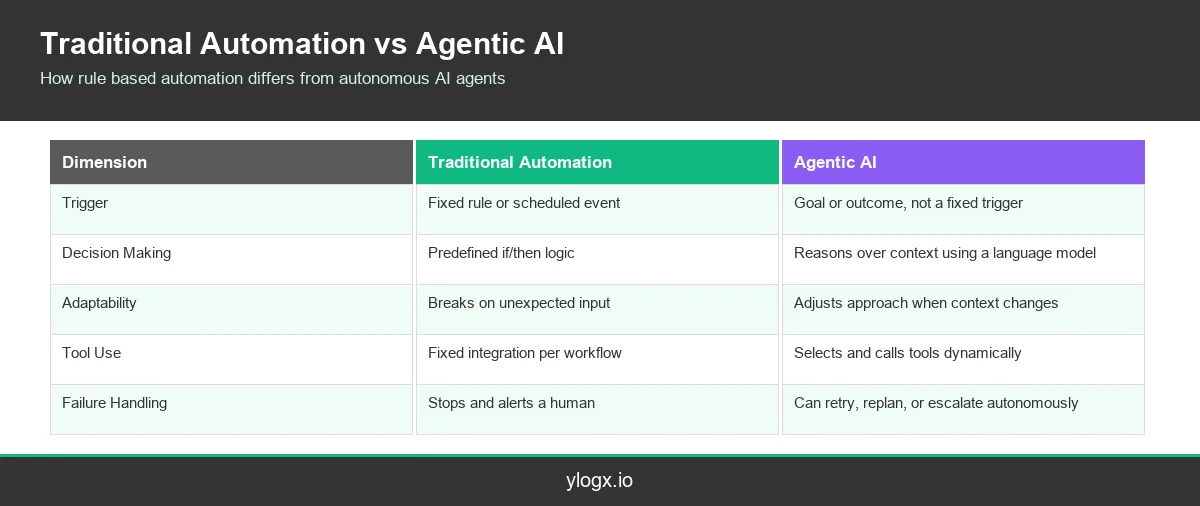
Agentic AI refers to AI systems that pursue a goal by reasoning over context, planning a sequence of actions, and adjusting that plan as conditions change, rather than executing a fixed script. Traditional automation, including most robotic process automation tools, follows predefined rules. It is fast and reliable within a narrow, well specified scope, but it breaks the moment it encounters an input the rules did not anticipate. Agentic AI is built to handle exactly that gap, using a language model to reason about unexpected situations rather than simply failing.
traditional-automation-vs-agentic-ai
The practical difference shows up most clearly in failure handling. A traditional automation script that hits an unexpected input stops and alerts a human. An agent facing the same situation can recognize the mismatch, reason about alternative approaches, and either retry with a different method or escalate with a specific explanation of what went wrong. This does not make agentic AI universally better. For a narrow, high volume, low variability task, traditional automation remains faster, cheaper, and easier to audit. Agentic AI earns its added complexity specifically in situations where the range of inputs is too broad to fully enumerate in advance.
Consider a claims processing workflow. A traditional automation rule can route a claim to the correct queue based on a fixed set of fields, but it has no way to handle a claim that is missing a required document, references an unusual policy combination, or contains a data entry inconsistency the rule was never written to catch. Each of those cases stops the workflow and waits for a human. An agent handling the same claim can recognize the missing document, retrieve the correct request template, generate a specific request back to the claimant, and continue processing once the gap is resolved, escalating only the genuinely ambiguous cases. The volume of work that reaches a human drops sharply, not because the agent is smarter than the rule, but because it can reason about the long tail of situations a rule set was never designed to cover.
It is worth being precise about what agentic AI is not. It is not simply a more capable chatbot, since a chatbot typically responds to one message at a time without independently planning or executing a sequence of actions. It is also not a replacement for traditional automation across the board. For tasks with genuinely fixed, well understood rules and high volume, a traditional automation script remains cheaper to build, easier to audit, and more predictable in its behavior. The decision to use agentic AI should follow directly from whether a task's variability exceeds what a rule set can reasonably cover, not from a general preference for newer technology.
Agentic AI Architecture: Vector Search, GraphRAG, and Knowledge Graphs
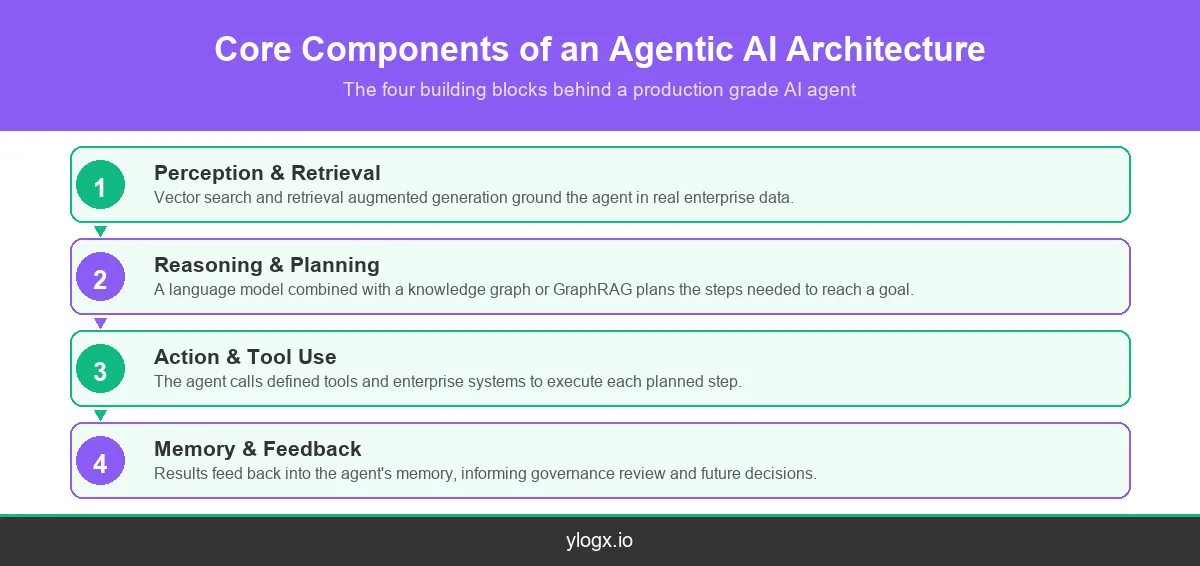
A production grade agentic AI system is built from four connected components, and weakness in any one of them limits what the whole system can reliably do.
agentic-ai-architecture-components
Retrieval and Grounding
An agent is only as good as the enterprise data it can retrieve and reason over. Vector search retrieves content based on semantic similarity, which works well for unstructured text but misses explicit relationships between entities. GraphRAG combines a knowledge graph with retrieval, allowing an agent to reason across connected data, for example following a chain from a customer to their contracts to related support tickets. Many production systems use both together, since neither approach alone covers every retrieval need an enterprise agent encounters. The choice between them is not purely technical either. Vector search is typically faster to stand up and cheaper to maintain, which makes it the right starting point for a first pilot, while GraphRAG earns its added setup cost once an agent needs to reason across explicit relationships a purely semantic search cannot surface.
Reasoning, Planning, and Tool Use
Once an agent has retrieved relevant context, it plans a sequence of steps toward its goal and executes those steps by calling defined tools, which might include internal APIs, databases, or other enterprise systems. This is where data engineering work becomes critical, since an agent calling a tool against unreliable or poorly governed data will confidently produce an unreliable result. The planning step is also where most of an agent's unpredictability lives, which is exactly why the governance controls covered later in this guide have to wrap around this layer specifically. In practice, this means every tool an agent can call should have clearly defined inputs, outputs, and permission boundaries, treated with the same rigor as an API exposed to an external partner, not as an internal convenience wired up quickly during a pilot.
Memory and Feedback Loops
The fourth architectural layer, memory, is what separates a one off agent interaction from a system that improves over time. Short term memory lets an agent maintain context across the steps of a single task. Long term memory, when implemented carefully, lets an agent recall relevant details from past interactions or incorporate corrections from prior mistakes. This layer is also where governance monitoring plugs in, since a well designed feedback loop surfaces exactly the reasoning path and tool calls a governance review needs to evaluate, rather than only the final output.
Single-Agent vs Multi-Agent Systems
A single agent handles one goal end to end, using whatever tools and retrieval it needs along the way. This is the right starting point for most enterprises, since it is easier to build, easier to monitor, and easier to explain to stakeholders who are new to agentic AI. A multi-agent system splits a larger goal across several specialized agents, often coordinated by an orchestrator agent that assigns subtasks and combines results. Multi agent systems earn their added complexity when a task genuinely benefits from specialization, for example one agent focused on retrieving compliance data and a separate agent focused on drafting a customer response, each with different tools, guardrails, and review requirements.
Factor | Single Agent | Multi Agent |
Complexity to Build | Lower, one goal and one set of tools | Higher, requires an orchestration layer |
Debugging | Easier, one reasoning path to trace | Harder, failure can originate in any agent |
Governance | One set of guardrails to define | Each agent may need its own guardrails and ownership |
Best Fit | A single well scoped task or workflow | A goal that genuinely benefits from specialization |
The most common mistake enterprises make here is reaching for a multi agent architecture before a single agent has been tried and proven insufficient. Multi agent systems are harder to debug, since a failure can originate in any agent or in the coordination between them, and they are harder to govern, since each agent may need its own monitoring and ownership. Start with the simplest architecture that can plausibly solve the problem, and add agents only when a specific limitation of the single agent approach has actually been observed.
Agentic AI Governance and Risk Controls
Agentic AI carries more governance risk than traditional automation or even standard predictive models, because an agent can take a sequence of actions autonomously rather than producing a single output for a human to review. Gartner has extended its AI TRiSM model specifically to address this, introducing guardian agents as a runtime enforcement mechanism that monitors and constrains other agents' actions in production. This reflects a broader shift: governance for agentic systems increasingly has to be built as part of the runtime architecture, not just a review process applied before launch.
Guardrails and Human Oversight
Every production agent needs defined boundaries on what actions it can take autonomously versus what requires human approval. A support agent might be permitted to draft a response autonomously, but require approval before it can issue a refund above a set threshold. Defining these boundaries clearly, and building them into the agent's tool permissions rather than relying on prompt instructions alone, is the single most effective governance control available. Prompt based instructions can be reasoned around or simply missed under unusual conditions. A permission boundary enforced at the tool level cannot be bypassed by the agent's own reasoning, which is why serious production deployments treat this distinction as non-negotiable rather than a nice to have.
Monitoring Autonomous Decisions
Because an agent's reasoning path can vary between similar looking requests, monitoring has to track not just outcomes but the sequence of actions an agent took to reach them. This is aligned with the NIST AI Risk Management Framework, which emphasizes traceability across the AI lifecycle rather than a single point in time check. Enterprises moving from a pilot to production should expect to invest in this monitoring layer specifically, since it is rarely included by default in a proof of concept build. A practical monitoring setup logs every tool call an agent makes, the reasoning that led to it, and the outcome, so that a governance review can reconstruct exactly what happened in any specific case, not just see an aggregate accuracy metric that hides individual failures.
Governance Layer | What It Covers | Example Control |
Guardrails | Boundaries on autonomous action | Refund approval required above a set dollar threshold |
Monitoring | Visibility into agent behavior | Full log of tool calls and reasoning per interaction |
Ownership | Accountability for agent performance | A named owner reviews flagged interactions weekly |
Escalation | Handling genuinely ambiguous cases | Defined criteria for handing a case to a human |
Agentic AI Use Cases Across Industries
Agentic AI use cases cluster around tasks that involve multiple steps, some judgment, and access to several systems, which is exactly where traditional automation struggles most. In financial services, agents support fraud investigation by pulling data across multiple systems and assembling a case summary a human analyst can quickly review. In customer operations, agents handle multi step support requests that require checking several systems before responding, rather than the single system lookup a simpler chatbot can manage. In supply chain and manufacturing, agents monitor operational data and autonomously initiate a defined response, such as flagging a supplier risk or adjusting a maintenance schedule, while escalating anything outside their defined authority to a human. Across all of these, the common thread is a task too varied for fixed rules but too high volume for a human to handle every instance manually.
Industry | Agentic AI Use Case | Why It Fits Agentic AI |
Financial Services | Fraud investigation case assembly | Requires pulling and correlating data across multiple systems per case |
Customer Operations | Multi step support resolution | Each request may need a different combination of system lookups |
Manufacturing & Logistics | Operational risk monitoring | High volume of variable signals, most routine, some requiring judgment |
Insurance | Claims triage and document requests | Wide range of missing information scenarios no fixed rule set can enumerate |
Not every task in these industries is a good fit for agentic AI, and forcing one onto a task better served by traditional automation adds cost and governance overhead without a corresponding benefit. The clearest signal that a task is a good candidate is the presence of genuine variability, meaning the task cannot be reduced to a manageable number of fixed rules, combined with enough volume that manual handling does not scale. Tasks that are either simple enough for a rule set or rare enough to handle manually rarely justify the added investment agentic AI requires.
Agentic AI in Digital Transformation
Agentic AI is increasingly the mechanism through which digital transformation strategies actually get implemented, rather than a separate initiative running alongside them. According to McKinsey's 2026 research on the state of AI, enterprise AI adoption is accelerating specifically toward agentic systems as organizations move past early generative AI experimentation and look for AI that can execute multi-step work, not just generate content. This matters for how enterprises should sequence their broader AI strategy: agentic AI capability is not a future phase to plan for later. It is increasingly the default architecture for any new AI initiative that spans more than a single system lookup or a single generated response.
This has a direct implication for how enterprises should plan a transformation roadmap. Rather than treating agentic AI as a discrete, later phase project, it makes more sense to evaluate each planned transformation initiative against the question of whether it involves multi step work spanning several systems, since that is precisely where an agentic architecture will outperform either a simple automation script or a single purpose generative AI tool. Enterprises that build this evaluation into their roadmap planning from the outset avoid the common pattern of retrofitting agentic capability into a transformation initiative that was designed around an older automation model.
That said, sequencing still matters. An enterprise with no prior AI deployment experience is better served starting with a single, well scoped agentic use case, proving governance and monitoring work as intended, and then expanding, rather than attempting a broad agentic transformation across many functions simultaneously. The architecture and governance principles covered throughout this guide apply at any scale, but the discipline of proving them on one use case before scaling is what separates enterprises that build lasting agentic AI capability from those that produce an impressive demo which never becomes a dependable part of daily operations.
Further Reading
This guide draws on YlogX's existing agentic AI coverage. For deeper detail, see:
AI Consulting Services: GraphDB vs. Vector Search for Agentic AI: a deeper technical comparison of retrieval architectures.
AI and Digital Transformation: Agentic AI vs Traditional Automation: a closer look at where automation stops being sufficient.
How Agentic AI Is Redefining Digital Transformation: the strategic case for agentic AI within a broader transformation roadmap.
Conclusion
Agentic AI earns its complexity when a task is too varied for fixed automation rules but too frequent for manual handling at scale. Start with a single agent architecture, build governance and monitoring from the start rather than after launch, and expand to multi agent systems only once a specific limitation has been observed, not in anticipation of one. To scope an agentic AI use case for your enterprise, review our case studies or contact YlogX to talk through your requirements with our team.
Frequently Asked Questions
What is agentic AI in simple terms?
Agentic AI is an AI system that pursues a goal by reasoning, planning a sequence of actions, and adapting that plan, rather than following a fixed automated script.
How is agentic AI different from a chatbot?
A chatbot typically responds to a single message. An agent plans and executes multiple steps across tools and systems to reach a goal, often without a human prompting each step.
What is GraphRAG?
GraphRAG combines a knowledge graph with retrieval augmented generation, letting an agent reason across explicitly connected data rather than relying on semantic similarity alone.
When should an enterprise use multi agent systems instead of a single agent?
Only after a single agent has been tried and shown a specific limitation that specialization would solve. Multi agent systems are harder to debug and govern.
What governance controls does agentic AI require?
Defined action boundaries enforced through tool permissions, human approval for high risk actions, and monitoring that tracks the agent's reasoning path, not just its outputs.
Are agentic AI systems riskier than traditional AI models?
They carry different risk, since an agent can take autonomous multi-step actions rather than producing a single output for review, which is why runtime guardrails matter more.
What industries benefit most from agentic AI?
Financial services, customer operations, and manufacturing see strong results, particularly for multi step tasks that involve several systems and some judgment.
Does agentic AI replace the need for data engineering?
No. Reliable data pipelines are a prerequisite, since an agent calling tools against poor quality data will produce confident but unreliable results.
How does agentic AI fit into a digital transformation strategy?
Increasingly as the default execution mechanism, not a separate initiative. See our FAQ page for related engagement questions.
Where can I learn how YlogX approaches agentic AI projects?
Explore our solution accelerators or contact our team to discuss a specific use case.