AI and Digital Transformation: Agentic AI vs Traditional Automation
YlogX Team · 2026-06-25
Explore how agentic AI compares with traditional automation in enterprise operations. Learn when to use each approach, how AI and digital transformation…
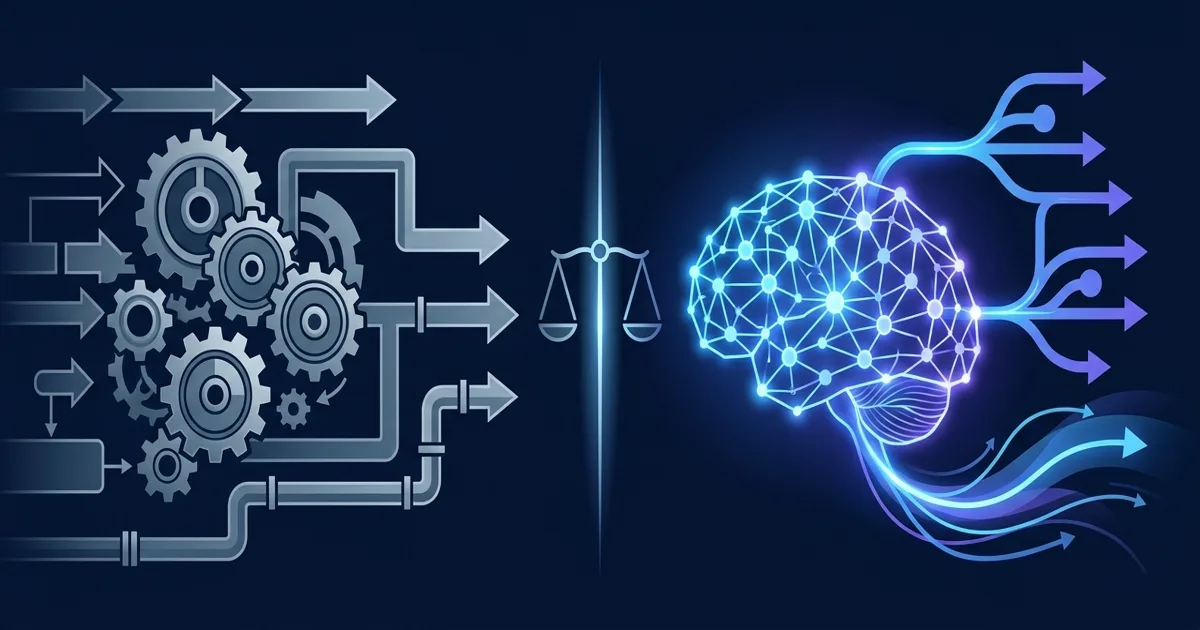
AI and digital transformation are reshaping how enterprises operate, compete, and grow. As businesses explore smarter ways to automate workflows, two distinct approaches have emerged: agentic AI and traditional automation. Understanding the difference between these two is no longer optional for enterprise leaders. It is a strategic necessity. This blog compares both approaches across key dimensions to help you decide which one aligns with your operational goals and long-term transformation roadmap.
Key Takeaways
Traditional automation excels at repetitive, rule-based tasks while agentic AI brings reasoning, adaptability, and autonomous decision-making to complex enterprise workflows.
Choosing between the two depends on your process complexity, data maturity, and transformation readiness, and many enterprises benefit from a hybrid approach that layers both strategically.
Working with experienced artificial intelligence consulting services is the most reliable way to design a phased transformation roadmap that reduces risk and accelerates impact.
What Is Traditional Automation in Enterprise Operations?
Traditional automation refers to rule-based systems that follow predefined instructions to execute repetitive tasks. These include Robotic Process Automation (RPA), workflow engines, and scripted bots that handle structured, predictable processes.
Traditional automation works best when the inputs are consistent, the rules are clearly defined, and the outcomes are deterministic. Common examples include invoice processing, data entry, report generation, and employee onboarding checklists.
However, traditional automation has real limits. It cannot handle ambiguity, adapt to changing conditions, or make contextual decisions. Any deviation from the expected input often causes the system to fail or require human intervention. According to Gartner, most RPA implementations face significant challenges when processes contain exceptions or require judgment.
Strengths of Traditional Automation
Fast deployment for well-defined, structured processes
Low cost and relatively simple to maintain
High accuracy on repetitive tasks with stable inputs
Easily auditable with clear rule trails
Works well in compliance-heavy environments like finance and HR
Limitations of Traditional Automation
Brittle when process inputs change or rules evolve
Cannot understand context, language, or intent
Requires frequent manual updates as business logic shifts
No learning capability or self-improvement over time
Struggles with unstructured data like emails, PDFs, or images
What Is Agentic AI and How Does It Differ?
Agentic AI refers to AI systems that can plan, reason, take actions, and adapt to achieve a defined goal with minimal human intervention. Unlike traditional automation, agentic AI does not just follow a script. It evaluates situations, selects actions, and learns from outcomes.
These systems combine large language models, retrieval-augmented generation, tool use, and memory to behave more like a knowledgeable collaborator than a simple bot. They can handle multi-step tasks, process unstructured data, and adjust their approach when conditions change.
For enterprises exploring generative AI for business, agentic systems represent a significant leap forward. They can manage complex workflows such as end-to-end customer onboarding, dynamic supply chain decisions, or intelligent document analysis without needing every step pre-coded. This is why AI consulting engagements increasingly focus on designing agentic architectures for enterprise scale. You can explore the full range of AI and automation services at YlogX to understand how these capabilities are structured for real enterprise use cases.
Strengths of Agentic AI
Handles complex, multi-step workflows autonomously
Adapts to changing inputs, exceptions, and new information
Works with unstructured data like text, images, and documents
Can coordinate across multiple tools and systems
Continuously improves through feedback and learning loops
Limitations of Agentic AI
Requires strong data infrastructure and model governance
Higher implementation complexity and cost upfront
Needs clear guardrails to ensure safe and compliant behavior
Explainability can be challenging in regulated industries
Demands mature AI strategy consulting to deploy effectively
Head-to-Head Comparison: Agentic AI vs Traditional Automation
To make the right decision for your enterprise, it helps to compare these two approaches across the dimensions that matter most to operations leaders.
Task Complexity
Traditional automation is ideal for simple, linear tasks. Agentic AI handles multi-step, decision-heavy workflows. If your process has more than five decision points or involves unstructured inputs, traditional automation will likely require constant maintenance. Agentic AI thrives precisely in these conditions, making it the stronger choice for dynamic enterprise environments.
Adaptability and Learning
Traditional automation does not learn. Every rule change requires a developer to manually update the system. Agentic AI can evaluate new scenarios and adapt its behavior within defined parameters. For enterprises operating in fast-changing markets, this adaptability is a major competitive advantage. This is a core reason why AI consulting services now prioritize agentic design in transformation roadmaps.
Data Handling
Traditional automation requires clean, structured data. It cannot process a scanned contract, a customer email thread, or a handwritten form without additional preprocessing layers. Agentic AI can natively understand and act on unstructured data. This makes it far more suitable for industries like healthcare, finance, and legal services where documents are diverse and complex.
Cost and Time to Value
Traditional automation typically has a lower upfront cost and faster deployment for simple use cases. Agentic AI requires more investment in data infrastructure, model selection, and governance frameworks. However, the long-term return is higher because agentic systems scale more efficiently and require less ongoing human oversight. Enterprises working with artificial intelligence consulting services often find that a phased approach delivers the best value.
Governance and Risk
Traditional automation is easier to audit and explain. Its logic is explicit and traceable. Agentic AI introduces new risks around model behavior, hallucination, and decision transparency. Enterprises must invest in proper guardrails, monitoring, and explainability frameworks. AI strategy consulting in Kochi and across India is increasingly focused on building these governance layers as agentic deployments grow.
When Should Enterprises Choose Agentic AI Over Traditional Automation?
The decision is not always binary. Many enterprises benefit from running both in parallel. Traditional automation handles the stable, high-volume repetitive layer. Agentic AI manages the complex, judgment-heavy, or exception-prone layer sitting above it.
Consider agentic AI when your enterprise faces these situations. Your current automation breaks frequently due to process exceptions. You are dealing with large volumes of unstructured content. You need AI to coordinate across multiple departments or systems. You want AI that can interact with stakeholders in natural language. You are pursuing generative AI for business applications that require contextual understanding.
Consider traditional automation when your processes are stable and well-defined, your team needs fast deployment at low cost, and your regulatory environment demands fully auditable and deterministic logic.
For enterprises unsure of where to begin, a structured AI consulting engagement that includes discovery, process mapping, and technology assessment is the right first step. At YlogX, the enterprise AI solutions practice is designed to help organizations navigate exactly this kind of decision with clarity and confidence.
How AI Strategy Consulting Bridges the Gap
Choosing between agentic AI and traditional automation is ultimately a strategic decision, not just a technical one. It requires deep understanding of your business processes, data landscape, risk tolerance, and transformation goals.
This is where AI strategy consulting in Kochi and broader artificial intelligence consulting services play a critical role. A good consulting engagement will map your existing automation maturity, identify where agentic AI creates the most value, and design a phased roadmap that reduces risk while accelerating impact.
YlogX works with enterprise clients across HR, finance, healthcare, manufacturing, and marketing to design and implement both traditional and agentic AI solutions. The approach starts with a discovery and assessment phase to understand your specific goals, followed by architecture design, proof-of-concept development, and full implementation.
According to research published by McKinsey, enterprises that combine AI with robust process redesign see significantly greater operational improvements than those deploying automation tools in isolation. This reinforces why strategy must lead technology selection, not follow it.
Conclusion
AI and digital transformation success depends on choosing the right tools for the right problems. Traditional automation remains valuable for structured, repetitive workflows. Agentic AI opens new possibilities for complex, adaptive, and intelligent enterprise operations. The smartest enterprises are not choosing one over the other. They are building transformation architectures that leverage both strategically. If your organization is ready to move beyond basic automation and explore the full potential of AI and digital transformation, working with experienced AI consulting services is the most reliable path forward. Connect with the YlogX team to start your discovery and assessment today.
FAQs
1: What is the main difference between agentic AI and traditional automation?
Traditional automation follows fixed rules for structured, repetitive tasks. Agentic AI can reason, plan, and adapt to changing inputs without pre-coded instructions. Enterprises exploring AI-driven enterprise solutions increasingly rely on agentic systems for complex, judgment-heavy workflows.
2: Is traditional automation still relevant for enterprises in 2026?
Yes, traditional automation remains highly relevant for stable, high-volume, rule-based processes like invoice processing or data entry. It offers fast deployment, low cost, and easy auditability, making it a strong choice in compliance-heavy industries like finance and HR.
3: When should a business invest in agentic AI over RPA?
Invest in agentic AI when your processes involve unstructured data, frequent exceptions, or multi-step decision-making. If your current RPA breaks often or requires constant rule updates, agentic AI offers more resilient and scalable automation for enterprise operations.
4: How does generative AI fit into enterprise automation strategies?
Generative AI for business powers the language understanding and content generation layer within agentic systems. It enables AI to interpret documents, draft communications, and handle nuanced interactions, extending automation well beyond what traditional rule-based tools can achieve in enterprise environments.
5: What industries benefit most from agentic AI implementations?
Healthcare, finance, manufacturing, and HR benefit greatly from agentic AI due to their complex, document-heavy workflows. These industries deal with unstructured data and frequent exceptions that traditional automation cannot handle reliably, making agentic AI a strategic fit for transformation goals.
6: How do I start an AI and digital transformation journey for my enterprise?
Start with a structured discovery and assessment phase to map your current processes and data maturity. Partnering with experienced artificial intelligence consulting services ensures you identify high-impact use cases and build a realistic, phased transformation roadmap.
7: What role does AI strategy consulting play in automation decisions?
AI strategy consulting helps enterprises evaluate process complexity, data readiness, and risk tolerance before selecting automation tools. It ensures technology choices align with business goals, reducing costly misalignments and accelerating time to value across both traditional automation and agentic AI deployments.
8: Can traditional automation and agentic AI work together in one enterprise?
Absolutely. Many enterprises use a hybrid model where traditional automation handles structured, high-volume tasks while agentic AI manages complex, exception-prone workflows. This layered approach maximizes operational efficiency and allows organizations to scale AI and digital transformation progressively.
9: What are the governance challenges of deploying agentic AI at scale?
Key governance challenges include ensuring model explainability, preventing hallucinations, maintaining compliance, and monitoring autonomous decision-making. Enterprises need clear guardrails, audit mechanisms, and oversight frameworks before deploying agentic AI in regulated domains like finance or healthcare.
10: How does YlogX support enterprises in choosing between automation approaches?
YlogX provides end-to-end AI consulting services covering discovery, architecture design, and implementation. The team helps enterprises assess their automation maturity and design hybrid strategies. Explore the YlogX FAQ page for more details on how the engagement process works.