Agentic AI Architecture: Building Production-Ready AI Agents
YlogX Team · 2026-08-24
A practical guide to agentic AI architecture: retrieval strategy, tool permissions, guardrails, monitoring, and a production readiness checklist.

Most agentic AI prototypes work well in a demo and then stall before reaching production. This guide walks through the specific architecture decisions, around retrieval, tool permissions, and monitoring, that separate a demo from a system an enterprise can actually depend on. If you are scoping an AI consulting engagement to build an agent, use this as a checklist for what a serious build should include.
Key Takeaways
Retrieval strategy, vector search versus GraphRAG versus hybrid, should be chosen based on whether your agent needs semantic recall, relationship reasoning, or both.
Tool permissions enforced at the system level, not through prompt instructions, are the single most reliable guardrail for a production agent.
A production ready agent is tested and monitored before launch, not instrumented afterward once problems appear.
Why Most Agentic AI Prototypes Never Reach Production
A prototype agent is usually built to prove a single, favorable scenario works. It is tested against clean example inputs, runs with broad, loosely defined tool access, and has no real monitoring beyond a developer watching its output during a demo. None of that survives contact with production traffic. Real users provide messier inputs than the examples used to build the prototype. Tool access that seemed convenient during development becomes a liability once the agent is handling requests nobody is watching in real time. This gap is architectural, not a matter of the underlying model needing to be more capable. Closing it means making specific, deliberate decisions about retrieval, permissions, and monitoring before launch, not after the first incident. Our broader take on this pattern is covered in AI and digital transformation: agentic AI vs traditional automation; this guide focuses specifically on the architecture decisions that determine which outcome you get.
The pattern is consistent enough to be predictable. A team builds an agent, demonstrates it successfully to stakeholders using a handful of realistic looking examples, and gets approval to move toward production. Then real usage begins, and the agent encounters inputs that fall outside its tested range, calls a tool in a way nobody anticipated, or reaches a decision nobody can trace back to a clear reasoning path. At that point the project either stalls while the team retrofits governance and monitoring that should have been there from the start, or worse, it ships anyway and produces a visible failure that damages trust in agentic AI broadly across the organization, making the next initiative harder to get approved regardless of its own merits.
Choosing a Retrieval Strategy: Vector Search vs GraphRAG
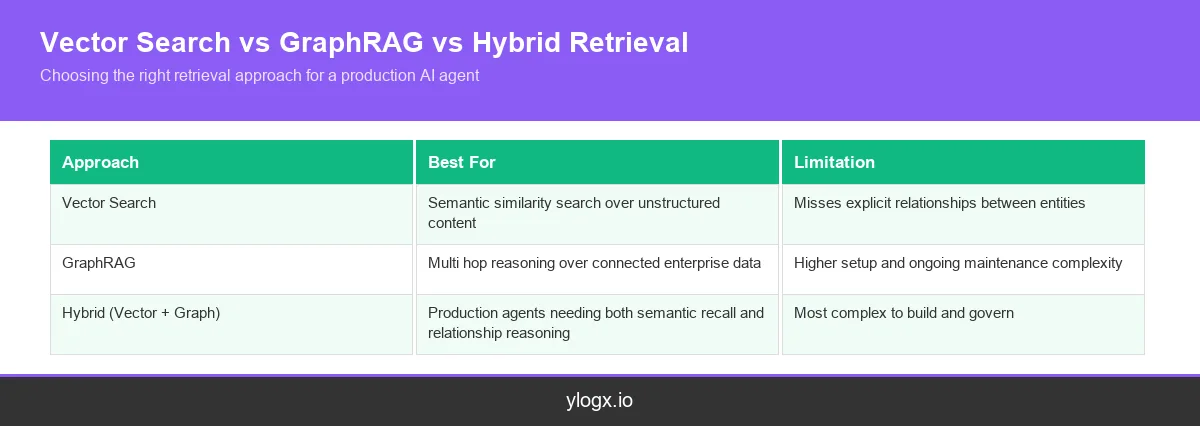
Retrieval is the foundation an agent's reasoning is built on, and the wrong choice here limits everything downstream. Vector search retrieves based on semantic similarity and is the right default for a first build, since it is faster to implement and cheaper to maintain than a full knowledge graph. GraphRAG becomes necessary once an agent needs to reason across explicit relationships that similarity search cannot surface, for example connecting a specific customer to their account history, related cases, and the specific policy terms that apply to them.
vector-search-vs-graphrag
Most production agents that handle non trivial enterprise workflows eventually adopt a hybrid approach, using vector search for broad semantic recall and a knowledge graph for the specific relationships their domain depends on. Starting with vector search alone, then adding graph capability only once a specific reasoning gap is observed, avoids the common mistake of over engineering the retrieval layer before real usage has revealed what the agent actually needs. For a deeper technical comparison of these retrieval approaches, see AI consulting services: GraphDB vs. vector search for agentic AI.
Designing Tool Permissions and Guardrails
An agent's tool permissions define what it can actually do, and this is where most production risk concentrates. Every tool an agent can call should be scoped as narrowly as the task allows, with explicit limits, such as a maximum refund amount or a restricted set of accounts it can modify, enforced at the system level rather than through instructions in the agent's prompt. Prompt based instructions describe intended behavior. Only a permission enforced outside the model's own reasoning actually guarantees that behavior under unexpected conditions. Gartner's extension of its AI TRiSM model to include guardian agents reflects this same principle at an industry level, treating runtime enforcement as a distinct layer from the agent's own reasoning rather than trusting the agent to police itself.
A practical approach is to classify every action an agent can take into three tiers: fully autonomous actions with low risk and easy reversal, actions requiring human approval above a defined threshold, and actions the agent should never take without triggering an explicit workflow reviewed by a person. Mapping every tool the agent has access to against this classification before launch, rather than discovering the gaps after an incident, is the difference between a governed system and one that simply has not failed publicly yet.
It is also worth deciding upfront how permission scope will change as an agent proves itself over time. A common pattern is to launch with a deliberately narrow set of autonomous actions, expand that scope gradually as monitoring confirms the agent performs reliably within its current boundaries, and treat any expansion request as requiring the same level of review the original launch did. Enterprises that instead grant broad permissions upfront to avoid repeated approval cycles consistently find this harder to walk back later, once an agent is already embedded in a workflow people depend on.
Testing and Monitoring Before Launch
Testing an agent against a handful of expected scenarios is not sufficient, since the entire value of an agentic approach is handling situations a fixed test set will not anticipate. Effective testing includes adversarial inputs designed to probe for permission boundary failures, ambiguous requests that should trigger escalation rather than a confident wrong answer, and load testing to confirm the agent's retrieval and tool calls perform acceptably under realistic volume, not just in a single user demo. Monitoring has to be live before launch, not added afterward, and should log the full reasoning path and tool calls behind every action, aligned with the traceability principles in the NIST AI Risk Management Framework, so a governance review can reconstruct exactly what happened in any specific case rather than relying on an aggregate accuracy number that can hide individual, serious failures.
A useful discipline during this phase is to deliberately try to break the agent before real users get the chance to. Feed it inputs that are incomplete, contradictory, or subtly outside its intended scope, and confirm it escalates rather than confidently producing a plausible sounding but wrong answer. An agent that fails safely, by recognizing what it does not know and asking for help or handing off to a human, is far more valuable in production than one that scores slightly higher on a benchmark but fails silently when it encounters something genuinely unexpected.
A Production Readiness Checklist
Before moving an agent from pilot to production, confirm each of the following is in place, not just planned.
Area | Production Ready Looks Like |
Retrieval | Strategy chosen deliberately, tested against real enterprise data, not just sample records |
Tool Permissions | Every tool scoped narrowly and enforced at the system level, not the prompt level |
Escalation | Clear criteria for when the agent hands a case to a human, tested against ambiguous inputs |
Monitoring | Full reasoning and tool call logs live before launch, with a named owner reviewing them |
Load Testing | Performance validated under realistic volume, not only in a single user demo |
An agent that has not been checked against every row in this table is still a prototype, regardless of how well it performs in a demo. Enterprises evaluating an AI consulting partner to build a production agent should ask directly which of these areas the partner treats as mandatory before launch, and review their case studies for evidence they have actually done so on a prior engagement, not just described it as a capability.
Conclusion
The gap between an agentic AI prototype and a production system is architectural: a deliberate retrieval strategy, tool permissions enforced at the system level, and monitoring live before launch rather than added afterward. Use the production readiness checklist above to evaluate any agent before it goes live, whether built internally or with a partner. To scope an agentic AI build for your enterprise, contact YlogX to discuss your specific use case.
Frequently Asked Questions
Why do agentic AI prototypes often fail to reach production?
Prototypes are usually tested against clean, favorable scenarios with loose tool access and no real monitoring, none of which survives real production traffic.
Should I use vector search or GraphRAG for my agent?
Start with vector search for a first build. Add GraphRAG once your agent needs to reason across explicit relationships semantic search cannot surface.
How should tool permissions be enforced for an AI agent?
At the system level, not through prompt instructions. A permission enforced outside the model's reasoning cannot be bypassed under unexpected conditions.
What should be tested before launching a production agent?
Adversarial inputs, ambiguous requests that should trigger escalation, and load testing under realistic volume, not just a small set of expected scenarios.
What does production monitoring for an AI agent look like?
Full logs of every tool call and the reasoning behind it, live before launch, reviewed by a named owner rather than only tracking an aggregate accuracy score.
What is a guardian agent?
A runtime enforcement mechanism, part of Gartner's extended AI TRiSM model, that monitors and constrains other agents' actions in production.
How many tiers of action classification should an agent have?
Three is a practical starting point: fully autonomous low risk actions, actions requiring human approval, and actions that always trigger human review.
Is a hybrid retrieval approach always necessary?
No. Many agents perform well on vector search alone. Add graph capability only once a specific relationship reasoning gap has been observed in real use.
How do I know if my agent is production ready?
Check it against a defined readiness checklist covering retrieval, tool permissions, escalation, monitoring, and load testing, not just demo performance.
Where can I get help building a production ready AI agent?
Review our case studies for prior agentic AI work, or contact our team to scope your specific use case.