Generative AI for Business vs Spreadsheet Operations: The Hidden Cost of Staying Manual
YlogX Team · 2026-06-26
Generative AI for business reveals the hidden cost of staying manual. Compare spreadsheets vs AI automation and see why the shift is critical now.
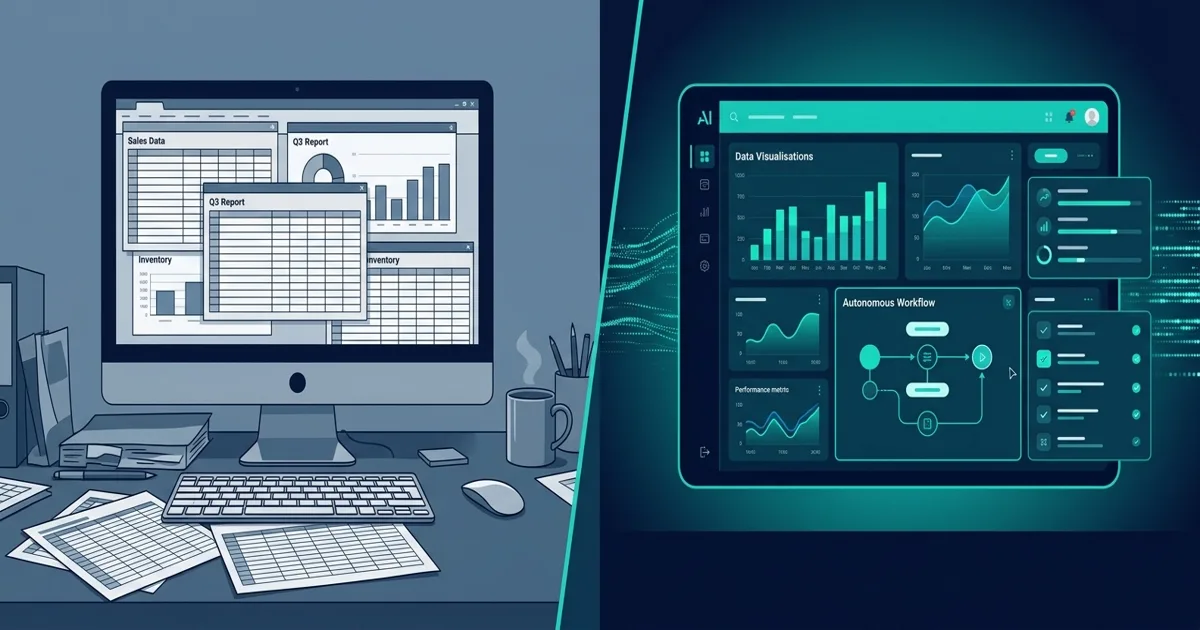
Generative AI for business is no longer a futuristic concept reserved for tech giants. It is a practical, accessible solution that enterprises of all sizes are adopting right now. Yet many businesses continue to rely on spreadsheets for critical operations, from financial reporting to inventory management.
Key Takeaways
Generative AI for business dramatically reduces manual effort, human error, and processing time compared to spreadsheet-based operations.
The hidden costs of spreadsheets include data errors, slow decision cycles, and limited scalability that quietly erode business growth and profitability.
Partnering with an experienced AI consulting company is the fastest path to building automation that fits your specific business needs.
Why Businesses Still Rely on Spreadsheets
Spreadsheets have been the backbone of business operations for decades. They are familiar, low-cost, and require no special training. Tools like Microsoft Excel and Google Sheets remain deeply embedded in finance, HR, marketing, and supply chain workflows across organizations worldwide.
According to a study by Forbes, nearly 90 percent of spreadsheets contain at least one significant error. Despite this alarming reality, businesses hold on to them because the switch feels risky or expensive. The real danger, however, is not in switching. It is in staying put.
Small teams managing their workflows manually might not feel the pain immediately. But as a business scales, those spreadsheet cracks become costly fault lines. Missed entries, version conflicts, and slow reporting cycles begin to erode productivity and profitability quietly.
The Hidden Costs of Spreadsheet Operations
Manual spreadsheet operations come with costs that rarely appear on a balance sheet. These are the invisible drains that compound over time and prevent businesses from moving at the speed the market demands.
Human Error and Data Integrity Issues
Manual data entry is error-prone by nature. A single misplaced decimal or duplicate row can cascade into flawed reports, incorrect financial statements, or bad strategic decisions. In regulated industries like finance and healthcare, these errors carry compliance risks and legal consequences. The cost of fixing data errors after the fact is often far greater than the investment required to prevent them through artificial intelligence services from the start.
Time Spent on Repetitive Tasks
Consider how many hours your team spends copying data between sheets, building pivot tables, or manually updating dashboards. These are repetitive, low-value tasks that consume high-value talent. A skilled finance analyst or HR manager should be making strategic decisions, not formatting cells. AI business automation reclaims these hours and redirects them toward activities that drive actual business value.
Lack of Real-Time Insights
Spreadsheets are static. They show you what happened yesterday, not what is happening right now. In fast-moving markets, delayed data means delayed decisions. Businesses using spreadsheet-based reporting often discover problems after the damage is done. AI-powered dashboards and automated pipelines deliver real-time visibility across operations, enabling faster and smarter responses to change.
Scalability Limitations
As your business grows, so does your data volume. Spreadsheets do not scale well. Large files become slow, crash-prone, and difficult to manage across teams. Collaboration becomes chaotic when multiple versions of the same file exist across email chains. This is a structural limitation that no formatting workaround can fix. It is a fundamental reason why AI and digital transformation become essential at a certain growth stage.
Generative AI for Business: What It Actually Does
Generative AI for business goes beyond simple automation. It understands context, generates outputs, processes natural language, and learns from data patterns to continuously improve performance. Here is how it changes the game across key business functions.
Intelligent Document Processing and Reporting
Instead of manually compiling data and building reports, generative AI can extract information from unstructured documents, emails, and databases. It summarizes insights, flags anomalies, and generates reports in seconds. What used to take a team hours can now be delivered in minutes with greater accuracy. This is one of the most immediate wins businesses experience when they move away from manual workflows.
Automated Workflows Across Departments
From HR onboarding to invoice processing, generative AI can handle entire workflows without human intervention. It integrates with existing tools and systems, routes approvals, sends notifications, and logs actions automatically. This kind of intelligent process automation eliminates bottlenecks that spreadsheets create between departments. Businesses that partner with an AI consulting company often find that automation opportunities exist in nearly every function.
Predictive Analytics and Decision Support
Spreadsheets can tell you what happened. Generative AI can tell you what is likely to happen next. By analyzing historical patterns and current signals, AI models generate forecasts, risk scores, and recommendations that support smarter decisions. Whether it is predicting customer churn, forecasting inventory needs, or identifying financial anomalies, AI-driven decision support is leagues ahead of manual analysis.
Natural Language Interfaces for Non-Technical Users
One of the most powerful features of modern generative AI consulting services is the ability to build natural language interfaces on top of business data. Instead of needing a data analyst to write queries, any team member can ask questions in plain language and receive instant, accurate answers. This democratizes data access and empowers every department to make evidence-based decisions without technical barriers.
Side-by-Side Comparison: Spreadsheets vs AI Business Automation
Data Accuracy: Spreadsheets are prone to human error and version conflicts. AI automation applies consistent rules with built-in validation to maintain data integrity.
Processing Speed: Manual spreadsheet updates take hours or days. AI processes and delivers outputs in real time or near real time.
Scalability: Spreadsheets become unstable with large datasets. AI systems are designed to scale seamlessly with growing data volumes.
Collaboration: Spreadsheets suffer from version control issues. AI platforms provide centralized, synchronized access for all users.
Insight Generation: Spreadsheets require manual analysis. AI generates insights, forecasts, and anomaly alerts automatically.
Cost Over Time: Spreadsheets appear cheap upfront but accumulate hidden costs in errors and lost productivity. AI automation reduces operational costs at scale.
Customization: Spreadsheets require manual formulas and workarounds. AI solutions can be tailored to specific business logic and workflows through proper AI consulting services.
When Should a Business Make the Switch?
The right time to transition is not when your spreadsheet system breaks down. It is before that point. If your team is spending more than 20 percent of its time on manual data tasks, if reporting cycles are longer than 48 hours, or if data errors are causing recurring business problems, the warning signs are already there.
The transition does not need to be a massive overnight overhaul. Many businesses start with a targeted proof of concept in one department, validate the value, and then scale across the organization. This phased approach reduces risk and builds internal confidence. Working with a trusted AI and data services provider makes this journey significantly smoother and more aligned with your specific business context.
According to McKinsey, companies that adopt AI-driven automation early gain a compounding productivity advantage over peers that delay. The gap between early adopters and laggards widens every year, making the cost of inaction higher than the cost of investment.
How YlogX Helps Businesses Move from Manual to Intelligent
At YlogX, we specialize in helping enterprises transition from manual, spreadsheet-driven operations to intelligent, AI-powered workflows. As an AI-first digital transformation company based in Kochi, Kerala, we bring deep expertise in generative AI consulting services, data engineering, and business automation.
Our process starts with a discovery and assessment phase where we understand your current workflows, identify automation opportunities, and design a roadmap that fits your business goals. We then architect and implement solutions that integrate with your existing tools, so the transition is smooth rather than disruptive.
Whether you are looking to automate a single workflow or redesign your entire data and reporting infrastructure, our team is equipped to guide you through every step. Reach out through our AI consulting and transformation contact page to understand how we can help your business move forward.
Conclusion
Generative AI for business is not just a technology upgrade. It is a fundamental shift in how work gets done. The hidden costs of spreadsheet operations, from errors and inefficiencies to slow decisions and scalability limits, accumulate quietly until they become a serious competitive disadvantage. Businesses that invest in AI consulting and intelligent automation today are positioning themselves for faster growth, better decisions, and more resilient operations tomorrow. The question is not whether to make the switch. It is how soon you can start.
FAQs
1: What is generative AI for business and how does it differ from traditional automation?
Generative AI for business uses large language models and machine learning to create outputs, process unstructured data, and make contextual decisions. Traditional automation follows fixed rules. Generative AI adapts, learns, and handles complex tasks that rule-based systems cannot manage effectively.
2: How much does it cost to implement AI business automation compared to maintaining spreadsheets?
Spreadsheets appear cheaper upfront but carry hidden costs in errors, rework, and lost productivity. AI automation requires an initial investment but delivers lower operational costs over time.
3: Can small and mid-size businesses benefit from generative AI consulting services?
Absolutely. Generative AI consulting services are not exclusive to large enterprises. Mid-size businesses often see the fastest returns because their workflows are agile enough to adopt automation quickly. A phased approach starting with one department makes the transition manageable and cost-effective for smaller organizations.
4: What industries benefit most from replacing spreadsheets with AI automation?
Finance, healthcare, HR, manufacturing, and marketing all see significant gains. These industries handle large data volumes, repetitive reporting cycles, and compliance requirements that spreadsheets struggle to manage reliably. Artificial intelligence services bring accuracy, speed, and scalability to all of these operational areas.
5: How long does it take to transition from spreadsheet operations to AI-powered workflows?
A focused proof of concept can be built and validated within four to eight weeks. Full enterprise rollout depends on scope and complexity. Businesses that follow a structured roadmap guided by a skilled AI consulting company significantly reduce implementation timelines and minimize disruption to existing operations.
6: What are the biggest risks of staying manual with spreadsheet-based operations?
The biggest risks include compounding data errors, slow decision cycles, poor scalability, and growing competitive disadvantage. As markets accelerate, businesses relying on manual processes fall further behind peers using AI and digital transformation strategies. The cost of inaction increases every quarter that action is delayed.
7: Do I need a large IT team to implement AI business automation?
Not necessarily. A skilled AI consulting company handles architecture, integration, and deployment on your behalf. Many AI solutions are designed to work with existing tools and require minimal internal IT involvement after setup. Your team focuses on using the system rather than building or maintaining it.
8: What is the role of an AI consulting company in a digital transformation project?
An AI consulting company assesses your current workflows, identifies automation opportunities, designs the right architecture, and oversees implementation. They bring technical expertise and industry knowledge that reduces risk and accelerates time to value. Without proper guidance, AI projects often fail to deliver meaningful business outcomes.
9: How does AI automation handle data security compared to spreadsheets?
AI platforms built by professional AI consulting services providers incorporate encryption, access controls, and audit logs by design. Spreadsheets shared via email are far more vulnerable to unauthorized access and data leaks. Proper AI implementation through a trusted partner actually improves your overall data security posture significantly.
10: Where can I learn more about AI and digital transformation strategies for my business?
A great starting point is exploring YlogX blogs on AI and digital transformation, which cover practical strategies, use cases, and insights for enterprise decision-makers. You can also connect with our team directly to discuss your specific business challenges and explore how intelligent automation can address them.