Why Generative AI Product Development Fails Without RAG
YlogX Team · 2026-06-15
Discover why generative AI product development fails without RAG. Learn how strong data foundations, governance, and Retrieval-Augmented Generation…
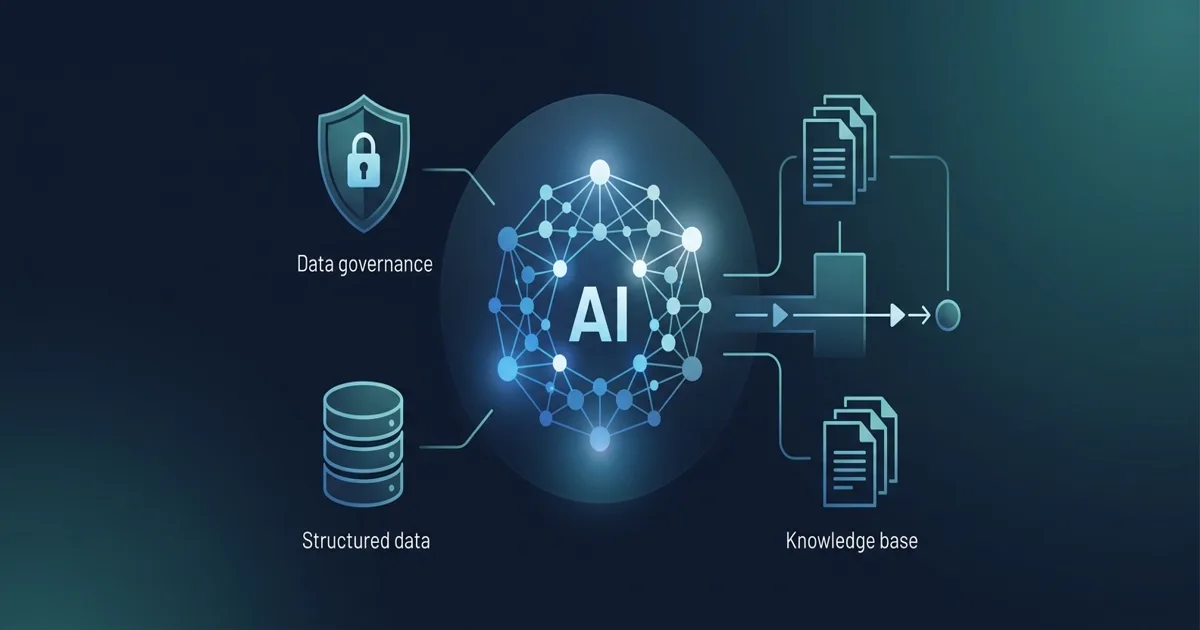
Generative AI product development is reshaping how enterprises build intelligent applications. From automating knowledge workflows to enhancing customer experiences, the promise is enormous. Yet many organizations find that their AI initiatives fall short of expectations. Outputs are inaccurate, responses are outdated, and models hallucinate facts with alarming confidence. The root cause is almost always the same: deploying AI without a strong data foundation or Retrieval-Augmented Generation (RAG) architecture. This blog explains why that combination is essential and how to get it right.
Key Takeaways
Standalone large language models lack access to trusted enterprise data, making hallucinations and outdated outputs a persistent risk in generative AI product development.
RAG architecture connects AI systems to real-time, verified knowledge sources, dramatically improving accuracy, relevance, and business reliability.
Strong data foundations, including data quality, governance, and structured knowledge management, are prerequisites for scalable and production-ready AI products.
The Hidden Problem With Standalone AI Models
Large language models (LLMs) are trained on vast public datasets. They are remarkably capable at generating fluent, coherent text. However, they have a fundamental limitation: they do not know what your business knows. They cannot access your internal documents, policies, customer records, or proprietary databases. When asked a question that requires this context, they either generate a plausible-sounding but incorrect answer or acknowledge ignorance.
This is the hallucination problem. According to Gartner, a significant percentage of enterprise AI projects fail to move beyond the pilot phase, often because the outputs are not reliable enough for operational use. Without access to current, accurate, and organization-specific data, even the most sophisticated AI model becomes unreliable in a business setting.
For organizations investing in generative AI for business, this is not a minor inconvenience. It is a fundamental barrier to value creation. A customer support AI that gives wrong answers damages trust. A financial AI that cites outdated regulatory information creates compliance risks. The stakes are high, and the solution requires more than a better model.
What Is RAG Architecture and Why Does It Matter
Retrieval-Augmented Generation (RAG) is a framework that combines the language generation capabilities of LLMs with a real-time retrieval mechanism. Instead of relying solely on what the model learned during training, a RAG system first searches a curated knowledge base to find relevant, current information. It then passes that retrieved context to the model, which uses it to generate a grounded and accurate response.
Think of RAG as giving your AI a well-organized, always-updated library to consult before answering. The model no longer has to guess. It retrieves verified facts, internal documents, or structured data and uses them to inform its output. This dramatically reduces hallucinations and ensures that responses reflect your organization's actual knowledge, policies, and data.
For enterprises working with a generative AI development company, implementing RAG is increasingly seen as the baseline requirement for production-ready AI. It bridges the gap between the general capabilities of LLMs and the specific, contextual needs of enterprise applications. Without it, AI products are essentially operating blind within the business context they are meant to serve.
Why Data Foundations Determine AI Success or Failure
RAG architecture is only as effective as the data it retrieves from. If your knowledge base contains outdated, inconsistent, or poorly structured information, the AI will retrieve and reproduce those flaws. Garbage in, garbage out remains the most important principle in enterprise AI. This is why building strong data foundations is not optional. It is a prerequisite.
Strong data foundations include several interconnected elements. Data quality ensures that information is accurate, complete, and current. Data governance establishes who owns data, how it is maintained, and who can access it. Knowledge management structures information so it is discoverable and useful for retrieval systems. Data engineering builds the pipelines and infrastructure that keep all of this running reliably.
Organizations that work with experienced providers of generative AI consulting services often discover that their biggest AI challenges are not about models at all. They are about data. Fragmented data silos, inconsistent formats, missing metadata, and poor documentation all undermine the retrieval layer in a RAG system. Addressing these challenges before deploying AI is what separates successful implementations from failed pilots.
According to research published by McKinsey, organizations with mature data management practices are significantly more likely to realize value from AI initiatives. The data foundation is not just a technical concern. It is a strategic asset.
Common Reasons Enterprise AI Projects Fail to Scale
Many enterprise AI projects launch with excitement and stall without delivering sustained value. Understanding the common failure patterns can help organizations avoid the same pitfalls. The following are the most frequently observed reasons why generative AI product development fails to scale in enterprise environments.
Poor data quality: AI systems trained or grounded on inaccurate data produce unreliable outputs that erode user trust quickly.
Absence of governance: Without clear ownership and data stewardship, knowledge bases become stale and inconsistent over time.
No retrieval layer: Deploying LLMs without RAG means the model cannot access current enterprise context, leading to hallucinations and irrelevant responses.
Siloed data sources: When critical business data lives in disconnected systems, the retrieval mechanism cannot surface the right information at the right time.
Underestimating infrastructure needs: Production-ready AI requires robust data pipelines, embedding models, vector databases, and monitoring systems that many teams underestimate in early stages.
Lack of domain expertise: Generic AI implementations without industry-specific tuning often fail to meet the precision requirements of regulated sectors like finance, healthcare, and manufacturing.
Each of these challenges points back to the same root issue. Without a deliberate strategy for data and architecture, AI products cannot achieve the reliability needed to operate at enterprise scale. This is why engaging with a qualified AI development company or global partner that specializes in end-to-end AI implementation makes a measurable difference in outcomes.
Best Practices for Building Production-Ready AI With RAG
Building a successful RAG-enabled AI product requires deliberate planning across data, architecture, and governance. The following practices reflect what leading teams apply when moving from AI concept to production.
Start With a Data Audit to Strengthen Generative AI Product Development
Before selecting a model or designing a product feature, audit your data landscape. Identify where critical knowledge lives, how current it is, who maintains it, and how accessible it is programmatically. This audit informs both the retrieval design and the data engineering work needed to support RAG. Teams that skip this step often build retrieval systems that surface incomplete or contradictory information.
Design a Knowledge Architecture That Supports Generative AI Product Development at Scale
Not all data is equally useful for retrieval. Structure your knowledge base with clear metadata, consistent formatting, and logical categorization. Use embedding models appropriate to your domain and store vectors in a purpose-built vector database. Ensure that documents are chunked thoughtfully so that retrieval returns coherent, contextually complete excerpts rather than fragments. A well-designed knowledge architecture is the backbone of an effective RAG system.
Implement Governance From Day One
Data governance should not be an afterthought. Define ownership for each knowledge source, establish review cycles to keep content current, and implement access controls that reflect your organization's security and compliance requirements. For organizations in regulated industries, governance documentation is also a compliance requirement. Artificial intelligence consulting services that include governance advisory as part of their scope help enterprises build this foundation systematically rather than reactively.
Monitor, Evaluate, and Iterate Continuously
Production AI systems require ongoing evaluation. Track retrieval quality, response accuracy, and user satisfaction metrics. Implement feedback loops that allow domain experts to flag incorrect or outdated outputs. Use this data to refine both the retrieval pipeline and the knowledge base. AI products that improve over time are built on monitoring infrastructure, not just initial model quality. Explore YlogX services to understand how end-to-end AI implementation support can accelerate this process for your organization.
How YlogX Supports Enterprise AI Product Development
At YlogX, we work with enterprises to design and implement AI products built on reliable data foundations and modern architectures including RAG. Our approach begins with discovery and assessment, where we evaluate your existing data landscape, identify gaps, and define a clear roadmap for AI readiness. We then design the data engineering infrastructure needed to support retrieval systems, including pipelines, knowledge bases, and governance frameworks.
Our team provides end-to-end generative AI consulting services that cover model selection, RAG architecture design, data preparation, deployment, and ongoing optimization. We serve clients across industries including finance, healthcare, manufacturing, and human resources, bringing domain-relevant expertise to every engagement.
For organizations evaluating AI consulting partners, we offer proof-of-concept development and technology validation so you can validate your AI strategy before committing to full-scale implementation. Our goal is to help you build AI products that are not just technically functional but genuinely useful, accurate, and aligned with your business objectives. Visit our AI and data solutions page to learn more about how we approach enterprise AI transformation.
Conclusion
Generative AI product development holds transformative potential for enterprises. But realizing that potential requires more than deploying a capable language model. It demands a strong data foundation, a well-designed retrieval architecture, and disciplined governance practices. RAG is not a luxury feature. It is the mechanism that connects AI to the knowledge your business actually holds. Without it, AI products remain unreliable, limited, and difficult to scale. Organizations that invest in data quality, governance, and RAG-enabled architectures are the ones that will build AI products delivering lasting, measurable business value. If you are ready to move from AI experimentation to production-ready implementation, connect with the YlogX team to explore how we can support your enterprise AI journey.
FAQs
1: What is Retrieval-Augmented Generation and why is it important for enterprise AI?
Retrieval-Augmented Generation (RAG) connects large language models to curated knowledge bases, enabling AI to retrieve accurate, current information before generating responses. This reduces hallucinations and improves reliability. For enterprises, RAG is essential for building AI products that deliver contextually accurate and business-relevant outputs consistently.
2: How does poor data quality affect generative AI product development?
Poor data quality directly undermines AI performance. When the retrieval layer surfaces inaccurate, outdated, or inconsistent information, the AI reproduces those flaws in its outputs. Strong data quality practices are a prerequisite for any enterprise AI implementation service aiming to deliver reliable results at scale.
3: What are the most common reasons enterprise generative AI projects fail?
The most common reasons include poor data quality, absence of governance, no retrieval architecture, siloed data sources, and underestimated infrastructure needs. Many organizations also lack domain-specific tuning, which is critical for regulated industries like healthcare and finance where output precision is a compliance requirement.
4: Can a business deploy generative AI without RAG architecture?
Technically yes, but the results are often unreliable for enterprise use. Without RAG, AI systems rely solely on training data, which quickly becomes outdated and lacks organizational context. Businesses that skip RAG typically experience higher rates of hallucinations, lower user trust, and limited scalability in production environments.
5: What role does data governance play in generative AI for business?
Data governance defines ownership, maintenance cycles, and access controls for the knowledge sources that feed AI systems. Without governance, knowledge bases become stale and inconsistent. For generative AI for business applications to remain trustworthy over time, governance must be built into the AI strategy from the very beginning.
6: How do I evaluate if my organization is ready for generative AI product development?
Start by auditing your data landscape to assess quality, accessibility, and governance maturity. Identify critical knowledge sources and evaluate whether they are structured for retrieval. Organizations exploring AI and data transformation solutions benefit from a formal discovery and assessment phase before committing to full implementation.
7: What industries benefit most from RAG-enabled generative AI applications?
Industries with large internal knowledge bases benefit most, including healthcare, finance, manufacturing, human resources, and legal services. These sectors require AI that can reference accurate, domain-specific policies and data. RAG architecture ensures AI outputs in these industries align with current regulations, internal guidelines, and organizational knowledge.
8: How do artificial intelligence consulting services help with RAG implementation?
Experienced artificial intelligence consulting services guide organizations through data auditing, knowledge architecture design, model selection, and retrieval pipeline development. They also provide governance advisory and ongoing optimization support, ensuring that RAG systems remain accurate and performant as business knowledge evolves and scales over time.
9: What is the difference between a fine-tuned model and a RAG-enabled model?
Fine-tuning updates a model's internal parameters using specific data, but that knowledge becomes static after training. RAG retrieves live information at inference time, keeping outputs current without retraining. For most enterprise use cases, RAG offers a more flexible, maintainable, and cost-effective approach to grounding AI in organizational knowledge.
10: How long does it take to build a production-ready RAG-based AI product?
Timelines vary depending on data readiness, infrastructure maturity, and product complexity. A proof-of-concept can typically be developed in a few weeks, while a fully governed, production-ready deployment may take several months. Engaging a qualified AI implementation partner with clear milestones significantly reduces time-to-value for enterprise AI projects.