Predictive vs Reactive Maintenance: An AI Consulting Perspective
YlogX Team · 2026-07-23
Artificial intelligence services are transforming maintenance strategies. Learn how AI consulting and data engineering reduce downtime and cut costs in…
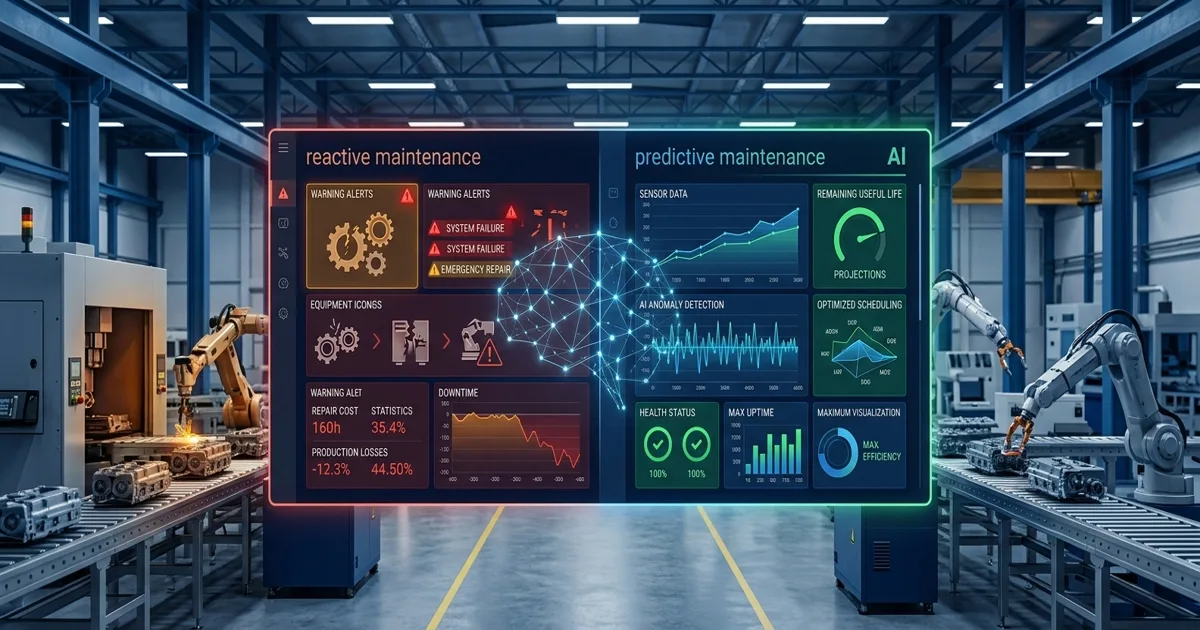
Artificial intelligence services are fundamentally changing how industrial enterprises manage equipment, assets, and operations. Every year, unplanned equipment failures cost organizations billions of dollars in production losses, emergency repairs, and supply chain disruptions. Yet many businesses still rely on reactive maintenance, waiting for something to break before taking action. This blog explores how AI consulting, data science, and modern data engineering are enabling a smarter, more proactive approach to enterprise maintenance strategy.
Key Takeaways
Reactive maintenance increases operational costs, reduces asset lifespan, and exposes businesses to unnecessary downtime and safety risks.
Artificial intelligence services combined with data engineering and IoT enable predictive maintenance that detects equipment failures before they occur.
Industries including manufacturing, energy, logistics, and healthcare are already achieving measurable ROI through AI-powered predictive maintenance guided by expert AI consulting.
Understanding Enterprise Maintenance Strategies
Before exploring how AI transforms maintenance, it is important to understand the three core maintenance models used across industries today. Each represents a different level of maturity, cost efficiency, and operational intelligence.
Reactive Maintenance
Reactive maintenance means fixing equipment only after a failure has already occurred. This approach requires no advance planning and involves no investment in monitoring or prediction. While it may seem cost-effective on the surface, reactive maintenance consistently results in higher emergency repair costs, unplanned production stops, and significant safety risks. For asset-heavy industries, this model is increasingly unsustainable.
Preventive Maintenance
Preventive maintenance involves scheduling regular inspections and servicing based on fixed time intervals or usage thresholds. This model reduces unexpected failures compared to purely reactive strategies, but it is inherently inefficient. Equipment is often serviced before it needs attention, wasting labor and parts, or it deteriorates faster than the schedule anticipates, leading to failures between service windows.
Predictive Maintenance
Predictive maintenance uses real-time sensor data, machine learning models, and historical operational records to identify when equipment is likely to fail before the failure happens. This approach enables maintenance teams to act at precisely the right time, extending asset lifespan, minimizing downtime, and optimizing resource utilization. It is the most data-intensive and operationally sophisticated maintenance model available today.
Why Reactive Maintenance Is Costing Organizations More Than Ever
According to McKinsey and Company, predictive maintenance can reduce machine downtime by up to 50%, lower maintenance costs by up to 40%, and extend equipment life by years when implemented effectively. These numbers highlight just how costly staying reactive has become for industrial enterprises.
Unplanned Downtime
When a critical machine fails unexpectedly, operations stop immediately. Production lines halt, delivery schedules slip, and customer commitments are missed. In manufacturing alone, unplanned downtime can cost thousands of dollars per minute. Unlike planned maintenance windows, unplanned stoppages create cascading disruptions across the entire value chain.
Higher Repair Costs
Emergency repairs are almost always more expensive than planned maintenance. Organizations facing sudden failures must source parts urgently, pay premium rates for expedited service, and often replace components that could have been preserved with earlier intervention. Reactive maintenance consistently drives higher per-incident costs compared to predictive alternatives.
Reduced Asset Lifespan
Equipment that operates until failure experiences significantly more wear and structural damage than assets maintained proactively. Repeated reactive maintenance shortens asset lifespan, forcing organizations into more frequent capital replacement cycles. This represents a compounding financial burden that grows as an organization scales its asset base.
Production and Revenue Losses
Every unplanned stoppage translates directly into lost production output and revenue. For manufacturers, logistics operators, and energy providers, even a few hours of unplanned downtime per month can represent millions of dollars in lost revenue annually. Reactive maintenance makes these losses a recurring operational reality.
How Artificial Intelligence Services Enable Predictive Maintenance
IBM explains how AI-powered predictive maintenance combines IoT, machine learning, and analytics to detect equipment anomalies before failures occur. This combination of technologies, when properly integrated through robust data engineering capabilities, gives enterprises an entirely new level of operational visibility and control.
Machine Learning for Failure Prediction
Machine learning models trained on historical maintenance records, sensor readings, and operational data learn to recognize patterns that precede equipment failures. These models estimate the remaining useful life (RUL) of components, flag deteriorating performance, and trigger maintenance alerts before critical thresholds are breached. Over time, models improve as they ingest more operational data, making predictions increasingly accurate.
IoT Sensors and Real-Time Monitoring
Industrial IoT sensors continuously capture temperature, vibration, pressure, current draw, and dozens of other operational parameters from equipment in real time. This data stream provides the raw material that AI models analyze to detect anomalies and forecast failures. Microsoft Azure AI demonstrates how cloud AI and IoT enable real-time predictive maintenance across manufacturing and industrial operations at enterprise scale.
Data Engineering for Predictive Analytics
Effective predictive maintenance is impossible without high-quality, integrated, and reliable data pipelines. Data engineering services ensure that sensor data, maintenance logs, operational records, and external contextual data are collected, cleaned, transformed, and delivered to AI models in real time. Without strong data engineering foundations, even the most sophisticated AI models produce unreliable predictions.
AI-Powered Anomaly Detection
AI anomaly detection algorithms continuously monitor equipment behavior, comparing current operational signatures against established baselines. When sensor readings deviate from expected patterns, the system flags potential issues for investigation. This capability allows maintenance teams to investigate and resolve developing problems before they escalate into full equipment failures, dramatically reducing unplanned downtime.
Predictive vs Reactive Maintenance: A Comparison
Reactive maintenance leads to frequent and unplanned downtime because repairs only begin after equipment fails. This approach often results in high maintenance costs, low equipment reliability, and inefficient resource utilization due to emergency repairs. Repeated failures can shorten asset lifespan, while the lack of operational data limits planning capabilities. As a result, businesses face negative ROI, higher operational and safety risks, and find it difficult to scale maintenance across multiple facilities.
Predictive maintenance uses real-time sensor data and historical information to detect issues before they become failures. This minimizes downtime, reduces maintenance costs by up to 40%, and improves equipment reliability through continuous monitoring. It also optimizes resource utilization, extends asset lifespan with proactive care, and enables maintenance planning weeks or months in advance. These advantages deliver a strong, measurable ROI, significantly reduce business risk, and allow organizations to scale maintenance efficiently across facilities using AI-powered platforms.
Industry Use Cases for Predictive Maintenance
The World Economic Forum highlights AI-enabled predictive maintenance as a key driver of smart manufacturing, operational resilience, and sustainable industrial transformation. Across sectors, organizations are already achieving meaningful outcomes through AI-powered maintenance strategies.
Manufacturing
Manufacturers use AI to monitor CNC machines, conveyor belts, industrial robots, and assembly line equipment. Predictive models detect bearing wear, motor degradation, and lubrication failures before production is impacted. This reduces unplanned stoppages, improves throughput, and lowers per-unit production costs across facilities.
Logistics and Warehousing
Fleet operators and warehouse automation providers use AI to monitor vehicle health, conveyor systems, and automated guided vehicles in real time. Predictive maintenance reduces unexpected breakdowns, improves delivery reliability, and lowers fleet operating costs by scheduling repairs during low-demand periods.
Energy and Utilities
Power generation and distribution companies use AI to monitor turbines, transformers, and grid infrastructure. Early detection of insulation degradation, vibration anomalies, and temperature spikes prevents costly outages and extends the operational life of expensive infrastructure assets.
Automotive
Automotive manufacturers and dealership networks are integrating predictive maintenance into connected vehicles. AI analyzes real-time telemetry data from engine components, braking systems, and battery modules to alert drivers and service teams before failures occur, improving safety and reducing warranty costs.
Healthcare Equipment
Hospitals and medical device operators use AI to monitor critical imaging equipment, ventilators, and laboratory instruments. Predictive maintenance reduces the risk of equipment failure during patient care, ensures regulatory compliance, and lowers the cost of emergency equipment servicing.
Mining and Heavy Industries
Mining operations deploy AI to monitor haul trucks, drilling rigs, and conveyor systems operating in extreme conditions. Predictive models estimate equipment fatigue, detect early signs of component failure, and enable maintenance scheduling that minimizes impact on continuous production operations.
Why Data Engineering Is the Foundation of Predictive Maintenance
Deloitte's smart factory research highlights predictive maintenance as one of the highest-value Industry 4.0 initiatives for improving operational efficiency. However, its success depends entirely on the quality, availability, and integration of enterprise data. This is why data engineering services in USA, India, and globally are increasingly critical to industrial AI programs.
Effective predictive maintenance data engineering involves:
Data collection: Aggregating sensor streams, maintenance records, and operational logs from diverse equipment and systems.
Sensor integration: Connecting industrial IoT devices to centralized data platforms using protocols such as MQTT, OPC-UA, and REST APIs.
Cloud data platforms: Deploying scalable cloud infrastructure to store, process, and analyze high-frequency sensor data at enterprise scale.
Data quality management: Applying validation rules, deduplication, and normalization to ensure model inputs are clean and reliable.
Real-time analytics: Enabling streaming data pipelines that deliver near-instant insights to maintenance dashboards and alert systems.
Feature engineering: Transforming raw sensor readings into meaningful statistical features that improve AI model accuracy and interpretability.
How AI Consulting Services Help Enterprises Build Predictive Maintenance Solutions
Building an effective predictive maintenance capability requires more than deploying a machine learning model. It requires a structured, business-first implementation approach guided by experienced AI consulting expertise. The key stages of a successful predictive maintenance program include:
AI readiness assessment: Evaluating data availability, sensor infrastructure, IT architecture, and organizational readiness for AI adoption.
Data engineering strategy: Designing pipelines that connect equipment sensors, operational systems, and cloud platforms to deliver reliable, real-time data.
Model development: Building and validating machine learning models for failure prediction, anomaly detection, and remaining useful life estimation.
MLOps implementation: Deploying models with automated retraining, performance monitoring, and drift detection to maintain accuracy over time.
Enterprise integration: Connecting predictive maintenance outputs with CMMS, ERP, and SCADA systems so maintenance teams can act on AI insights seamlessly.
Continuous optimization: Refining models and data pipelines as new equipment data becomes available and operational conditions evolve.
Why YlogX Delivers Smarter Predictive Maintenance Solutions
YlogX is an AI-first digital transformation company that combines AI consulting services, advanced data engineering, and machine learning implementation to help enterprises build intelligent maintenance capabilities. Our approach focuses on measurable business outcomes rather than technology for its own sake.
What makes YlogX a strong predictive maintenance partner:
AI consulting expertise: We help enterprises define maintenance transformation roadmaps aligned with operational goals and data maturity.
Data engineering capabilities: Our teams design and deploy scalable data pipelines that connect IoT sensors, cloud platforms, and enterprise systems.
Machine learning implementation: We develop and deploy failure prediction models, anomaly detectors, and RUL estimators tailored to specific equipment and industries.
Industrial AI experience: YlogX brings practical experience applying AI and data science and machine learning capabilities across manufacturing and asset-intensive sectors.
Scalable enterprise solutions: Our solutions are designed to scale from a single facility to multi-site operations without major architectural changes.
Continuous model improvement: We implement MLOps frameworks that keep predictive models accurate, reliable, and operationally relevant as conditions change.
Conclusion
Predictive maintenance is no longer just an operational improvement. It is becoming a competitive advantage that separates resilient, data-driven enterprises from those still absorbing the financial and operational costs of reactive approaches. Artificial intelligence services, supported by strong data engineering and expert AI consulting, give organizations the tools to predict equipment failures, optimize maintenance schedules, and maximize asset performance across their entire operations. Enterprises that invest in AI-driven maintenance today will build more efficient, safer, and more competitive operations for the future. Ready to move from reactive maintenance to intelligent operations? Connect with the YlogX team to explore how our AI consulting and data engineering capabilities can help your organization implement a smarter, more resilient predictive maintenance strategy.
FAQ
1: What is predictive maintenance?
Predictive maintenance uses real-time sensor data, machine learning models, and historical operational records to forecast equipment failures before they occur. This allows maintenance teams to intervene at precisely the right time, minimizing unplanned downtime, extending asset lifespan, and significantly reducing emergency repair costs across industrial operations.
2: What is the difference between predictive and reactive maintenance?
Reactive maintenance fixes equipment after failure occurs, leading to unplanned downtime and high emergency costs. Predictive maintenance uses AI and sensor data to detect failure signals in advance, enabling scheduled interventions that reduce disruption, lower costs, and extend asset lifespan compared to purely reactive approaches.
3: How do artificial intelligence services improve predictive maintenance?
Artificial intelligence services apply machine learning models to sensor streams and historical data to detect anomalies, estimate remaining useful life, and trigger maintenance alerts before failures occur. This transforms maintenance from a reactive, costly process into a proactive, data-driven operational strategy that delivers measurable financial and reliability benefits.
4: Why is data engineering important for predictive maintenance?
Predictive maintenance depends entirely on clean, integrated, and real-time data from sensors, maintenance logs, and operational systems. Strong data engineering ensures pipelines are reliable, data quality is maintained, and AI models receive the accurate inputs needed to generate trustworthy failure predictions and actionable maintenance recommendations at enterprise scale.
5: What industries benefit most from AI-powered predictive maintenance?
Manufacturing, energy and utilities, logistics, automotive, healthcare equipment management, and mining all benefit significantly. These industries operate asset-heavy environments where unplanned failures carry high financial and safety consequences, and AI-powered predictive maintenance helps them reduce downtime, optimize maintenance budgets, and improve overall operational resilience.
6: How does predictive maintenance reduce operational costs?
By identifying failing components before breakdown, predictive maintenance eliminates costly emergency repairs, reduces parts waste from unnecessary preventive servicing, and minimizes production losses from unplanned stoppages. Organizations adopting generative AI and predictive analytics capabilities report maintenance cost reductions of up to 40% and measurable improvements in overall equipment effectiveness.
7: Why should businesses partner with AI consulting services for predictive maintenance?
Building a predictive maintenance capability requires expertise across data engineering, machine learning, IoT integration, and MLOps. Experienced AI consulting services guide enterprises through readiness assessments, data strategy, model development, and enterprise integration, ensuring implementations deliver real operational value rather than becoming costly technology experiments with limited business impact.
8: How long does it take to implement an AI predictive maintenance solution?
Implementation timelines vary depending on data maturity, sensor infrastructure, and organizational readiness. A focused proof of concept typically takes six to twelve weeks, while full enterprise deployment can take six to eighteen months. Organizations exploring AI solution accelerators can reduce initial setup and architecture delays substantially.
9: What data is needed to build an effective predictive maintenance model?
Effective models require historical sensor readings covering vibration, temperature, pressure, and current draw, combined with maintenance records, failure logs, and equipment specifications. The more complete and consistent the historical data, the more accurately machine learning models can identify failure patterns and generate reliable remaining useful life estimates for specific assets.
10: Can predictive maintenance solutions scale across multiple facilities?
Yes. Cloud-based AI platforms and standardized data engineering architectures allow predictive maintenance solutions to scale from a single facility to enterprise-wide deployments. With proper MLOps frameworks and modular pipeline design, organizations can extend monitoring and prediction capabilities to new facilities without rebuilding core infrastructure, making scalability a key advantage of AI-driven maintenance programs.