HR Analytics: How AI Consulting Firms Reduce Attrition
YlogX Team · 2026-07-20
AI consulting firms help enterprises reduce attrition with predictive HR analytics. Discover how workforce intelligence drives retention and business…
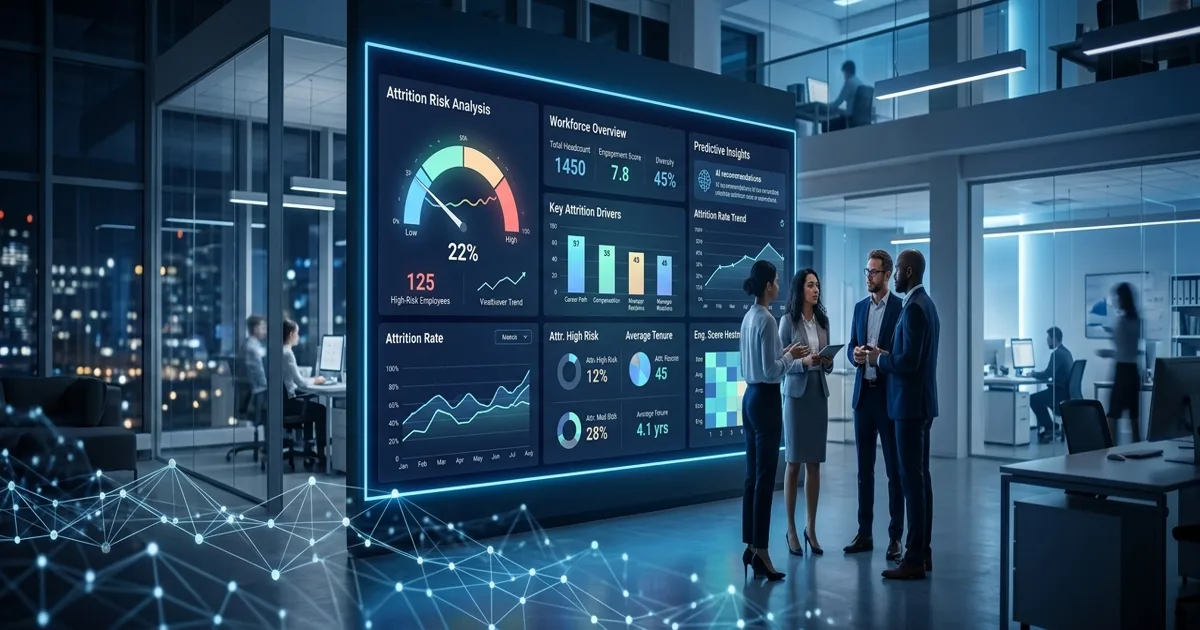
AI consulting firms are reshaping how enterprises approach one of their most persistent challenges: employee attrition. Organizations worldwide lose billions annually to high turnover, reduced productivity, and the loss of institutional knowledge. Yet most HR teams still rely on retrospective reports that explain why employees left rather than predicting who might leave next. AI-powered consulting is changing that equation by transforming raw workforce data into actionable retention intelligence.
Key Takeaways
AI consulting firms help enterprises build predictive attrition models that identify at-risk employees before they resign, enabling proactive retention strategies that reduce costly turnover.
Modern HR Analytics combines machine learning, engagement data, and performance trends to move organizations from reactive reporting to predictive workforce intelligence.
Ethical AI practices, employee privacy, and bias detection are foundational to responsible HR Analytics deployment at scale.
Why Employee Attrition Is a Business Challenge
The Financial Impact of High Turnover
Replacing a single employee can cost between 50% and 200% of their annual salary when accounting for recruitment, onboarding, training, and lost productivity. For large enterprises, even a modest improvement in retention rates translates into significant cost savings. According to the Gallup State of the Global Workplace, employee engagement is one of the strongest predictors of retention, and disengaged employees cost organizations trillions of dollars in lost productivity every year.
The financial burden of attrition extends beyond direct replacement costs. When experienced employees leave, they take institutional knowledge, client relationships, and team morale with them. This hidden cost is rarely captured in traditional HR reports but can have lasting effects on business performance.
Operational and Productivity Risks
High attrition disrupts project continuity, increases workloads for remaining team members, and slows down delivery timelines. In competitive industries where specialized skills are scarce, losing a key performer can set a team back by months. The World Economic Forum Future of Jobs Report 2025 highlights that organizations are increasingly investing in AI and data-driven workforce planning to address talent shortages and rapidly changing workforce dynamics.
Operational risk also compounds over time. Teams experiencing repeated turnover develop fragile knowledge structures, reduced innovation capacity, and lower confidence in organizational stability.
The Limitations of Traditional HR Reporting
Traditional HR dashboards report on what already happened. They measure turnover rates, headcount changes, and exit survey themes after employees have already decided to leave. This reactive posture means HR leaders are always solving yesterday's problems rather than preventing tomorrow's exits. Artificial intelligence consulting firms offer a fundamentally different approach: using predictive models to surface attrition risk signals in real time.
What Is HR Analytics?
From Descriptive to Predictive Analytics
HR Analytics is the practice of using data, statistical models, and AI to understand and improve workforce decisions. The field has evolved from basic descriptive analytics, which answers 'what happened,' through diagnostic analytics that explains 'why it happened,' into predictive and prescriptive analytics that answer 'what will happen' and 'what should we do about it.' This evolution is made possible by data science services and advanced machine learning capabilities that can process large volumes of HR data at scale.
Key Components of Modern HR Analytics
A mature HR Analytics platform integrates multiple data streams to build a comprehensive picture of workforce health. Key components include employee engagement measurement, performance management data, compensation benchmarking, career progression tracking, learning and development activity, manager effectiveness metrics, absenteeism patterns, and internal mobility trends. When these components work together, HR leaders gain a 360-degree view of each employee's experience and risk profile.
How AI Enhances Workforce Intelligence
AI elevates HR Analytics from reporting to prediction. Machine learning algorithms can identify subtle patterns across thousands of data points that human analysts would miss. For example, a combination of stagnant career growth, below-market compensation, low engagement scores, and infrequent manager interactions may collectively signal high attrition risk even when no single indicator appears alarming. AI based consulting teams bring the technical expertise to design, train, and deploy these models within enterprise HR environments.
How AI Consulting Firms Help Reduce Attrition
Building Predictive Attrition Models
Best AI consulting firms begin by assessing the quality, completeness, and structure of an organization's HR data before building any predictive model. They design data pipelines that consolidate inputs from HRIS platforms, engagement tools, performance systems, and payroll data. Using supervised machine learning techniques, these models are trained on historical attrition patterns to identify the combination of factors most predictive of future resignations. The result is an attrition risk score for each employee that HR leaders can act on proactively.
According to the Deloitte Global Human Capital Trends report, organizations are increasingly adopting AI and workforce analytics to improve talent decisions, organizational resilience, and employee experience. This adoption is accelerating as AI consulting capabilities become more accessible to enterprises of all sizes.
Identifying High-Risk Employees
Once predictive models are deployed, HR teams receive dashboards that flag employees with elevated attrition risk. These insights can be segmented by team, department, tenure, role, or location. Rather than treating all employees the same, this approach allows HR business partners to focus their time and resources on the employees most likely to leave. Early identification means retention conversations can happen months before a resignation decision is finalized.
Personalizing Retention Strategies
Not all employees leave for the same reasons. A high-potential employee may be at risk due to a lack of growth opportunities, while another may be responding to below-market compensation or an ineffective manager. AI consultants help organizations design retention strategy engines that match individual risk profiles to personalized interventions, whether that means a promotion discussion, a compensation review, a lateral move, or an enhanced learning and development plan. This precision improves both retention outcomes and employee experience.
The LinkedIn Workplace Learning Report consistently shows that career development opportunities, internal mobility programs, and learning investments are among the most powerful drivers of employee retention. AI models can identify which of these levers is most relevant for each individual.
Supporting Workforce Planning
AI-powered HR Analytics also strengthens long-term workforce planning. By forecasting attrition trends at the team and department level, HR leaders can anticipate hiring needs, succession gaps, and skill shortages before they become critical. This proactive planning reduces the reactive scramble that often follows unexpected resignations and improves the organization's ability to maintain operational continuity.
Data Sources That Power AI-Driven HR Analytics
The accuracy and reliability of predictive attrition models depend directly on the quality and diversity of the data used to train them. Leading AI consulting firms integrate multiple data sources to maximize model performance:
Employee engagement surveys: Measure sentiment, motivation, and satisfaction at regular intervals.
Performance reviews: Capture trends in goal achievement, manager ratings, and development feedback.
Attendance and absenteeism: Patterns of increased absences can signal disengagement or burnout.
Compensation and benefits data: Identifies employees whose pay has fallen below market benchmarks.
Learning and development activity: Low or declining participation can indicate disengagement.
Internal mobility records: Employees passed over for internal moves are statistically more likely to seek external opportunities.
Exit interview data: Provides validated labels for training supervised attrition models.
Collaboration and productivity trends: Where privacy-compliant, aggregate patterns can reveal disengagement signals across teams.
Business Benefits of AI-Powered HR Analytics
Organizations that invest in data science consulting for HR Analytics unlock a range of measurable business benefits:
Reduced employee turnover: Proactive interventions prevent resignations before they occur.
Better hiring decisions: Workforce analytics improves candidate fit and reduces early attrition.
Improved workforce planning: Forecasting models anticipate talent gaps before they affect operations.
Increased employee engagement: Personalized retention strategies signal to employees that their growth is valued.
Lower recruitment costs: Reducing attrition directly lowers the cost of replacement hiring.
Stronger leadership insights: Manager effectiveness analytics help organizations develop better leaders.
Better succession planning: AI identifies high-potential employees for development and advancement.
Higher organizational productivity: Stable, engaged teams consistently outperform those with high turnover.
The IBM Institute for Business Value highlights that organizations using AI for workforce decision-making are improving HR efficiency, talent planning, and employee experiences through data-driven insights.
Ethical Considerations in AI-Powered HR Analytics
Responsible AI
Building predictive attrition models requires a responsible AI framework that prioritizes fairness, transparency, and accountability. Artificial intelligence consulting firms that follow responsible AI principles ensure that models are explainable, auditable, and aligned with the organization's values. HR leaders should understand how attrition risk scores are generated and what factors drive them.
Employee Privacy
Workforce analytics involves sensitive personal data. Organizations must establish clear data governance policies that define what data can be collected, how it will be used, and who can access it. Employee privacy protections should be built into the analytics platform architecture from the start, not added as an afterthought. Transparency with employees about how their data is used builds trust and supports a positive workplace culture.
Bias Detection and Fairness
AI models trained on historical HR data can inadvertently encode existing biases related to gender, age, ethnicity, or tenure. AI based consulting teams with strong data science capabilities include bias detection and fairness testing as standard components of model development. Regular audits ensure that attrition predictions do not systematically disadvantage any employee group.
Regulatory Compliance
Organizations operating across multiple geographies must ensure their HR Analytics platforms comply with applicable data privacy regulations, including GDPR in Europe and relevant labor laws in other jurisdictions. Data science and machine learning teams with compliance expertise help organizations design analytics systems that are both powerful and legally sound.
Best Practices for Implementing HR Analytics
Start with High-Quality HR Data
The most sophisticated AI model will underperform if built on incomplete or inconsistent HR data. Before deploying predictive analytics, organizations should audit their HR data for accuracy, completeness, and consistency across systems. Data quality improvement is often the most impactful early step in an HR Analytics transformation journey.
Align Analytics with Business Goals
HR Analytics should be designed to answer specific business questions, not generate reports for their own sake. What attrition rate is the organization targeting? Which roles carry the highest replacement cost? Which departments are most at risk? Aligning analytics objectives with business priorities ensures that insights translate into action rather than remaining unused in dashboards.
Integrate HR and Business Systems
HR Analytics becomes significantly more powerful when HR data is connected with business performance data. Linking workforce metrics to revenue, customer satisfaction, and operational outcomes allows organizations to quantify the business impact of talent decisions. Data engineering capabilities are essential for building the integration pipelines that make cross-system analytics possible.
Continuously Improve AI Models
Attrition patterns change as business conditions, workforce demographics, and market dynamics evolve. Predictive models require regular retraining and validation to remain accurate. Best AI consulting firms build model monitoring and retraining processes into their HR Analytics implementations to ensure sustained performance over time.
Why AI Consulting Firms Accelerate HR Transformation
Building an enterprise HR Analytics platform requires a combination of capabilities that most HR teams do not have in-house. AI consulting firms bring together expertise across AI strategy development, data engineering, predictive model development, HR dashboard implementation, AI governance, change management, and enterprise scalability. This end-to-end capability accelerates the time to value and reduces the risk of failed implementations.
YlogX works with enterprise clients to design and implement intelligent HR Analytics solutions that are aligned with business goals, built on responsible AI principles, and scalable across the organization. From data strategy to model deployment, our generative AI and analytics capabilities help organizations transform workforce data into strategic retention intelligence.
Conclusion
HR Analytics is no longer a reporting tool. It is becoming a core strategic capability that separates organizations that retain their best talent from those that consistently lose it. AI consulting firms give enterprises the expertise, technology, and data science rigor needed to move from reactive HR reporting to predictive workforce intelligence. Organizations that invest in AI-powered HR Analytics today will build more resilient, engaged, and productive workforces tomorrow. Ready to transform your workforce data into actionable retention strategies? Connect with YlogX to explore how our AI consulting experts can help you design a smarter, more strategic HR Analytics platform.
FAQ
1: What is HR Analytics?
HR Analytics is the use of data, statistical models, and AI to improve workforce decisions. It helps organizations understand employee behavior, predict attrition risks, and design targeted retention strategies that integrate engagement, performance, and compensation data to deliver actionable insights for HR leaders.
2: How does AI reduce employee attrition?
AI reduces attrition by identifying at-risk employees before they resign. Machine learning models analyze engagement scores, performance trends, compensation gaps, and career progression data to generate attrition risk scores. HR teams can then act on these signals with personalized retention interventions, preventing resignations and reducing costly turnover across the organization.
3: What are predictive HR Analytics?
Predictive HR Analytics uses machine learning and historical workforce data to forecast which employees are most likely to leave. Unlike traditional reporting, predictive models surface risk signals months in advance, giving HR leaders time to act with targeted strategies before resignation decisions are finalized, improving retention outcomes significantly.
4: How do AI consulting firms improve workforce retention?
AI consulting firms design and deploy predictive attrition models, personalized retention engines, and workforce planning dashboards. They integrate HR data from multiple systems, build explainable AI models, and embed responsible AI governance. This end-to-end capability helps organizations retain top talent through data-driven, proactive strategies rather than reactive responses.
5: What data is used to predict employee attrition?
Predictive attrition models use engagement survey results, performance reviews, absenteeism patterns, compensation benchmarks, internal mobility records, learning activity, manager effectiveness scores, and exit interview data. Organizations that invest in AI consulting capabilities can consolidate these inputs into a unified, high-accuracy analytics platform that delivers reliable attrition intelligence.
6: What are the business benefits of HR Analytics?
HR Analytics reduces turnover costs, improves hiring quality, strengthens workforce planning, and increases employee engagement. Organizations gain better succession planning, stronger leadership insights, and higher productivity. By identifying retention risks early, enterprises can allocate HR resources more efficiently and build workforces that are more stable, skilled, and strategically aligned.
7: How can AI improve employee engagement?
AI analyzes engagement survey trends, collaboration patterns, and career development activity to identify disengagement signals before they escalate. Personalized recommendations, timely manager interventions, and targeted learning opportunities can then be delivered based on each employee's profile. This data-driven approach makes engagement strategies more precise and measurable across large organizations.
8: Why are enterprises investing in AI-powered HR Analytics?
Enterprises are investing in AI-powered HR Analytics to reduce the high cost of attrition, address talent shortages, and improve workforce resilience. As workforce dynamics grow more complex, traditional HR reporting falls short. AI enables proactive talent management at scale, and AI accelerators help organizations deploy workforce analytics solutions faster and more cost-effectively.
9: What role does responsible AI play in HR Analytics?
Responsible AI ensures that attrition models are transparent, fair, auditable, and compliant with data privacy regulations. It includes bias detection, fairness testing, and clear governance over how employee data is collected and used. Responsible AI practices build employee trust and protect organizations from legal and reputational risks associated with algorithmic workforce decisions.
10: How do best AI consulting firms approach HR Analytics implementation?
Best AI consulting firms begin with a data quality assessment, then design integrated data pipelines, build and validate predictive models, and implement actionable HR dashboards. They embed governance, change management, and model monitoring into every phase. This structured approach ensures that enterprise HR Analytics platforms deliver sustained business value well beyond the initial deployment.