How to Choose an AI Consulting Partner: Enterprise Buyer's Guide
YlogX Team · 2026-08-17
A practical enterprise buyer's guide to evaluating AI consulting firms, with a five point scorecard, key questions, and red flags to watch for.

Choosing how to choose an AI consulting firm is a decision most enterprises only get to make well once. Pick the wrong partner and you lose months to a pilot that never reaches production. This guide gives you a structured way to evaluate AI consulting partners against real criteria instead of marketing claims, including a five category scorecard, the questions worth asking in a first discovery call, and the red flags that should end a conversation early.
Key Takeaways
Score every AI consulting partner against five categories: production evidence, governance design, data readiness, pricing transparency, and industry references.
A credible partner welcomes direct questions about past production deployments and governance design. A partner who deflects them is a warning sign.
The best AI consulting firms differentiate themselves through evidence, not superlatives. Treat unverifiable claims as a reason to dig deeper, not a reason to sign.
Why Marketing Claims Are Not Enough
Nearly every AI consulting firm markets itself as experienced, innovative, and results driven. Those words appear on almost every consulting website in the category, which means they carry almost no evaluative signal on their own. What actually separates a partner capable of shipping production AI from one that is not is evidence: named examples of models running live, a specific explanation of how governance gets designed, and pricing that scales predictably rather than surprising you after the first pilot succeeds. An enterprise that evaluates on evidence instead of adjectives makes a meaningfully better decision, and does it faster, because vague claims are quickly exposed by a small number of direct, specific questions.
The cost of getting this decision wrong is not just the fee paid to the partner. It is the months of internal time spent on a pilot that never reaches production, the credibility an AI initiative loses internally after a visible failure, and the harder conversation needed to secure budget for a second attempt. Enterprises that treat partner selection as a rigorous, evidence based process rather than a quick procurement step consistently avoid this cost, because most of the risk in an AI engagement is set before a single line of code is written, in how the partner is chosen and what they commit to upfront.
The Five Category Evaluation Scorecard
A structured scorecard turns a series of sales conversations into a comparable evaluation. Score every candidate partner against the same five categories, using the same criteria, so the final comparison is based on evidence rather than which pitch was most polished.
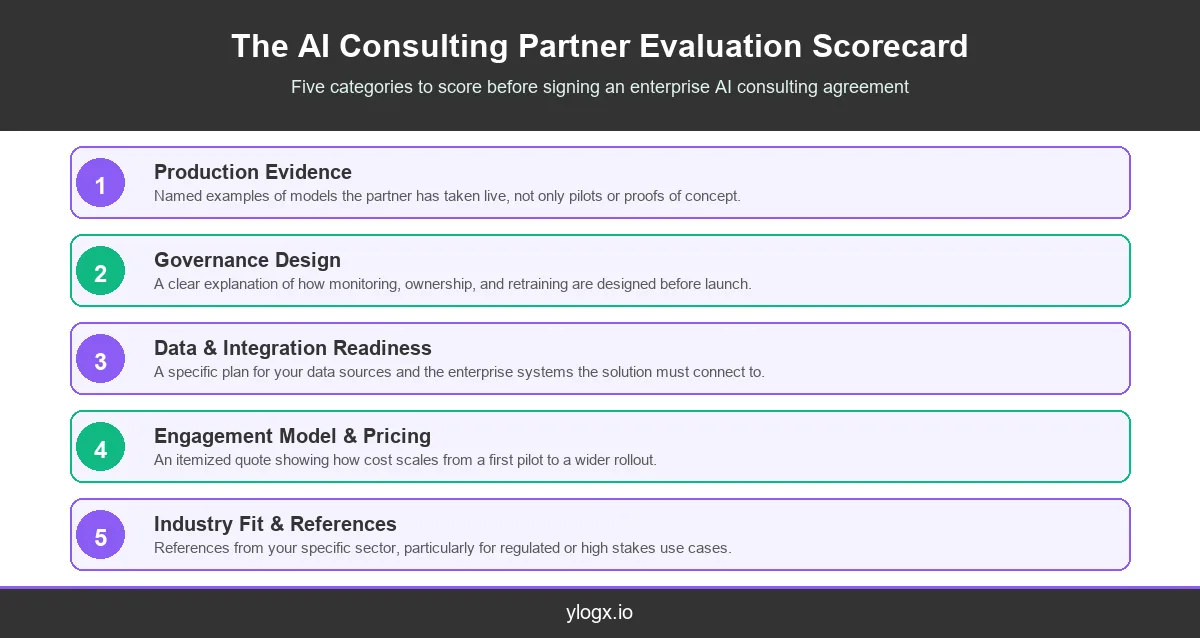
five category scorecard for evaluating AI consulting partners
Production evidence and governance design matter most for enterprises that have already run a pilot and been burned by one that never shipped. Data and integration readiness matters most for enterprises early in their AI journey, since this is where estimates most often go wrong. Engagement model and pricing transparency, covered in more depth in our guide to AI consulting pricing, protects against budget surprises later. Industry fit and references matter most in regulated sectors, where a partner's general AI experience does not guarantee they understand your specific compliance requirements.
Questions to Ask in the First Discovery Call
A short set of direct questions in the first conversation reveals more than a formal RFP process often does. Ask the partner to describe, in detail, one model they have taken from pilot to production, including what went wrong along the way. A partner with real experience will have a specific, unglamorous answer. Ask how they would structure governance for your specific use case before any contract is signed, not as a generic answer about best practices. Ask what percentage of their pilots in the last two years reached production, and how they define production. Ask for a reference specifically in your industry, not just a general enterprise reference, particularly if you operate under any regulatory oversight. Frameworks like the NIST AI Risk Management Framework are a useful shared reference point to ask a candidate partner how their governance approach aligns with recognized standards, rather than an internal process only they can describe.
It is also worth asking who on the partner's team will actually do the work, not just who is in the sales conversation. AI consulting firms vary widely in how much of the delivery team overlaps with the people pitching the engagement, and a mismatch here is a common source of disappointment once a contract is signed. Ask for the names and backgrounds of the engineers and data scientists who would be assigned to your engagement, and treat a vague answer here with the same scrutiny as a vague answer about governance or production evidence.
Red Flags That Signal a Partner Is Not Ready
A few patterns show up consistently among partners who are not ready for a production engagement. Case studies described only in terms of a pilot or proof of concept, with no mention of what happened after, are the clearest signal. A single flat price quoted before any discovery work has happened is another, since it means the quote was never actually scoped against your data or systems. Governance and monitoring treated as an add on rather than a core part of the proposal is a third, and it usually predicts the same governance gap will show up again once the engagement is under way. Reluctance to provide a reference in your specific industry, or references that are all generic cross industry examples, is a fourth. None of these alone is disqualifying, but two or more together are a strong reason to keep evaluating other partners rather than proceeding.
A fifth pattern worth watching for is a proposal that reads as generic across industries, with the same language and structure regardless of whether the use case is fraud detection, predictive maintenance, or HR analytics. A partner who has genuinely done the discovery work will reflect specifics about your business back to you in the proposal itself. One that has not will often reuse the same template language seen in other AI consulting firms' generic pitch decks, changing only the company name and logo on the cover slide.
Making the Final Decision
Once you have scored two or three finalists against the same five categories, the decision usually becomes clearer than it felt at the start of the process. Weight production evidence and governance design most heavily, since those two categories predict whether your engagement will actually reach production, which is the outcome the entire evaluation exists to protect. Review case studies directly with your finalist rather than relying on summarized claims, and involve your own technical and compliance stakeholders in that review before signing. A rigorous selection process is itself a preview of how disciplined the engagement will be once it starts.
If two finalists score closely, use the discovery call quality itself as the tiebreaker. The partner who asked sharper questions about your data, your systems, and your success metric during the sales process is very likely the same partner who will bring that same rigor to the actual engagement. That pattern tends to hold regardless of company size or brand recognition, which is why a structured, criteria based evaluation consistently outperforms a decision made on reputation alone.
Conclusion
Choosing an AI consulting partner on evidence, not marketing language, is the single highest leverage decision in any enterprise AI initiative. Use the five category scorecard, ask the direct discovery questions above, and treat the red flags as disqualifying when two or more appear together. To discuss your specific use case with our team, contact YlogX for a scoped conversation. The time spent evaluating properly at the start is consistently smaller than the time lost to a poorly chosen partner later, which makes this one of the highest return conversations an enterprise can have before committing budget to an AI initiative.
Frequently Asked Questions
What is the most important factor in choosing an AI consulting partner?
Production evidence. A partner who can show models running live, not just pilots, is the strongest single predictor of a successful engagement.
How do I verify an AI consulting firm's production claims?
Ask for a specific, detailed account of one production deployment, including challenges encountered, and request a reference who can confirm the outcome.
Should I ask for references in my specific industry?
Yes, particularly in regulated sectors. General enterprise AI experience does not guarantee familiarity with your specific compliance requirements.
What red flags suggest an AI consulting partner is not ready for production work?
Case studies limited to pilots, a flat quote given before discovery, governance treated as optional, and no industry specific references.
How many AI consulting partners should I evaluate before deciding?
Two to three finalists scored against the same criteria is usually enough to make a confident, evidence based decision.
Is the cheapest AI consulting quote usually the best choice?
Not necessarily. A very low quote given before discovery often signals the partner has not actually scoped your data and integration requirements.
Does company size matter when choosing an AI consulting partner?
Less than production evidence and governance discipline. Smaller, focused firms can outperform larger generalist firms on a specific use case.
What questions should I ask about AI governance during evaluation?
Ask exactly how monitoring, model ownership, and retraining triggers are designed before launch, not as a general policy statement.
How long should the AI consulting partner evaluation process take?
A structured evaluation using a scorecard and discovery calls typically takes two to four weeks for two or three finalists.
Where can I learn more about working with YlogX?
Visit our solutions page for examples of our engagement approach, or contact our team directly to discuss your use case.