Generative AI for Business: Scalable Value vs Costly Experimentation
YlogX Team · 2026-06-02
Generative AI for business offers enormous potential, but many organizations struggle to move beyond costly experimentation. Learn how a structured AI…
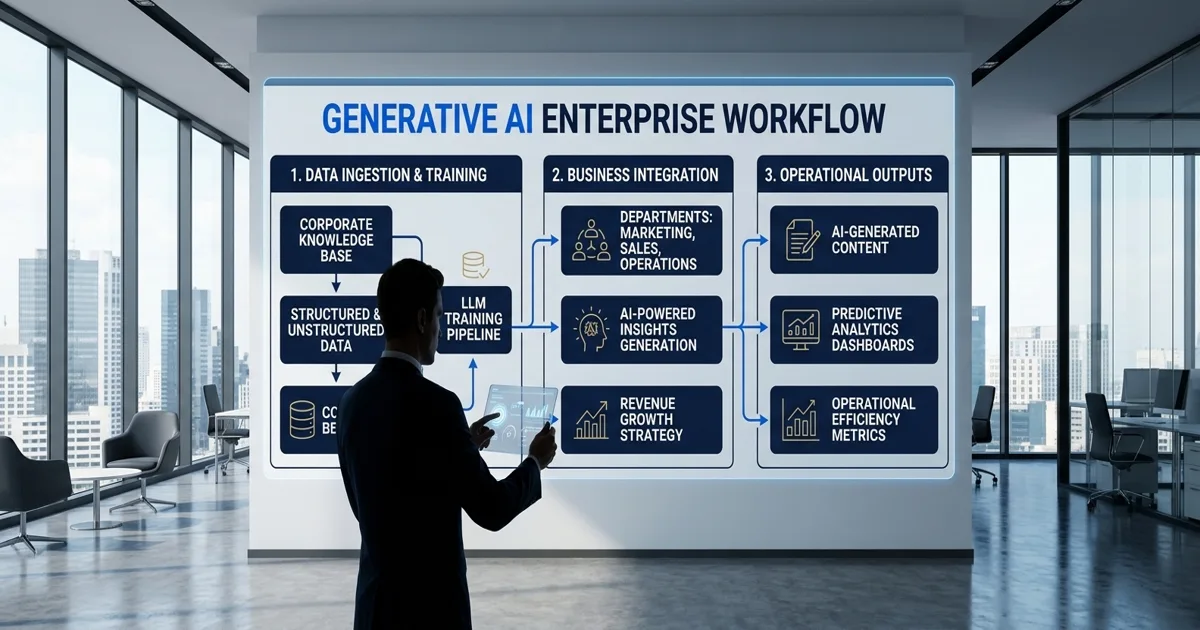
Generative AI for Business: Are You Building Value or Just Experimenting?
Generative AI for business has moved from boardroom curiosity to operational priority across nearly every major industry. Yet despite the surge in adoption, a large share of enterprise AI initiatives produce little measurable impact. Organizations deploy AI chatbot development services, launch content generation tools, and spin up copilots, only to find that the results do not justify the investment. The core problem is not the technology. It is the absence of a structured ai adoption strategy that connects AI capabilities to business outcomes. This article explains how to close that gap.
Key Takeaways
Generative AI for business delivers real value only when tied to clear business objectives, measurable KPIs, and operational workflows rather than isolated experiments.
Most GenAI failures stem from poor data governance, undefined ROI frameworks, and lack of enterprise-grade architecture planning.
Partnering with a specialist generative ai consulting services provider helps enterprises reduce implementation risk and accelerate value delivery across enterprise AI use cases.
What Is Generative AI for Business?
Generative AI refers to AI systems that can create content, synthesize information, automate reasoning, and support decision-making at scale. In a business context, this includes large language models (LLMs), enterprise AI copilots, intelligent assistants, AI-powered workflow automation, and knowledge management systems.
Unlike traditional software, these systems can interpret unstructured data, generate contextual responses, and operate across multiple business functions simultaneously. When applied correctly, they enable organizations to compress decision cycles, reduce manual processing, and surface insights from data that would otherwise remain buried in documents, emails, and databases.
The distinction that matters most is this: generative AI is not a product to deploy. It is a capability to build. Organizations that treat it as the former consistently underperform those that treat it as the latter.
Why Many Generative AI Initiatives Fail to Deliver ROI
The gap between GenAI potential and actual business outcomes is well-documented. According to research from McKinsey, while AI adoption has accelerated, the share of organizations reporting meaningful revenue or cost impact remains modest relative to overall experimentation spend. Understanding why is critical to avoiding the same mistakes.
Lack of Business Alignment in AI Projects
The most common failure mode is launching AI initiatives without a clear connection to business objectives. Teams experiment with public AI tools or deploy off-the-shelf chatbots without asking the fundamental question: what specific business problem does this solve, and how will we measure success? Without that anchor, AI projects drift into demonstrations rather than operational systems.
This misalignment also shows up in disconnected pilot projects. A marketing team runs one experiment, an operations team runs another, and IT builds a third. None of these inform each other. The organization ends up with fragmented AI investments that cannot scale because they were never designed to connect.
Poor Data Governance and Infrastructure Readiness
Generative AI systems are only as good as the data they operate on. Many enterprises discover mid-implementation that their data is siloed, inconsistently formatted, or insufficiently governed to support reliable AI outputs. This creates two serious problems: inaccurate model outputs that erode user trust, and compliance exposure when sensitive data is inadvertently processed by public AI services.
Overdependence on public AI tools compounds this risk. Organizations that route proprietary business data through general-purpose AI APIs without proper controls face security, confidentiality, and regulatory risks that are often only recognized after the fact. A mature generative ai development company will identify and address these infrastructure gaps before deployment begins.
Scalability Problems and Technical Debt
Pilot projects that succeed in isolation frequently fail when organizations attempt to scale them. The underlying architecture was not designed for enterprise workloads, integrations with existing systems were not planned, and the compute and data infrastructure cannot support broader deployment. The result is technical debt that makes future AI investment more expensive rather than more efficient.
The Hidden Cost of AI Experimentation Without Strategy
Unstructured AI experimentation carries costs that rarely appear on project budgets. Wasted development cycles, duplicated tooling, shadow IT proliferation, and the opportunity cost of teams focused on experiments that will never reach production all accumulate quietly. Security exposure from employees using unauthorized AI tools adds compliance and legal risk on top of operational inefficiency.
Perhaps the most damaging cost is organizational. When early AI experiments produce poor results, leadership confidence erodes and future initiatives face skepticism that makes meaningful investment harder to secure. The organization becomes trapped between hype-driven overcommitment and reactionary underinvestment, neither of which produces competitive advantage.
This is why the framing matters. Generative AI for business is not an experiment. It is an infrastructure investment that requires the same governance discipline applied to any other enterprise technology platform. Organizations that internalize this shift in perspective move from costly experimentation to scalable value creation.
How Enterprises Can Build Scalable Generative AI Systems
Scalable enterprise AI is not built in a single sprint. It is developed through a structured process that connects business strategy to technical architecture and operational change management. The following components are non-negotiable for organizations that want durable outcomes.
Identifying High-Value Enterprise AI Use Cases
Use case selection is the highest-leverage decision in any AI program. The right use cases combine high business impact, reasonable data availability, and manageable implementation complexity. Poor use case selection is the primary driver of wasted AI investment.
Practical frameworks for prioritization evaluate each candidate use case against dimensions such as: volume of the underlying process, cost or quality impact of errors, availability of quality training or retrieval data, and feasibility of human-in-the-loop validation. Use cases that score well across all dimensions should be prioritized ahead of technically interesting but operationally marginal applications.
AI Readiness and Data Maturity Assessment
Before committing to implementation, enterprises must honestly evaluate their AI readiness. This includes assessing data infrastructure quality, existing integration capabilities, security and compliance posture, and organizational change capacity. Skipping this step is one of the most reliable predictors of implementation failure.
A structured readiness assessment surfaces the gaps that need to be addressed before AI systems can operate reliably. It also creates a shared understanding across technology, business, and leadership teams of what will be required to succeed, which is essential for securing the sustained organizational commitment that scaled AI deployment demands. You can explore the full range of AI and data services that support this process.
Governance, Security, and Compliance Frameworks
Enterprise AI governance is not optional. Organizations deploying generative AI systems must establish clear policies covering data access controls, model output validation, audit logging, regulatory compliance, and escalation procedures for edge cases. These controls are not bureaucratic overhead. They are the foundation that allows AI systems to operate at scale without accumulating unacceptable risk.
Security controls must address both the AI system itself and the data pipelines that feed it. Access controls, encryption protocols, and data classification frameworks should be established before deployment, not retrofitted afterward. This is particularly critical in regulated industries such as healthcare and finance, where the consequences of compliance failures are severe.
Human-in-the-Loop Validation and KPI Frameworks
Generative AI outputs require human oversight, especially in high-stakes business processes. Human-in-the-loop validation systems ensure that AI-generated content, decisions, or recommendations are reviewed before acting on them in contexts where errors carry significant consequences. These systems also generate the feedback data needed to continuously improve model performance over time.
Equally important is establishing KPI frameworks before deployment. Organizations must define what success looks like in measurable terms: processing time reduction, accuracy rates, cost per transaction, user adoption rates, and downstream business outcomes. Without these benchmarks, it is impossible to distinguish a working AI system from one that is merely running.
Enterprise AI Use Cases That Deliver Measurable Value
Grounding the conversation in practical applications makes the strategic case more concrete. The following enterprise AI use cases represent areas where generative AI has demonstrated consistent operational value across multiple industries.
AI customer support assistants: Intelligent assistants that handle tier-one support queries, escalate complex cases, and generate accurate, context-aware responses reduce support costs while improving resolution times.
Intelligent document processing: Automating the extraction, classification, and summarization of information from contracts, invoices, reports, and regulatory filings reduces manual processing time and improves accuracy.
Knowledge management copilots: Internal AI systems that surface relevant organizational knowledge from documentation, past projects, and expert networks accelerate employee productivity and reduce duplicated effort.
AI-powered workflow automation: Combining generative AI with process automation enables end-to-end automation of multi-step business workflows that previously required human judgment at each stage.
Enterprise search and retrieval: AI-enhanced search systems allow employees to query organizational knowledge bases in natural language and receive synthesized, contextually relevant answers rather than a list of documents.
Internal productivity assistants: Copilots integrated into existing enterprise tools help employees draft communications, analyze data, prepare reports, and manage tasks with significantly less manual effort.
The Role of Generative AI Consulting Services
Working with experienced generative ai consulting services providers accelerates the path from strategy to scalable deployment. Consultants bring implementation knowledge that most enterprises cannot develop internally in a reasonable timeframe, particularly in areas such as AI architecture design, vendor and model selection, data governance structuring, and organizational change management.
A qualified consulting partner helps enterprises avoid the pitfalls that derail self-directed AI programs: over-scoped pilots, infrastructure mismatches, governance gaps, and misaligned success metrics. The value of consulting is not in the technology delivered but in the strategic alignment and risk reduction it provides throughout the implementation lifecycle. To understand how generative ai product development works within a managed consulting engagement, explore the AI solutions framework that guides structured enterprise delivery.
AI Chatbot Development Services vs Enterprise AI Systems: An Important Distinction
The market often conflates AI chatbot development services with enterprise AI capability. These are fundamentally different things. A chatbot handles structured, predefined interactions within a narrow scope. An enterprise AI system orchestrates multiple AI components, integrates with business processes, operates across data sources, and adapts to complex, variable inputs.
Organizations that invest in chatbot deployments expecting enterprise AI outcomes are almost always disappointed. The technology is not wrong, but the scope is mismatched to the ambition. True enterprise AI orchestration involves connecting language models to retrieval systems, workflow engines, business logic layers, and integration middleware in ways that deliver coherent, governed, and scalable outcomes across the organization.
Understanding this distinction is essential for setting realistic expectations, budgeting appropriately, and selecting the right implementation partners. A mature generative ai development company will make this distinction clearly and help organizations choose the right architecture for their actual requirements.
Building a Long-Term AI Adoption Strategy
Sustainable AI adoption is a multi-year organizational journey, not a project with a defined end date. Enterprises that approach it as a journey build compounding capability over time. Those that approach it as a project often find themselves starting over after each initiative cycle.
A durable ai adoption strategy includes phased implementation that starts with high-confidence use cases and expands as organizational capability matures. It includes cross-functional governance structures that keep AI aligned with business priorities across departments. It includes workforce enablement programs that build AI literacy and adoption capacity at the operational level. And it includes scalability planning that anticipates infrastructure and data requirements before they become bottlenecks.
AI ethics and responsible use frameworks are also non-negotiable components of long-term strategy. Organizations must establish clear policies on bias monitoring, transparency, accountability, and the human oversight required to maintain trust in AI-generated outputs. These policies protect both the organization and the people it serves. Learn how leading organizations approach AI strategy through expert insights that translate into operational practice.
The Future of Generative AI in Enterprise Operations
The trajectory of enterprise AI points toward autonomous workflows, multimodal systems, and industry-specific AI agents that operate across entire business functions with minimal human initiation. AI-powered operational intelligence systems will aggregate signals from across the enterprise and surface actionable insights in real time, enabling faster and more accurate decision-making at every level.
Organizations that begin building mature AI infrastructure today will be positioned to adopt these capabilities as they emerge. Those that remain in experimentation mode will face an increasing capability gap relative to competitors who have built the governance, data, and integration foundations that advanced AI requires. According to research published by Gartner, enterprises that invest in AI governance and data infrastructure early consistently achieve faster time-to-value on subsequent AI initiatives.
Conclusion: From Experimentation to Enterprise AI Transformation
Generative AI for business is one of the most significant operational opportunities available to enterprise leaders today. But its value is not automatic. It must be earned through strategic prioritization, disciplined execution, and the organizational commitment to build AI as infrastructure rather than experiment with it as a novelty. The enterprises that will define competitive advantage in the next decade are those investing now in the architecture, governance, and expertise required to make AI work at scale. If your organization is ready to move beyond experimentation and build a scalable AI capability, connect with the YogX team to explore what a structured enterprise AI engagement looks like in practice.
FAQs
1: What is generative AI for business and how is it different from traditional AI?
Generative AI for business refers to AI systems that create content, synthesize data, and support decisions using large language models. Traditional AI classifies or predicts based on structured data. Generative AI operates on unstructured inputs, making it applicable across a far broader range of enterprise AI use cases and business functions.
2: Why do so many generative AI initiatives fail to deliver measurable ROI?
Most failures result from launching AI without clear business objectives, skipping data readiness assessments, and using fragmented pilot approaches that cannot scale. Without defined KPIs and governance frameworks, organizations cannot measure success or build on early results, turning promising experiments into expensive dead ends.
3: What are the most valuable enterprise AI use cases for large organizations?
High-value enterprise AI use cases include intelligent document processing, AI customer support assistants, internal knowledge management copilots, AI-powered workflow automation, and enterprise search systems. These use cases deliver consistent ROI because they target high-volume, process-heavy operations where AI can reduce cost and improve accuracy simultaneously.
4: How do generative AI consulting services reduce implementation risk?
Experienced generative ai consulting services providers bring structured methodologies for use case prioritization, AI readiness assessment, architecture design, and governance framework development. This reduces the risk of misaligned investments, infrastructure failures, and compliance gaps that commonly derail self-directed enterprise AI programs.
5: What is the difference between AI chatbot development services and enterprise AI orchestration?
AI chatbot development services deliver narrow, structured conversational tools. Enterprise AI orchestration connects language models, retrieval systems, workflow engines, and integration layers to enable complex, multi-step automation across business functions. The scope, architecture, and governance requirements are fundamentally different between the two approaches.
6: How should enterprises prioritize which generative AI use cases to pursue first?
Prioritize use cases that combine high business impact, reasonable data availability, and manageable implementation complexity. Evaluate each candidate on process volume, error impact, data quality, and feasibility of human validation. Starting with high-confidence use cases builds organizational capability and stakeholder confidence for broader AI transformation programs.
7: What role does data governance play in successful generative AI product development?
Data governance is foundational to generative ai product development. Without consistent data classification, access controls, and quality standards, AI systems produce unreliable outputs and create compliance exposure. Governance frameworks must be established before deployment to ensure AI operates reliably, securely, and in alignment with regulatory requirements.
8: How do enterprises build an effective long-term AI adoption strategy?
A durable ai adoption strategy includes phased implementation starting with proven use cases, cross-functional governance structures, workforce enablement programs, AI ethics policies, and scalability planning. Treating AI as an infrastructure investment rather than a project ensures that each implementation builds compounding organizational capability over time.
9: What infrastructure do enterprises need before deploying generative AI systems?
Enterprises need clean, accessible data pipelines, integration middleware compatible with target systems, security and access control frameworks, compute infrastructure scaled to workload requirements, and audit logging capabilities. A thorough AI readiness assessment conducted by a qualified generative ai development company identifies gaps before they become deployment blockers.
10: How can a company like YlogX help with enterprise generative AI implementation?
YlogX provides end-to-end support covering AI strategy consulting, readiness assessment, architecture design, and implementation across industries including finance, healthcare, and manufacturing. Their structured approach helps enterprises move from experimentation to scalable AI deployment. Visit the YlogX FAQ page for more details on engagement models and service scope.