Generative AI Development Company: What Enterprise Buyers Should Demand
YlogX Team · 2026-06-08
Selecting the right generative AI development company is critical to enterprise AI success. This guide helps decision-makers evaluate AI vendors based on…
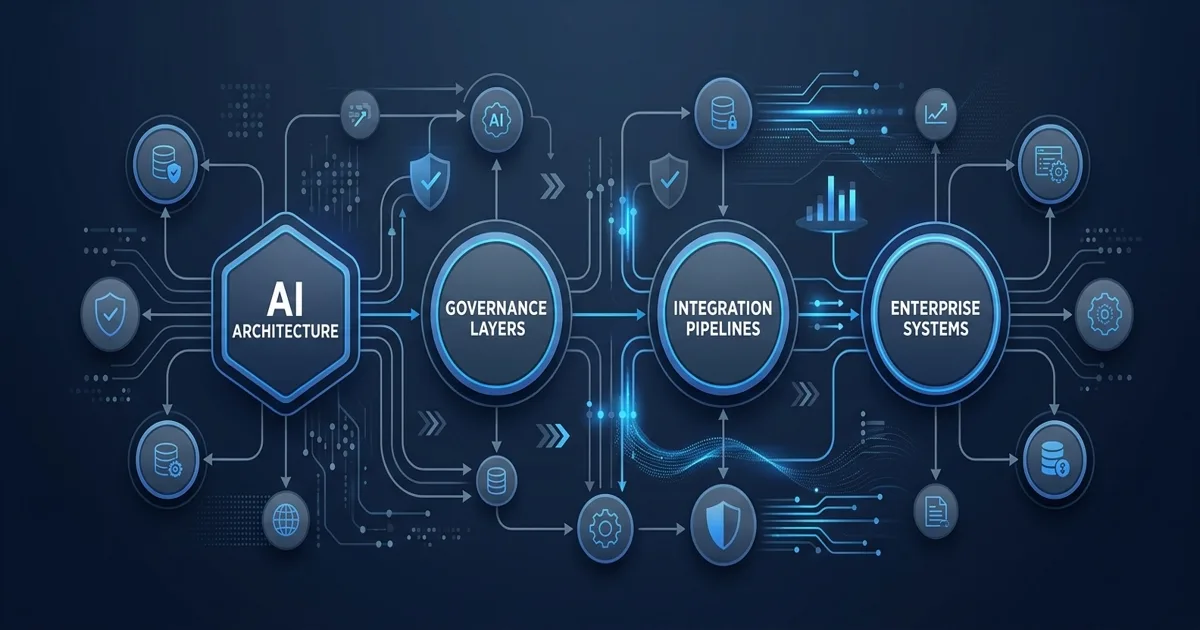
Selecting the right generative AI development company is one of the most consequential technology decisions an enterprise can make today. Budgets are being committed, pilots are being launched, and vendors are competing aggressively for contracts. Yet a large proportion of enterprise GenAI initiatives stall, fail, or deliver far less than promised. The root cause is almost always the same: organizations committed to projects before they had a clear framework for evaluating the partner behind them. This guide gives enterprise decision-makers exactly that framework.
Key Takeaways
Successful generative AI for business depends on architecture, governance, and integration capability, not just impressive demos.
Enterprise buyers should evaluate generative AI consulting services, scalability planning, security maturity, and ROI alignment before committing to any vendor.
Asking the right procurement-stage questions separates experimental AI vendors from true enterprise transformation partners.
What a Generative AI Development Company Should Actually Deliver
Many vendors use the label loosely. A credible generative AI development company does far more than fine-tune a large language model or build a chatbot interface. It designs and architects the full AI layer within your enterprise technology stack.
Core capabilities of a genuine enterprise AI partner include generative AI consulting services, LLM integration, enterprise AI architecture, AI workflow automation, AI copilots and assistants, custom GenAI application development, and end-to-end AI integration services. The distinction that matters most is this: experimental AI vendors optimize for impressive prototypes. Enterprise-grade implementation partners optimize for operational reliability, security, and long-term scalability.
Understanding this difference is the first step in effective vendor evaluation. Organizations that treat GenAI as a product purchase rather than a strategic transformation programme consistently underperform. Reviewing the enterprise AI solutions landscape will help you understand what a comprehensive engagement model looks like in practice.
Why Many GenAI Projects Fail at the Enterprise Level
The failure rate of enterprise GenAI initiatives is not a technology problem. It is a planning and governance problem. Research from Gartner consistently shows that a large proportion of AI projects do not make it from pilot to production. Understanding why is essential before you select a vendor.
Unclear Business Goals and Disconnected Pilots
The most common failure point is starting with technology rather than business outcomes. A team runs an exciting proof of concept, leadership approves expansion, and then no one can define what success looks like at scale. Pilots get disconnected from operational workflows, adoption stalls, and the initiative is quietly deprioritized. Every successful generative AI for business programme begins with a defined problem, measurable outcomes, and executive alignment before a single model is trained.
Weak Infrastructure and Scalability Limitations
Generative AI workloads are computationally intensive and architecturally complex. Many enterprises underestimate the data pipeline requirements, latency sensitivities, and cloud resource demands involved in running GenAI at scale. A vendor that builds a compelling demo on a small dataset may completely lack the infrastructure expertise needed to deploy the same capability across millions of transactions or across geographically distributed teams.
Lack of Governance, Security, and Compliance Frameworks
AI hallucination, data leakage, and regulatory non-compliance are not edge cases. They are predictable risks that require deliberate governance architecture. Enterprises operating in regulated industries such as finance, healthcare, and manufacturing face significant exposure if their generative AI product development partner has no structured approach to model validation, output monitoring, access controls, or audit trails. Governance is not optional. It is the structural foundation of enterprise AI.
Unrealistic ROI Expectations and Poor Adoption Planning
Vendors frequently overpromise on timelines and underdeliver on integration depth. When ROI projections are not tied to specific workflows and measurable KPIs, enterprise sponsors lose confidence. Change management and adoption planning are equally critical. Even technically excellent AI systems fail when end users are not prepared, trained, and supported through the transition.
What Enterprise Buyers Should Demand Before Committing to GenAI Projects
This is the section that should drive your vendor evaluation checklist. A capable generative AI development company will welcome these demands. A weak one will deflect them.
Clear Business Outcome Alignment and AI Readiness Assessment
Before any architecture conversation, your vendor should conduct a structured AI readiness assessment. This covers your data maturity, infrastructure state, team capabilities, regulatory environment, and existing technology stack. Without this foundation, any GenAI proposal is built on assumptions rather than evidence. Demand a written outcome alignment document that maps proposed AI capabilities to specific business KPIs.
Enterprise Integration Capability
GenAI does not operate in isolation. It must integrate with your ERP, CRM, HRMS, data warehouse, and communication platforms. Ask specifically how the vendor has integrated LLM-based applications into enterprise systems. Shallow integrations create fragile workflows. Deep integrations require mature AI consulting services expertise in API design, data orchestration, and middleware architecture. This is where many vendors expose their limitations.
Governance, Compliance, and Secure AI Architecture
Demand a documented governance framework before any contract is signed. This should include model validation protocols, hallucination detection and mitigation strategies, data privacy controls aligned to applicable regulations such as GDPR or DPDP, role-based access management, audit logging, and incident response procedures. If a vendor cannot present this framework clearly, treat it as a disqualifying signal.
Human Oversight and Validation Systems
Fully autonomous AI decision-making is inappropriate for most enterprise contexts. A responsible generative AI development company builds human-in-the-loop mechanisms into the architecture. This means approval workflows for high-stakes outputs, confidence scoring for model responses, escalation paths for low-certainty scenarios, and feedback loops that continuously improve model performance. Oversight architecture is a maturity signal, not an admission of AI limitation.
Scalability Planning and Long-Term Optimization
Ask your vendor to walk you through their scalability model. How does performance hold as user volume grows tenfold? How does the architecture adapt as new data sources are introduced? How are model updates managed without service disruption? Long-term optimization capability, including retraining schedules, drift monitoring, and capability expansion roadmaps, separates genuine enterprise partners from project-based vendors.
KPI Measurement and ROI Accountability
Any credible partner offering generative AI consulting services will insist on defining measurement frameworks before deployment begins. This includes baseline metrics, target improvement ranges, measurement methodology, and review cadences. Be cautious of vendors who resist specific KPI commitments or who frame success in purely qualitative terms.
Change Management and Adoption Strategy
Technology is only half the transformation. Ask your vendor what their adoption strategy includes. Training programmes, stakeholder communication plans, feedback collection mechanisms, and iterative rollout approaches are all indicators of implementation maturity. Vendors who treat change management as the client's problem have likely left a trail of underutilized deployments behind them.
Generative AI for Business: From Experimentation to Operational Transformation
The most impactful uses of generative AI for business are not experimental novelties. They are operational transformations embedded in core workflows. Mature enterprise deployments include intelligent workflow automation that eliminates manual processing bottlenecks, enterprise search and knowledge management systems that surface institutional knowledge on demand, AI copilots that augment human decision-making in customer service, sales, legal, and finance, and decision intelligence platforms that synthesize structured and unstructured data into actionable recommendations.
The shift from experimentation to operational transformation requires a partner with both technical depth and change management experience. This is precisely why the selection of your generative AI development company is a strategic decision, not a procurement shortcut.
The Role of Generative AI Consulting Services in Reducing Deployment Risk
Structured generative AI consulting services are the mechanism through which enterprises reduce implementation risk and accelerate time to value. Consultants who understand both the technology and the business context help prioritize the highest-impact use cases, establish governance before problems arise, align AI capabilities with existing operational workflows, and build the internal competencies needed for long-term AI maturity.
At YlogX, the consulting engagement model begins with discovery and assessment, moves through architecture and design, and extends through implementation and optimization. This end-to-end approach ensures that GenAI investments are grounded in operational reality rather than vendor enthusiasm. Organizations evaluating AI consulting firms should prioritize those that offer structured advisory frameworks rather than technology-first sales conversations. Explore the full range of AI and data transformation services that mature enterprise partners offer before you begin your vendor selection process.
Key Questions Enterprises Should Ask AI Vendors
How do you handle enterprise data security and prevent data leakage during model inference?
How do you define, measure, and report on ROI for generative AI deployments?
What enterprise systems have you integrated LLM-based applications with, and what were the integration challenges?
How do you detect and mitigate AI hallucination risks in production environments?
What governance framework do you implement for regulated industries?
How does your architecture support scaling from a departmental pilot to an enterprise-wide deployment?
Red Flags to Watch for When Evaluating an AI Development Company
Not every vendor presenting as an AI consulting firm has the depth to support enterprise transformation. Watch for these warning signals during your evaluation process.
Demo-heavy presentations with no discussion of architecture or infrastructure requirements
Inability to explain enterprise integration approaches beyond generic API references
No documented governance or compliance framework for AI outputs
Vague or absent scalability models when pressed on production workloads
Security maturity limited to standard encryption with no model-level data controls
Promises of rapid automation with no acknowledgment of change management complexity
Reluctance to define KPIs or commit to measurable success criteria
A vendor that cannot address these points directly during a sales conversation will almost certainly be unable to address them during implementation. Reviewing real-world AI implementation case studies gives you a clearer picture of what mature deployment engagements actually look like compared to vendor pitch materials.
The Future of Enterprise Generative AI
The next generation of enterprise GenAI will be defined by autonomous AI agents that execute multi-step workflows without continuous human prompting, multimodal AI systems that process text, voice, images, and structured data within unified pipelines, and enterprise orchestration layers that coordinate multiple AI models across complex operational contexts. AI-powered operational intelligence will progressively move from reporting on past performance to actively shaping real-time decisions.
Enterprises that build strong governance, architecture, and integration foundations today will be positioned to adopt these advanced capabilities faster and with significantly lower risk. Those that rush into poorly governed deployments will find themselves rebuilding foundations under operational pressure. Choosing the right generative AI development company now is an investment in your organization's long-term AI maturity.
Conclusion: Strategic AI Planning Before Implementation
The enterprises that succeed with generative AI for business are not the ones that moved fastest. They are the ones that planned most deliberately. They selected AI consulting firms with genuine enterprise architecture depth. They demanded governance frameworks before signing contracts. They defined measurable outcomes before building models. And they treated enterprise AI deployment as an operational transformation, not a technology purchase.
If your organization is evaluating generative AI product development partners, the framework in this article gives you the procurement-stage questions that separate credible partners from demo-driven vendors. YlogX approaches every GenAI engagement with this same standard of operational maturity. To begin a structured conversation about your enterprise AI roadmap, connect with the YlogX team for a discovery consultation.
FAQs
1: What should enterprise buyers look for in a generative AI development company?
Enterprise buyers should evaluate architecture depth, governance frameworks, enterprise integration capability, security maturity, and scalability planning. A credible partner will address all of these areas before proposing any technical solution, and reviewing the YlogX team's expertise and background helps verify that depth of experience.
2: Why do so many generative AI projects fail in enterprise environments?
Most failures trace back to unclear business goals, disconnected pilots, weak infrastructure, and absent governance frameworks. Poor adoption planning and unrealistic ROI expectations compound these issues, making structured generative AI consulting services essential for any serious enterprise deployment.
3: How do generative AI consulting services reduce implementation risk?
Generative AI consulting services help organizations prioritize high-impact use cases, establish governance before deployment, align AI capabilities with existing workflows, and build internal competencies. This structured approach reduces both technical and organizational risks throughout the implementation lifecycle.
4: What governance frameworks should a generative AI development company implement?
A mature provider should implement model validation protocols, hallucination detection strategies, data privacy controls aligned to regulations like GDPR, role-based access management, audit logging, and incident response procedures. Governance architecture should be documented and presented before any contract is signed.
5: How does AI hallucination risk affect enterprise generative AI deployments?
AI hallucination produces confident but incorrect outputs, which creates significant risk in regulated workflows. Responsible vendors build confidence scoring, human review checkpoints, output validation layers, and continuous feedback mechanisms to detect and mitigate hallucination risks in production environments.
6: What integration challenges should enterprises expect during generative AI product development?
Deep integration with ERP, CRM, HRMS, and data warehouse platforms requires mature API design, data orchestration expertise, and middleware architecture knowledge. Shallow integrations create fragile workflows, so enterprises should carefully examine a vendor's track record and explore the enterprise AI solutions portfolio during the selection process.
7: How should enterprises measure ROI from generative AI for business initiatives?
ROI measurement requires baseline metrics established before deployment, clearly defined target improvement ranges, a documented measurement methodology, and regular review cadences. Vendors who resist specific KPI commitments or frame success only in qualitative terms are a significant procurement-stage red flag.
8: What is the difference between an experimental AI vendor and an enterprise AI partner?
Experimental vendors optimize for impressive demos and rapid prototypes. Enterprise AI partners optimize for operational reliability, governance, scalability, and long-term integration depth. The distinction becomes clear when you ask detailed questions about architecture, compliance frameworks, and post-deployment support models.
9: How important is change management in enterprise AI deployment?
Change management is critical. Even technically excellent AI systems fail when end users are unprepared. Training programmes, stakeholder communication plans, feedback collection mechanisms, and iterative rollout strategies all directly influence adoption rates and the overall business value realized from generative AI investments.
10: What red flags indicate a weak generative AI development company during evaluation?
Watch for demo-heavy presentations with no architecture discussion, vague scalability models, absent governance documentation, reluctance to define KPIs, and security maturity limited to basic encryption. Enterprises refining their selection criteria will find the frequently asked questions about AI services a useful reference for framing vendor evaluation conversations.