Data Engineering for AI: Building the Foundation for AI Models
YlogX Team · 2026-08-30
A complete guide to data engineering for AI: the full stack, batch vs streaming, generative vs predictive requirements, governance, and readiness signals.

Data engineering for AI rarely gets the attention that model selection or prompt design gets, and it is consistently the reason ambitious AI initiatives stall. This guide covers the full data engineering stack a production AI system depends on, when to use batch versus streaming pipelines, what changes between generative and predictive AI workloads, and the governance and readiness signals that determine whether your data can actually support the AI initiative you are planning. If you are scoping data engineering work alongside an AI project, start here.
Key Takeaways
Data engineering is the foundation every AI initiative depends on, spanning five layers from ingestion through serving.
Generative AI and predictive models place different demands on the data engineering stack, particularly around the retrieval layer.
Most AI projects that stall trace back to underestimated data engineering work, not model limitations.
Why Data Engineering Is the Foundation AI Strategy Depends On
Every AI initiative, whether a predictive model, a generative AI product, or an autonomous agent, depends on a reliable supply of clean, accessible, well governed data. When that foundation is weak, the failure shows up downstream, often misdiagnosed as a model problem when the actual cause sits in the data pipeline feeding it. A model trained or grounded on inconsistent, poorly documented data will confidently produce unreliable results, and no amount of prompt engineering or model fine tuning compensates for that underlying gap. This is why serious AI consulting engagements scope data engineering work explicitly, rather than treating it as an assumed prerequisite that will simply be handled along the way.
The cost of underestimating this work is one of the most common patterns behind stalled AI initiatives. A team builds a promising pilot against a clean, curated sample dataset, secures approval to move toward production, and only then discovers that the real production data is fragmented across several legacy systems, inconsistently formatted, and missing the documentation needed to trust it at scale. At that point, the project either absorbs a significant unplanned data engineering effort, or quietly stalls while stakeholders lose confidence in the timeline. Scoping data engineering work honestly at the start of an AI initiative, rather than discovering its true scope midway through, is one of the highest leverage decisions an enterprise can make.
Consider a generative AI customer support product built and demonstrated against a curated set of product documentation. The demo performs well because the source content is complete, current, and well organized. In production, the same system has to draw on documentation scattered across several content systems, some current and some years out of date, with no clear way to tell which version is authoritative. The generative model has not gotten worse. The data foundation it depends on was never actually production ready, and no amount of prompt refinement closes that gap. Only data engineering work, consolidating sources, establishing a single authoritative version, and keeping it current, actually solves the underlying problem.
The Data Engineering Stack for AI
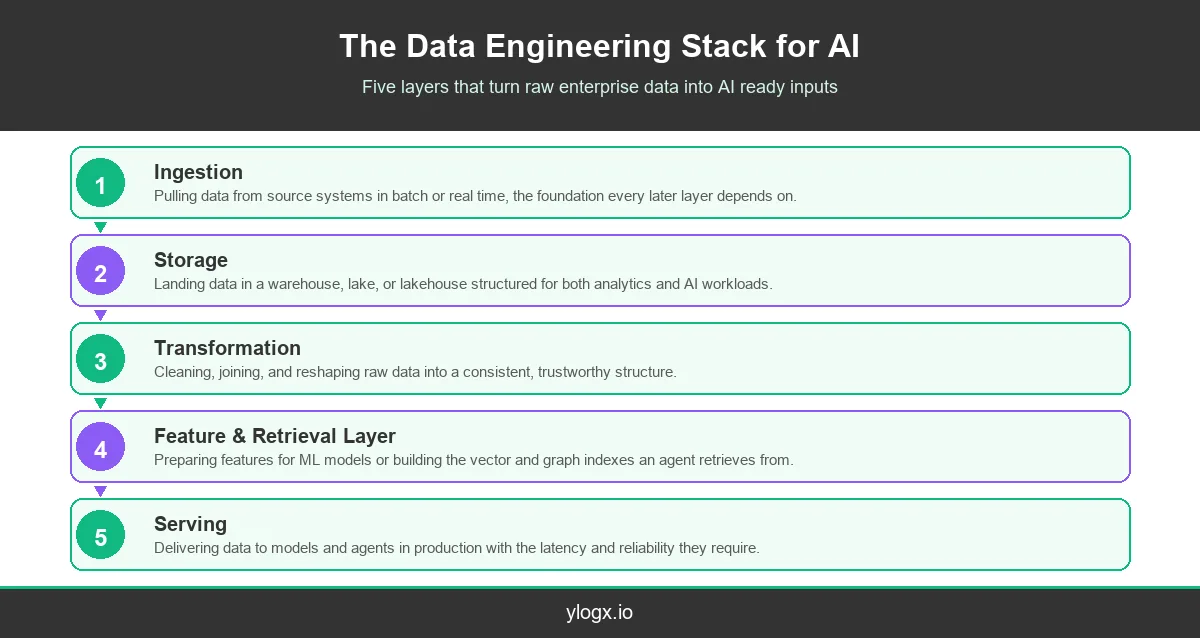
A production AI system depends on five connected layers of data engineering work, and a weakness in any one of them limits what the layers above it can reliably do.
Ingestion and Storage
Ingestion pulls data from source systems, whether internal applications, third party APIs, or operational databases, and is the foundation every later layer depends on. A gap or inconsistency introduced at ingestion propagates through the entire stack, which is why ingestion pipelines need the same reliability engineering discipline as any other production system, including monitoring for silent failures rather than only obvious ones. Storage then lands that data in a structure suited to both analytics and AI workloads, whether a traditional warehouse, a data lake, or a lakehouse architecture that combines properties of both. The right choice depends on the mix of structured and unstructured data an enterprise needs to support, and is covered in more depth below.
Architecture | Best Fit | Trade-off |
Data Warehouse | Structured, well defined data for analytics and reporting | Poor fit for unstructured content an AI system needs to retrieve from |
Data Lake | Large volumes of raw, unstructured, or semi structured data | Requires more transformation work before data is reliably usable |
Lakehouse | Enterprises needing both analytics and AI workloads on shared data | More complex to set up than a single purpose warehouse or lake |
Transformation and the Feature or Retrieval Layer
Transformation cleans, joins, and reshapes raw ingested data into a consistent, trustworthy structure, resolving the inconsistencies and duplicate records that are common across real enterprise systems. The layer above that diverges depending on the AI workload it serves. For predictive models, this means building well engineered features, structured, well documented input variables a model can learn from. For generative AI and agentic systems, this means building the vector and graph indexes a retrieval pipeline depends on, since an agent or a generative AI product is only as good as what it can retrieve from at inference time. This layer is also where most of the ongoing maintenance burden in an AI system lives. Unlike a one time model training run, retrieval indexes and feature pipelines need continuous updates as source data changes, which makes the operational discipline behind this layer as important as its initial build. Enterprises that treat this layer as a one time setup task, rather than an ongoing operational responsibility, consistently see retrieval quality degrade within months of launch as the underlying source data drifts out of sync with what was indexed at build time.
Batch vs Streaming: Choosing the Right Processing Model
The choice between batch and streaming processing shapes both the cost and the capability of the data infrastructure supporting an AI initiative, and getting this choice wrong in either direction creates real problems. Over engineering a streaming pipeline for a use case that only needed periodic batch updates adds unnecessary infrastructure cost and operational complexity. Under engineering with a batch pipeline for a use case that genuinely needs real time data, such as fraud detection or a live agentic AI system, limits what the AI system can actually accomplish regardless of how capable the model itself is.
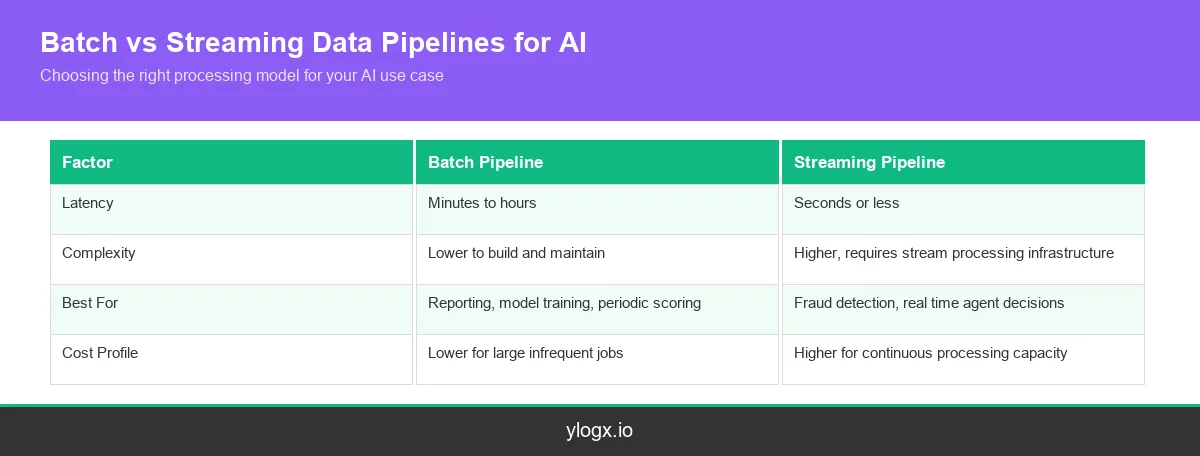
Batch pipelines process data on a scheduled interval, from every few minutes to once daily, and are the right default for reporting, model training, and any use case where a delay of minutes to hours between an event and its reflection in the data is acceptable. They are meaningfully cheaper to build and operate than streaming infrastructure. Streaming pipelines process data continuously as it arrives, supporting latency measured in seconds, and are necessary for use cases like fraud detection or a customer facing agent that needs to act on current information rather than data that may be hours old. Many production AI systems eventually adopt a hybrid approach, using streaming for the specific data that genuinely needs to be current and batch processing for everything else, rather than building streaming infrastructure across the entire pipeline by default.
A useful way to make this decision concretely is to ask what actually happens if a specific piece of data is an hour out of date. For a monthly sales forecasting model, an hour of staleness changes nothing about the model's usefulness, which points clearly to batch processing. For a fraud detection agent evaluating a transaction as it happens, an hour of staleness could mean the difference between catching fraud in progress and confirming it after the loss has already occurred, which just as clearly points to streaming. Running this test against each data source an AI system depends on, rather than applying one processing model uniformly across the entire pipeline, produces a more cost effective architecture than defaulting to streaming everywhere out of caution.
Data Engineering for Generative AI vs Predictive Models
Generative AI, predictive models, and agentic systems place meaningfully different demands on the underlying data engineering work, and treating them identically is a common source of underestimated scope.
Data Engineering for Generative AI
Generative AI systems depend heavily on the retrieval layer, since output quality is directly tied to what relevant, current, and accurate content the system can retrieve and ground its response in. This means data engineering work for generative AI focuses disproportionately on building and maintaining vector indexes, keeping them current as source content changes, and in more advanced implementations, maintaining a knowledge graph that supports relationship aware retrieval. Data freshness matters more here than in many predictive use cases, since a generative AI product grounded in stale content will produce confidently wrong answers. Chunking strategy, how source documents are broken into retrievable pieces, is another decision specific to this workload, and getting it wrong produces retrieval that is technically functioning but consistently returns fragments that lack the context needed to ground a genuinely useful response.
Data Engineering for Predictive Models
Predictive models depend more heavily on structured feature engineering and historical data depth, since model accuracy is often a direct function of how much clean historical data is available to train against. This work centers on building reliable, well documented feature pipelines, managing feature consistency between training and production environments, and maintaining the historical data depth needed to retrain models as patterns shift over time. The retrieval concerns central to generative AI are largely absent here, replaced by a different discipline focused on feature quality and training data governance.
A related but distinct requirement for predictive models is monitoring for data drift, changes in the statistical properties of incoming data relative to what a model was originally trained on. A predictive model can degrade silently as real world conditions shift, without any error or crash signaling the problem, which makes drift monitoring a data engineering responsibility as much as a data science one. This is a materially different operational concern than the retrieval freshness problem central to generative AI, which is exactly why the two workloads need to be scoped and staffed as related but distinct data engineering efforts rather than a single undifferentiated data workstream.
Data Governance and Quality as an AI Prerequisite
Data governance is not a separate initiative from data engineering for AI. It is a prerequisite woven through every layer of the stack. Without clear data lineage, an enterprise cannot explain to a regulator, an auditor, or its own leadership where a model's input data came from or how current it was, which becomes a serious problem the moment an AI system operates in a regulated context. This aligns with the traceability principles in the NIST AI Risk Management Framework, which treats data governance as inseparable from AI risk management rather than a separate compliance exercise. According to McKinsey's 2026 research on the state of AI trust, 51 percent of organizations have experienced at least one negative consequence from AI use, with data quality issues among the most common underlying causes.
Practically, this means every data source feeding an AI system should have a named owner, documented lineage back to its origin, and a defined quality standard the pipeline is measured against. Enterprises that build this governance discipline into their data engineering practice from the start, rather than retrofitting it once an AI system is already in production, consistently spend less time firefighting data quality incidents and more time expanding what their AI initiatives can actually do.
Data quality specifically deserves a concrete definition rather than being treated as a vague ideal. For most AI use cases, quality breaks down into completeness, whether required fields are actually populated, consistency, whether the same fact is represented the same way across systems, and timeliness, whether the data reflects current reality closely enough for the use case at hand. Measuring a data source against these three dimensions before it feeds an AI system turns an abstract governance conversation into a specific, testable checklist, and surfaces gaps while they are still cheap to fix rather than after they have already degraded a production system's output.
Signs Your Data Isn't AI Ready
A short set of warning signs reliably predicts that an AI initiative is underestimating its data engineering scope.
Warning Sign | What It Usually Means |
No single source of truth for a key entity | Data engineering work will be needed before reliable retrieval or features are possible |
Data quality has never been formally measured | Hidden inconsistencies will surface once an AI system depends on the data directly |
No documented data lineage | Explainability and governance requirements cannot currently be met |
Data updates are manual or irregular | Streaming or even reliable batch processing may require new infrastructure |
Multiple systems disagree on the same fact | A resolution and transformation layer is needed before this data is AI ready |
Recognizing two or more of these signs before committing to an AI project timeline allows an enterprise to scope the necessary data engineering work upfront, rather than discovering it midway through a stalled pilot. None of these signs individually rules out moving forward with an AI project. Together, they indicate how much of the project timeline should realistically be allocated to data engineering before model work can meaningfully begin, information that is far more useful discovered during initial scoping than during a stalled pilot review months into an engagement. For a closer look at how this plays out in a specific industry context, see data engineering services for scaling AI in manufacturing and logistics.
Further Reading
Data Engineering Services for Scaling AI in Manufacturing & Logistics: an industry specific look at data engineering for AI at scale.
Conclusion
Data engineering is the foundation every AI initiative, predictive, generative, or agentic, ultimately depends on, and it is consistently underestimated relative to its actual impact on whether an AI project reaches production. Map your data against the five layer stack above, choose batch or streaming deliberately rather than by default, and check your data against the readiness signals before committing to an AI project timeline. To scope data engineering work for your AI initiative, review our case studies or contact YlogX to talk through your requirements with our team.
Frequently Asked Questions
What is data engineering for AI?
The work of building reliable pipelines, storage, transformation, and retrieval infrastructure that supplies clean, accessible data to AI models and agents.
Why do AI projects fail without proper data engineering?
Models trained or grounded on inconsistent, poorly governed data produce unreliable results, regardless of how capable the underlying model is.
What is the difference between a data warehouse, data lake, and lakehouse?
A warehouse suits structured analytics, a lake handles unstructured data at scale, and a lakehouse combines both for AI and analytics workloads together.
Should I use batch or streaming data pipelines for AI?
Batch for reporting, training, and use cases tolerant of minutes to hours of delay. Streaming for fraud detection or live agentic systems needing real time data.
How does data engineering differ for generative AI versus predictive models?
Generative AI depends heavily on retrieval and vector indexing, while predictive models depend more on structured feature engineering and historical data depth.
What data governance is required for AI systems?
Named ownership, documented lineage, and a defined quality standard for every data source feeding an AI system, especially in regulated contexts.
How do I know if my data is ready for an AI project?
Check for a single source of truth, measured data quality, documented lineage, reliable updates, and consistency across systems for the same facts.
Does data engineering cost more for generative AI or predictive models?
It depends on the use case, but generative AI often requires ongoing investment in retrieval infrastructure that predictive models do not need.
Can solution accelerators reduce data engineering effort?
Yes, for common patterns. See our solution accelerators for pre built components that reduce custom pipeline development.
Where can I get help scoping data engineering for an AI project?
Visit our FAQ page for related questions, or contact our team to discuss your specific data engineering requirements.