Artificial Intelligence Services Beyond Pilot Projects
YlogX Team · 2026-05-14
Most enterprise AI projects never move beyond the pilot stage. The challenge is not the model. It is the lack of scalable infrastructure, governance, and…
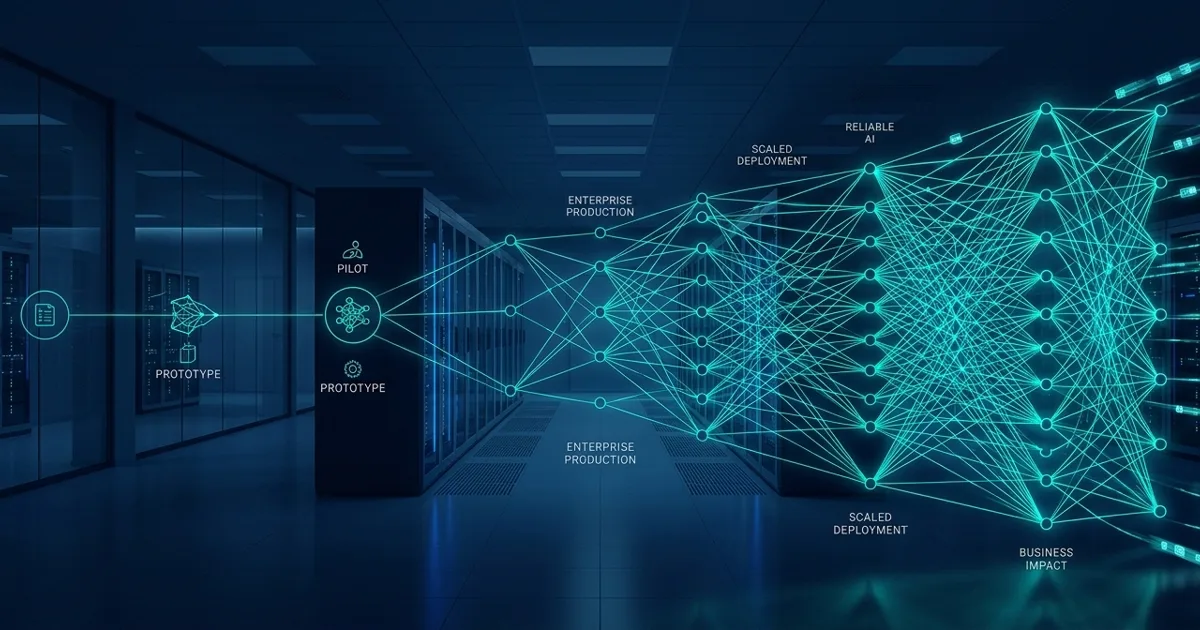
Artificial intelligence services have moved from buzzword to boardroom priority. Yet a striking number of enterprise AI initiatives never make it past the pilot stage. According to Gartner, a significant share of AI proofs-of-concept fail to reach production. The gap between a promising demo and a deployed, governed, value-generating AI system is wider than most organizations expect. This blog breaks down why AI pilots stall, what operational gaps hold enterprises back, and what it truly takes to scale AI solutions into the fabric of your business.
Key Takeaways
Artificial intelligence services are most valuable when they move from isolated pilots into integrated, production-grade systems that deliver measurable business outcomes.
The most common barriers to AI scaling are organizational, not technical. Poor data infrastructure, lack of governance, and misaligned strategy are the real obstacles.
Partnering with the right artificial intelligence consulting firm can bridge the gap between experimentation and enterprise-wide AI deployment.
Why Most AI Pilots Never Reach Production
A pilot project is designed to test feasibility, not to survive in a live enterprise environment. The conditions that make a pilot succeed, such as a focused dataset, a motivated team, and a narrow problem scope, rarely translate to the complexity of production. When the pilot ends, organizations are left with a working prototype and no clear path forward.
The root causes are consistent across industries. Data pipelines built for experimentation cannot handle production-grade volume or reliability. Model performance that looked strong in testing degrades when exposed to real-world variability. Security, compliance, and access control requirements that were deferred during the pilot suddenly become mandatory. The result is what researchers call the 'AI pilot purgatory': a cycle of testing without scaling.
For enterprises in sectors like healthcare, finance, and manufacturing, this stagnation has a real cost. Resources are spent on experiments that never generate returns. Organizational trust in AI erodes. And competitors who have figured out scaling gain a measurable advantage. Understanding why pilots fail is the first step toward building AI systems that last.
The Operational Gaps That Block AI Scaling
Scaling AI consulting engagements reveal a predictable set of operational gaps inside most enterprises. These are not failures of ambition. They are gaps in readiness that must be addressed before production deployment is realistic.
Data infrastructure fragmentation is the most common barrier. Enterprise data is often siloed across legacy systems, cloud platforms, and on-premise databases. A pilot can work around this with manual data pulls, but production AI requires clean, reliable, automated data pipelines. Without a modern data engineering foundation, models simply cannot be fed the inputs they need to perform.
Lack of MLOps and model governance is the second major gap. Deploying a model is not the same as maintaining one. Models drift over time as real-world data patterns shift. Without monitoring pipelines, retraining workflows, and version control, production AI systems become liabilities rather than assets. Enterprise AI service providers who understand MLOps are essential partners at this stage.
Organizational misalignment is the third and most overlooked gap. AI scaling requires cross-functional ownership. IT, data science, legal, compliance, and business units must all be aligned on goals, responsibilities, and risk tolerance. When these stakeholders operate in silos, enterprise AI initiatives stall in handoff, not because the technology failed, but because the organization was not ready to absorb it.
What Enterprise-Grade AI Deployment Actually Requires
Moving from pilot to production requires a fundamentally different mindset. It means designing for resilience, scalability, and governance from the start rather than retrofitting these properties after the fact.
Production-ready data pipelines: Automated, monitored, and reliable data flows that feed models with clean inputs at scale.
Model monitoring and retraining frameworks: Systems that detect model drift, trigger alerts, and support retraining cycles without manual intervention.
Security and compliance by design: Role-based access controls, audit logs, data encryption, and alignment with industry regulations built into the architecture.
API and system integration: AI outputs must be integrated into existing workflows, applications, and decision-making tools, not delivered as standalone dashboards.
Change management and adoption support: End users must understand, trust, and use AI-powered tools for the investment to generate returns.
This is where top AI consulting companies differentiate themselves. A firm that only builds models is not enough. The right AI-based consulting partner helps enterprises design the full system, from data architecture through deployment, integration, and ongoing governance. This is the difference between a demo and a genuine business transformation.
The Role of AI Strategy in Scaling Success
Scaling AI is not purely a technical problem. It is a strategic one. Enterprises that scale successfully share a common characteristic: they have a clear, documented AI implementation roadmap that connects initiatives to specific business outcomes.
This roadmap defines which use cases to prioritize, what data capabilities are required, how success will be measured, and who owns accountability for each workstream. Without this structure, AI scaling efforts become fragmented, with each team pursuing different tools, vendors, and objectives with no coherent integration.
An effective AI strategy also anticipates the governance requirements that come with production deployment. This includes explainability standards, bias monitoring, data lineage tracking, and model audit trails. Enterprises operating in regulated industries such as banking, healthcare, and insurance cannot afford to discover these requirements after deployment. They must be designed in from the beginning.
Working with an experienced artificial intelligence consulting firm during the strategy phase dramatically improves scaling outcomes. Strategic advisors bring cross-industry pattern recognition, technology neutrality, and the ability to stress-test roadmaps against real operational constraints. At YlogX, this advisory function is built into every engagement, from discovery and assessment through architecture and implementation.
Proven Strategies for Moving AI From Pilot to Production
Enterprises that successfully scale AI share a set of common practices. These are not theoretical. They are the operational habits that separate stalled pilots from production systems generating business value.
Start with a scaling plan, not just a pilot plan. Before launching any proof-of-concept, define what production success looks like. Identify the data, infrastructure, integration, and governance requirements that production will demand. Design the pilot to test not just model accuracy, but scaling readiness as well.
Invest in data engineering as a foundation. AI is only as strong as the data that feeds it. Enterprises that scale AI successfully treat data infrastructure as a prerequisite, not an afterthought. Clean, well-governed, accessible data reduces the time from pilot to production dramatically.
Build cross-functional AI ownership. Assign a dedicated AI product owner who sits at the intersection of business and technology. This person is responsible for translating business requirements into model specifications and for driving adoption across user groups.
Choose partners who operate across the full lifecycle. AI consulting services that cover strategy, architecture, engineering, and governance are far more effective than point solutions. End-to-end partners reduce handoff risk and ensure continuity from pilot through production. Explore the latest AI insights from the YlogX blog to understand how leading enterprises are approaching this journey.
Measure what matters in production. Pilot metrics such as accuracy, precision, and recall are necessary but not sufficient. Production AI must be measured against business KPIs: cost reduction, cycle time improvement, revenue impact, and customer satisfaction. Connecting AI performance to business outcomes builds the internal credibility that sustains long-term investment.
Conclusion
The gap between AI pilots and production-grade enterprise AI systems is real, but it is not insurmountable. Enterprises that close this gap do so through disciplined strategy, strong data foundations, cross-functional alignment, and the right advisory and implementation partners. The organizations winning with AI today are not those with the most pilots. They are those who have learned to scale. If your enterprise is ready to move beyond experimentation and build AI systems that deliver lasting value, connect with the YlogX team to explore how we can support your AI scaling journey from strategy through production deployment.
FAQs
1: Why do so many AI pilot projects fail to reach production?
Most AI pilots fail due to fragile data pipelines, lack of governance frameworks, and organizational silos. They are built for demonstration conditions, not production resilience. Addressing these gaps before a pilot launches dramatically improves the chance of successful enterprise AI deployment.
2: What is AI pilot purgatory and how can enterprises avoid it?
AI pilot purgatory describes the cycle where organizations continuously test AI without scaling it. Enterprises avoid this by defining production requirements upfront, assigning cross-functional ownership, and selecting AI consulting partners who support the full deployment lifecycle, not just model development.
3: What does enterprise-grade AI deployment require beyond model building?
Enterprise-grade AI requires production-ready data pipelines, model monitoring, MLOps workflows, security and compliance by design, and integration with existing business systems. Model accuracy alone is not enough. The right AI-based consulting firms help enterprises design the complete system architecture needed for sustainable production AI.
4: How do top AI consulting companies differ from basic model vendors?
Top AI consulting companies cover strategy, architecture, data engineering, deployment, and governance as a connected lifecycle. Basic model vendors deliver trained models without addressing integration, monitoring, or change management. End-to-end partners reduce handoff risk and ensure AI systems generate lasting business value after go-live.
5: What role does data infrastructure play in AI scaling?
Data infrastructure is the foundation of scalable AI. Without automated, reliable, and governed data pipelines, production models cannot maintain performance. Enterprises that explore YlogX team expertise in data engineering scale significantly faster than those who treat data readiness as an afterthought during pilot phases.
6: What is MLOps and why is it critical for production AI?
MLOps combines machine learning with DevOps practices to automate model deployment, monitoring, and retraining. Without MLOps, production models drift silently as real-world data patterns change. Implementing MLOps workflows is essential for any enterprise that wants AI systems to remain accurate, reliable, and governable over time.
7: How should enterprises measure AI success in production environments?
Production AI should be measured against business KPIs such as cost reduction, cycle time, revenue impact, and customer satisfaction rather than technical metrics alone. Connecting model performance to business outcomes builds internal credibility and justifies continued investment in scaling enterprise AI systems across the organization.
8: What industries benefit most from scaling AI beyond pilot projects?
Healthcare, finance, manufacturing, and logistics see the highest returns from scaled AI because they have high-volume, data-rich processes where automation and prediction drive significant efficiency gains. Enterprises in these sectors can identify the highest-value use cases by reviewing AI deployment case studies and insights.
9: How long does it typically take to move an AI pilot to production?
The timeline varies based on data readiness, integration complexity, and governance requirements. A well-scoped AI initiative with clean data and a defined roadmap can reach production in three to six months. Poorly prepared enterprises often spend a year or more in repeated pilot cycles without scaling successfully.
10: How can YLOGX help enterprises scale AI beyond the pilot stage?
YlogX provides end-to-end AI consulting capabilities covering strategy, architecture, data engineering, and production deployment. The team supports enterprises from discovery through implementation, ensuring AI systems are built for scale, integration, and governance from the outset. Reach out through the YlogX contact page to start a conversation.