AI Consulting Pricing: What Enterprises Should Budget For
YlogX Team · 2026-08-14
A practical guide to AI consulting pricing and engagement models, what drives cost, and how to budget your first enterprise AI initiative.

AI Consulting Pricing: What Enterprises Should Budget For
AI consulting pricing is rarely a single number, and enterprises that ask for one upfront usually get an answer that does not survive the first change in scope. This guide breaks down the three engagement models most AI consulting services are sold under, what actually drives cost inside each one, and how to budget realistically for a first engagement without overcommitting before you have proof the investment will pay off.
Key Takeaways
AI consulting pricing is structured around three common models: fixed scope pilots, phased roadmap retainers, and managed AI operations.
Cost is driven less by the AI model itself and more by data readiness, integration complexity, and governance requirements.
Budgeting for a first engagement should fund a fixed scope pilot, not a full enterprise rollout, until value is proven.
Why AI Consulting Pricing Varies So Much
Two enterprises asking for a fraud detection model can receive wildly different quotes, and both can be reasonable. Pricing depends on how much of the work is genuinely new versus how much can reuse existing, proven components. An enterprise with clean, accessible data and a defined success metric pays for model development and integration. An enterprise with fragmented data spread across legacy systems pays for data engineering work first, before a model can be built at all. Neither quote is wrong. They are pricing different amounts of underlying work, and the gap only becomes visible once a partner has actually looked at your data and systems rather than pricing from a generic template.
Pricing structure also reflects who is carrying the risk. A fixed price quote means the consulting partner absorbs the cost of unexpected complexity discovered mid project, which is why serious partners spend real time on discovery before quoting a fixed number rather than pricing from a short call. A time and materials or retainer structure shifts more of that risk to the enterprise, but usually comes with a lower headline number and more flexibility if scope needs to change. Neither structure is inherently better. The right choice depends on how well defined your use case already is before the engagement starts, and how much appetite your organization has for scope changing mid engagement versus paying a premium for price certainty.
The Three Common AI Consulting Engagement Models
Most AI consulting work is sold under one of three structures, and each fits a different stage of an enterprise's AI maturity.
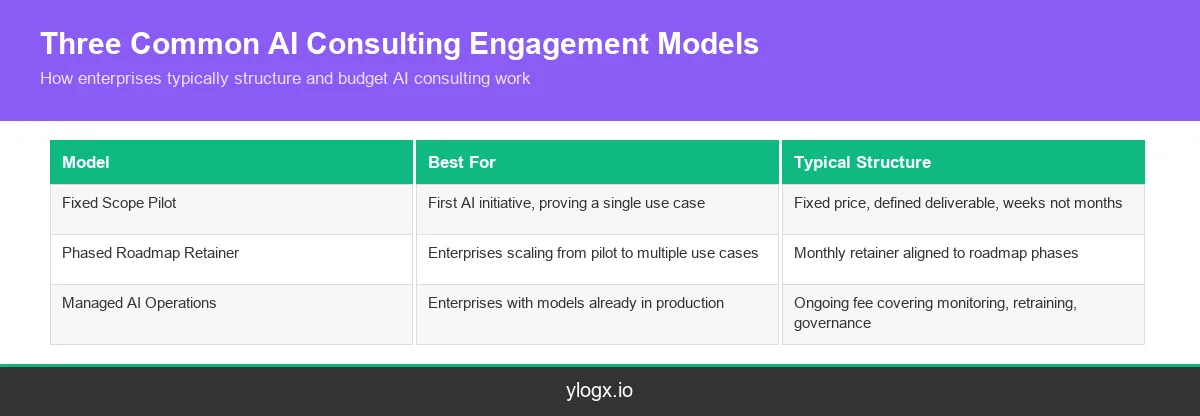
AI consulting engagement models
A fixed scope pilot is priced against a single, well defined deliverable, typically a working proof of concept validated on real data within a matter of weeks. A phased roadmap retainer is priced monthly and aligned to a multi use case roadmap, common once an enterprise has proven one use case and wants to scale to several more without renegotiating a contract for each one. Managed AI operations is priced as an ongoing fee once models are already in production, covering monitoring, retraining, and the governance work described in our guide to AI consulting services. Most enterprises move through all three models over time rather than choosing one permanently.
It is worth noting what each model deliberately does not include. A fixed scope pilot does not include ongoing monitoring once the proof of concept is validated, since that work only makes sense once a decision to scale has been made. A phased roadmap retainer does not usually include the deep operational support needed once several models are simultaneously live in production, which is what managed AI operations pricing is built for. Reading a quote closely enough to see what has been left out is as important as understanding what has been included, particularly around the transition points between models covered in why AI consulting fails moving from pilot to production.
What Drives Cost Within Each Model
Inside any of the three models, four variables move price more than anything else. Data readiness is the biggest one. A model built on clean, accessible, well documented data costs a fraction of one built on data that first needs to be extracted, cleaned, and piped through new data engineering infrastructure. Integration complexity is the second, since a model that has to connect into several existing enterprise systems takes materially longer to ship than a standalone tool. Governance and compliance requirements are the third, particularly in regulated industries where every decision needs to be explainable and auditable. Scale is the fourth: a model serving a single team costs less to build and run than one serving an entire organization across multiple geographies. A credible partner will walk through all four with you before quoting a number, not just after.
Cost Driver | Lower Cost Scenario | Higher Cost Scenario |
Data Readiness | Clean, accessible, well documented data | Fragmented data across legacy systems |
Integration Complexity | Standalone tool with minimal dependencies | Deep integration with multiple core systems |
Governance & Compliance | Internal, low risk use case | Regulated industry, auditable decisions required |
Scale | Single team or department | Organization wide, multi geography rollout |
Budgeting for a First AI Consulting Engagement
The most common budgeting mistake is sizing a first engagement as if it were a full enterprise rollout. A first engagement should fund a fixed scope pilot against one well chosen use case, with a clear metric for success agreed before work starts. This keeps early risk contained while still producing a concrete, evaluable result. According to McKinsey's 2026 research on enterprise AI, only about 6 percent of organizations qualify as AI high performers who capture significant measured value, and that group is disproportionately made up of enterprises who scaled deliberately from a proven pilot rather than committing a large budget upfront. Once a pilot proves out, moving budget to a phased roadmap retainer is a far easier internal conversation than asking for a large sum before any result exists. Solution accelerators can also reduce first engagement cost by reusing proven components instead of building every layer from scratch.
Underfunding a first engagement carries its own risk. A budget too small to cover a properly scoped discovery phase often results in a pilot built on assumptions rather than validated data, which produces exactly the kind of stalled result described in solution accelerators and why top AI consulting companies are replacing custom builds. The goal is not the smallest possible budget. It is the smallest budget that still funds a properly scoped, properly measured pilot capable of producing a real answer about whether to scale further.
Questions to Ask Before You Sign
Before agreeing to any AI consulting pricing structure, ask what happens if the data turns out to be less ready than assumed, since this is the single most common source of budget overruns. Ask whether governance and monitoring are included in the quoted price or billed separately once the pilot succeeds, since that is often where hidden ongoing cost appears. Ask how the pricing model changes as you move from a pilot to a wider rollout, and get that scaling structure in writing rather than negotiating it from scratch later. Frameworks like Gartner's AI TRiSM model are a useful reference point here, since governance maturity is increasingly priced into serious AI consulting engagements rather than treated as optional scope.
Finally, ask for the quote in writing broken down by phase rather than as a single lump sum. A partner willing to itemize discovery, pilot development, integration, and governance separately is giving you a real basis for comparison against other quotes. A single number with no breakdown makes it impossible to tell whether two competing proposals are actually pricing the same scope of work, which is the single easiest way an enterprise ends up comparing two fundamentally different engagements as if they were interchangeable.
Conclusion
AI consulting pricing reflects real variation in data readiness, integration complexity, and governance requirements, not arbitrary vendor markup. Budget a first engagement as a fixed scope pilot, ask the four cost driver questions above before you sign, and treat scaling pricing as something to negotiate upfront rather than after a pilot succeeds. To scope a budget for your specific use case, contact YlogX for a discovery conversation.
Frequently Asked Questions
How much does AI consulting cost for a first pilot?
A fixed scope pilot typically costs a fraction of a full rollout, since it targets one use case over a matter of weeks rather than an enterprise wide deployment.
What is the difference between a fixed scope pilot and a retainer?
A fixed scope pilot prices one defined deliverable. A retainer is a recurring monthly fee aligned to a phased roadmap covering multiple use cases over time.
Does AI consulting pricing include data engineering work?
It depends on the quote. Always confirm whether data pipeline work is included or billed separately, since this is the most common source of unexpected cost.
Is governance included in AI consulting pricing?
Not always by default. Ask specifically whether monitoring, retraining, and governance are part of the quoted price or a separate ongoing fee.
How does pricing change as an AI initiative scales?
Most enterprises move from a fixed scope pilot to a phased roadmap retainer and eventually managed AI operations as more use cases and models go live.
What is the biggest hidden cost in AI consulting engagements?
Underestimated data readiness. Fragmented or poorly documented data usually requires engineering work that was not priced into the original quote.
Should a first AI consulting engagement be a full rollout?
No. A first engagement should fund a single fixed scope pilot to prove value before committing budget to a wider enterprise rollout.
Can solution accelerators reduce AI consulting costs?
Yes. Pre-built accelerators reduce the amount of custom development required, which can meaningfully lower the cost of a first pilot. See our solutions.
How do I compare pricing between AI consulting partners?
Compare what is included, not just the headline number. Confirm governance, data engineering, and scaling terms are priced consistently across quotes.
Where can I get a budget estimate for my use case?
Visit our FAQ page for general engagement questions, or contact our team directly for a discovery conversation scoped to your use case.