AI Chatbot Development Services: Designing Enterprise-Grade Systems
YlogX Team · 2026-06-05
AI Chatbot Development Services help enterprises build intelligent conversational AI systems that integrate workflows, automate operations, improve…
AI Chatbot Development Services: Why Enterprise Conversational AI Demands More Than a Bot
AI chatbot development services are reshaping how enterprises manage operations, customer experience, and employee productivity. Yet despite growing investment, most chatbot deployments fall short of their goals. The problem is rarely the technology itself. It is the absence of enterprise architecture, workflow integration, and governance strategy. This article breaks down what separates a basic chatbot from an enterprise-grade conversational AI system and what it actually takes to build one that delivers measurable business value.
Key Takeaways
AI chatbot development services go far beyond deploying a support widget. They require strategic planning, enterprise architecture, LLM integration, and workflow orchestration.
Generative AI for business enables intelligent, context-aware conversational systems that automate complex workflows and improve operational efficiency.
Choosing the right AI development company with enterprise experience and integration maturity is critical to long-term success.
What Are AI Chatbot Development Services?
At their core, AI chatbot development services cover the full lifecycle of designing, building, integrating, and optimizing conversational AI systems for enterprise use. This goes well beyond scripting responses to frequently asked questions.
Enterprise-grade services include building virtual agents, AI-powered employee helpdesk systems, workflow automation bots, and generative AI assistants that can reason, retrieve knowledge, and execute multi-step processes. The goal is not to replace human workers with a chatbot. The goal is to create an intelligent operational layer that reduces manual effort, speeds up decision-making, and connects enterprise knowledge to the people who need it.
The distinction between a simple bot and an enterprise conversational system is significant. A rule-based bot follows a fixed script. An enterprise AI assistant powered by generative AI for business understands context, accesses real-time data, adapts to complex queries, and integrates with the workflows that run your organization. You can explore how YLogX approaches enterprise AI solutions to understand the depth of capability required for these systems.
Why Traditional Chatbots Fail in Enterprise Environments
Understanding failure patterns is essential before committing to any conversational AI initiative. Most chatbot projects underdeliver not because AI is immature but because deployment lacks the foundations that enterprise systems require.
Common Reasons Enterprise Chatbot Projects Fail
Limited contextual understanding: Rule-based bots cannot handle nuanced or multi-turn conversations. They break down when users deviate from a scripted path.
Disconnected systems: Chatbots that cannot access CRM, ERP, HRMS, or knowledge bases are unable to provide meaningful, actionable responses.
Poor scalability: Systems designed for a single department often collapse under enterprise-wide usage demands.
Inaccurate responses: Without grounding in verified enterprise data, generative AI systems can produce hallucinated or misleading outputs.
Governance gaps: No monitoring, audit trails, or escalation protocols means no accountability and no improvement over time.
Weak user adoption: If the assistant does not understand how employees or customers actually communicate, it will be abandoned quickly.
These are structural problems, not cosmetic ones. Fixing them requires rethinking the entire approach to AI chatbot development services from the ground up.
Designing Enterprise-Grade AI Conversational Systems
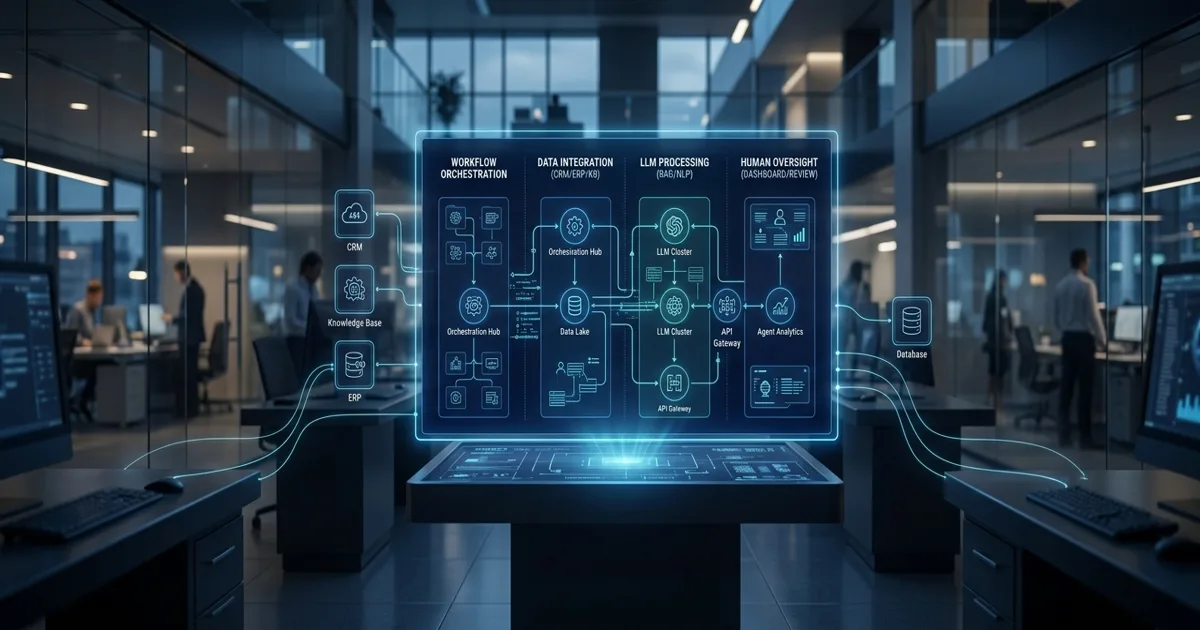
Building an enterprise conversational AI system is an architectural discipline. It requires decisions across technology, data, security, and business process layers that all work in concert.
Step 1: Business Use-Case Identification
Before any model is selected or any interface is designed, the use case must be defined with precision. Which workflows are being automated? Who are the end users? What are the success metrics? Vague objectives produce vague systems. The highest-value enterprise use cases include employee onboarding automation, IT helpdesk resolution, procurement support, customer service triage, and internal knowledge retrieval.
Step 2: Conversational Workflow Design
An enterprise AI assistant must mirror how work actually happens. This means mapping real workflows, identifying decision points, and designing conversation flows that align with operational logic rather than theoretical user journeys. Workflow design determines whether the system feels natural or frustrating to users.
Step 3: Enterprise Data Integration
A conversational system is only as useful as the data it can access. This means integrating securely with structured databases, document repositories, ticketing systems, and APIs. Retrieval-Augmented Generation (RAG) architectures are commonly used to ground AI responses in verified enterprise content, significantly reducing the risk of inaccurate outputs. According to research from Gartner, poor data quality is among the top reasons enterprise AI deployments miss their objectives.
Step 4: LLM and AI Model Selection
Selecting the right large language model is not a one-size-fits-all decision. Enterprise requirements around data residency, latency, cost, and domain specificity all influence whether a cloud-hosted LLM, a fine-tuned model, or an on-premises deployment is the appropriate choice. Model selection must be treated as a business and compliance decision, not purely a technical one.
Step 5: Security, Compliance, and Human Oversight
Enterprise conversational AI must operate within strict security boundaries. This includes role-based access controls, data encryption, audit logging, and compliance with regulations such as GDPR or sector-specific standards. Human-in-the-loop oversight ensures that high-stakes decisions are escalated appropriately and that the system remains accountable. Building governance into the system from the start is far less costly than retrofitting it later.
Enterprise Automation Through Conversational AI
Enterprise automation is one of the most compelling outcomes of well-designed conversational AI. When integrated properly, these systems can handle significant operational volume without proportional increases in headcount or infrastructure.
High-impact enterprise use cases include:
Customer support automation: Resolving tier-one queries, processing returns, and routing complex cases without human intervention.
Employee helpdesk systems: Answering IT, HR, and policy queries instantly, reducing service desk load by a substantial margin.
HR assistants: Supporting onboarding, leave management, benefits queries, and performance review scheduling.
Sales enablement assistants: Providing sales teams with instant access to product data, competitive intelligence, and proposal templates.
Enterprise knowledge search: Replacing static intranet pages with dynamic, conversational access to organizational knowledge.
Operations support: Automating status checks, escalation workflows, and cross-department coordination tasks.
These are not theoretical possibilities. They represent live operational improvements available to any enterprise that invests in building the system correctly. YLogX enterprise AI and automation services are designed precisely to help organizations move from pilot concepts to production systems at scale.
Generative AI for Business: The Shift Toward Intelligent Assistants
Generative AI for business represents a fundamental shift in what enterprise software can do. Earlier automation tools followed rigid rules. Generative AI systems understand intent, generate contextual responses, synthesize knowledge, and adapt to novel situations.
The emergence of AI copilots and autonomous conversational workflows means that enterprises can now build systems that do not just answer questions but actively participate in business processes. A sales copilot can draft a proposal. A logistics assistant can identify a supply chain risk and suggest mitigation steps. An HR assistant can identify a compliance gap and escalate it for review.
This shift requires more than deploying a capable model. It requires aligning AI behavior with business intent, which is precisely where generative AI consulting services add measurable value. Consultants with deep enterprise experience help organizations define AI governance policies, select appropriate model architectures, and design feedback loops that improve system performance over time. Explore YLogX insights on generative AI consulting for enterprise transformation to understand how strategic advisory accelerates outcomes.
Key Features of Scalable AI Conversational Systems
A production-grade enterprise conversational AI system requires a specific set of technical and operational capabilities. These are not optional enhancements. They are baseline requirements for any system expected to operate reliably at enterprise scale.
Contextual memory: The ability to maintain conversation history across sessions for continuity and personalization.
Multilingual support: Critical for enterprises operating across geographies or serving diverse customer populations.
API and system integrations: Seamless connections to CRM, ERP, HRMS, ticketing, and other enterprise platforms.
Analytics dashboards: Real-time visibility into query volume, resolution rates, escalation patterns, and user satisfaction.
Role-based access controls: Ensuring users only access information and capabilities appropriate to their role and clearance level.
Enterprise security: End-to-end encryption, audit trails, and compliance controls embedded at the infrastructure level.
Workflow automation capability: The ability to trigger actions, update records, and orchestrate multi-system processes from a conversational interface.
How Generative AI Consulting Services Improve Chatbot Success
Generative AI consulting services are not a luxury for enterprise AI projects. They are a risk management tool. The gap between a proof-of-concept and a production system that delivers business value is significant, and most organizations underestimate it.
Experienced consultants help enterprises reduce implementation risk by aligning AI capabilities with real operational workflows before a single line of code is written. They assess existing data infrastructure, identify integration dependencies, define governance frameworks, and establish the success metrics that will determine whether the investment is justified.
According to McKinsey research on AI adoption, organizations that invest in strategic AI planning and governance are significantly more likely to achieve scale and sustain value from their AI initiatives compared to those that treat deployment as a purely technical exercise.
How to Choose the Right AI Development Company
Selecting an AI development company for an enterprise conversational AI project requires evaluating more than technical capability. The right partner brings enterprise architecture experience, integration maturity, security knowledge, and a commitment to long-term optimization.
When evaluating potential partners, consider the following criteria:
Enterprise architecture expertise: Can they design systems that integrate with your existing technology stack?
Security maturity: Do they follow established protocols for data handling, access control, and compliance?
Integration capability: Have they built enterprise-grade integrations with the platforms your organization uses?
Scalability planning: Do they build systems that can grow with your organization rather than requiring a full rebuild at the next stage?
Long-term optimization services: AI systems require continuous monitoring and improvement. A partner that disappears after launch is a liability.
As an AI solutions company focused on enterprise transformation, YLogX combines strategic consulting, architecture design, and implementation capability to support organizations across the full AI development lifecycle. Connect with the YLogX team to discuss your enterprise conversational AI requirements.
The Future of Enterprise Conversational AI
The trajectory of enterprise conversational AI points toward increasingly autonomous and integrated systems. AI agents that can plan, act, and iterate across multi-step processes are moving from research to production environments. Voice-enabled enterprise systems are expanding conversational AI beyond text-based interfaces into operations centers, field services, and accessibility-focused applications.
The concept of an AI orchestration layer is gaining traction in enterprise architecture discussions. Rather than a single chatbot handling queries, organizations are beginning to deploy networks of specialized AI agents coordinated by an orchestration system that routes tasks, manages context, and ensures accountability across the entire operation.
These developments mean that the decisions enterprises make today about architecture, governance, and vendor selection will determine their competitive positioning for the next decade.
Conclusion
AI chatbot development services represent one of the most significant levers available to enterprise leaders seeking operational transformation. But the value is only realized when conversational AI is treated as a serious architectural and strategic investment rather than a quick deployment. From workflow design to LLM selection, from data integration to governance, every dimension of the system matters. If your organization is ready to move beyond basic automation and build intelligent systems that drive measurable outcomes, the foundation starts with the right strategy, the right architecture, and the right partner.
FAQs
1: What exactly do AI chatbot development services include for enterprise clients?
AI chatbot development services for enterprises include use-case discovery, conversational workflow design, LLM integration, enterprise data connectivity, security planning, and post-launch optimization. They cover the full lifecycle from strategy to production deployment, ensuring the system aligns with real operational goals rather than just answering FAQs.
2: How is an enterprise conversational AI system different from a standard chatbot?
A standard chatbot follows fixed scripts and handles simple queries. An enterprise conversational AI system integrates with business workflows, accesses live data, understands complex intent, maintains contextual memory across sessions, and can execute multi-step processes autonomously. The architectural complexity and operational integration are fundamentally different.
3: Why do so many enterprise chatbot projects fail to deliver value?
Most failures trace back to disconnected systems, poor data integration, lack of governance, and no alignment with real workflows. When a chatbot cannot access relevant enterprise data or escalate appropriately, it produces unreliable responses. Strategic planning and architecture discipline are the most effective prevention measures.
4: What role does generative AI play in enterprise chatbot development?
Generative AI for business enables enterprise assistants to understand nuanced queries, generate contextual responses, synthesize knowledge from multiple sources, and adapt to novel situations. Unlike rule-based systems, generative AI models handle ambiguity and complexity, making them far more effective for enterprise-scale operational use cases.
5: How do generative AI consulting services reduce implementation risk?
Experienced generative AI consulting services help enterprises define governance frameworks, assess data readiness, select appropriate model architectures, and align AI capabilities with specific business workflows. This front-loaded strategic work significantly reduces the risk of costly rework and ensures the system delivers measurable value at production scale.
6: What industries benefit most from enterprise AI chatbot development?
Industries with high query volumes, complex knowledge bases, and distributed workforces see the strongest returns. These include finance, healthcare, manufacturing, HR, and customer-facing retail operations. Each industry brings unique compliance and integration requirements that are best addressed by reviewing YLogX enterprise AI case studies to understand how these challenges have been solved in real deployments.
7: What is Retrieval-Augmented Generation and why does it matter for enterprise AI?
Retrieval-Augmented Generation (RAG) is an architecture that grounds AI responses in verified enterprise documents and databases rather than relying solely on model training data. This dramatically reduces hallucinations and improves accuracy, making it a critical design pattern for any enterprise conversational AI system handling sensitive or compliance-relevant information.
8: How should enterprises evaluate an AI development company for conversational AI projects?
Enterprises should assess the partner's experience with enterprise architecture, security protocols, integration capability with existing platforms, and approach to long-term system optimization. A credible AI development company will ask detailed questions about your workflows and data environment before proposing any solution, not after.
9: What does human-in-the-loop oversight mean in enterprise conversational AI?
Human-in-the-loop oversight means the AI system escalates uncertain, high-stakes, or sensitive interactions to a human agent rather than responding autonomously. It also involves humans reviewing AI outputs to identify errors and improve the model over time, which is a core governance requirement that the YLogX frequently asked questions on responsible AI governance address in greater detail.
10: What are the most important features of a scalable enterprise conversational AI system?
Scalable systems require contextual memory, multilingual support, secure API integrations, role-based access controls, real-time analytics, audit logging, and workflow automation capability. These are not optional enhancements. They are the foundational capabilities that separate a production-grade enterprise system from a limited pilot deployment that cannot survive real operational demands.