AI and Digital Transformation for Operational Scale
YlogX Team · 2026-05-18
AI and digital transformation are reshaping how enterprises scale operations, improve efficiency, and make faster decisions. This blog explores practical…
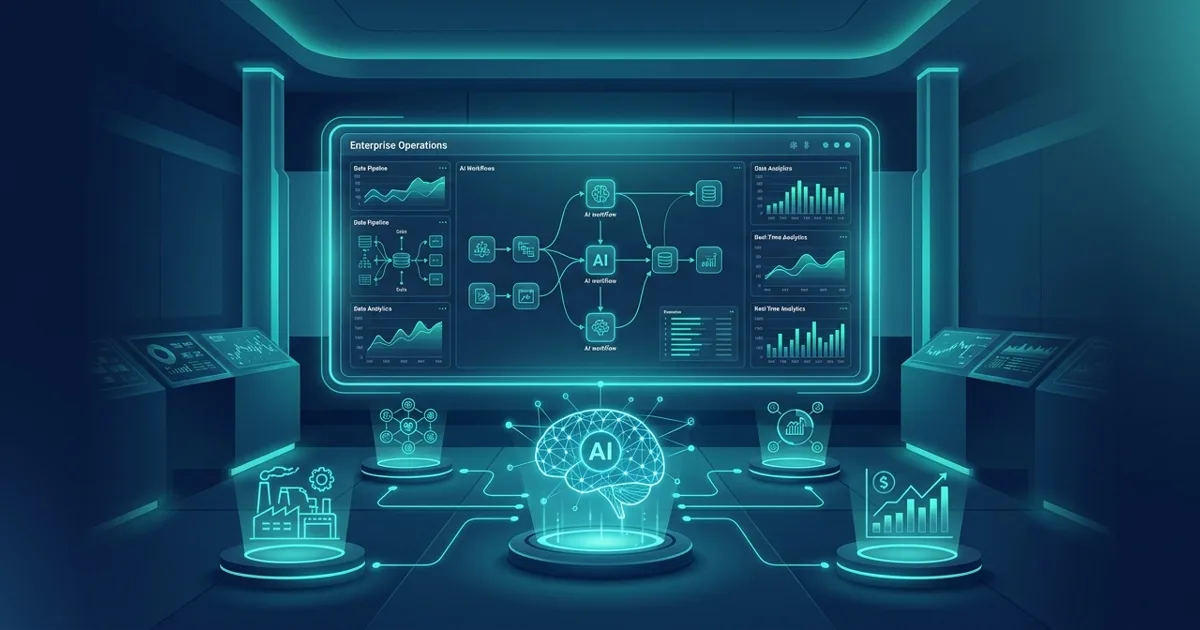
AI and digital transformation are no longer optional strategies for enterprises. They are fundamental to surviving and scaling in a competitive market. As organizations face growing operational complexity, embedding AI into core business workflows creates measurable efficiency gains and builds a foundation for sustainable growth. This blog explores how businesses can integrate AI-driven transformation effectively, covering practical frameworks, industry applications, and the operational strategies that matter most for decision-makers ready to scale.
Key Takeaways
AI and digital transformation work best when embedded into existing business workflows rather than treated as standalone initiatives, and scalable adoption requires structured frameworks that align technology with business goals.
Organizations partnering with the right AI and data services provider can accelerate transformation timelines, reduce implementation risk, and achieve consistent efficiency improvements across industries.
Measuring outcomes through focused operational metrics ensures that AI investments deliver ongoing returns and build internal support for expanding transformation across additional departments.
Why AI and Digital Transformation Must Work Together for Lasting Impact
Digital transformation alone delivers limited value without intelligence. Migrating systems to the cloud or digitizing paper-based workflows improves speed, but it does not create insight. When AI and digital transformation are integrated together, businesses gain the ability to not only digitize operations but also to optimize them continuously through data-driven decisions.
According to McKinsey Global Institute, companies that combine digital transformation with AI adoption are significantly more likely to report revenue growth compared to those pursuing digital initiatives alone. The combination enables organizations to move from reactive operations to proactive, predictive models that respond to change before it becomes a problem.
For enterprises evaluating their next growth phase, this integration is the strategic difference between incremental improvement and genuine operational scale. Leaders who treat AI as a layer of intelligence applied on top of digitized systems rather than a separate initiative consistently achieve faster, more durable results.
Building an AI-Ready Framework for Scalable Business Operations
Scaling with AI starts with a framework, not a tool. Many organizations make the mistake of purchasing AI software before establishing the data infrastructure and business alignment needed to make it work. A structured approach ensures that AI investments deliver value across the entire organization rather than in isolated pockets.
A practical AI-readiness framework includes four layers. The first is data infrastructure, which involves building clean, connected data pipelines that feed AI models with reliable inputs. Without high-quality data flowing consistently into AI systems, even the most sophisticated models will produce unreliable outputs. Organizations that invest in this foundation first consistently outperform those that skip it.
The second layer is business alignment, which means mapping AI capabilities directly to operational pain points and growth objectives. This step requires collaboration between technical teams and business leaders to ensure that AI initiatives solve real problems rather than demonstrate technical capability for its own sake. When this alignment is achieved, AI investments generate returns that are both measurable and meaningful to the organization.
The third layer is governance, which ensures responsible AI use through access controls, data quality checks, and model monitoring. As AI systems make more operational decisions, governance becomes a strategic asset rather than a compliance burden. Organizations with mature AI governance frameworks experience fewer production failures and build greater internal trust in AI-generated insights.
The fourth layer is iteration, which involves running quick proof-of-concept builds to validate solutions before full deployment. This approach reduces the risk of large-scale investment in approaches that may not work for a specific organizational context. Iterative development also builds internal capability, as teams learn through practical experimentation rather than purely theoretical training.
Organizations working with a dedicated data engineering and AI services team can accelerate the first layer significantly by outsourcing pipeline construction and cloud data architecture to specialists who have already solved these problems across multiple industries.
Real-World Applications of AI and Digital Transformation Across Industries
The most compelling evidence for AI and digital transformation comes from applied industry use cases. Across sectors, AI-powered workflows are replacing manual bottlenecks and creating systems that improve with use.
AI in Manufacturing and Automotive Operations
In manufacturing, AI-powered computer vision systems inspect products at speeds no human team can match. Predictive maintenance models analyze sensor data to flag equipment failures before they cause downtime. Automotive companies are applying similar logic to quality control and supply chain forecasting. These applications reduce waste, improve throughput, and lower operational costs at scale. Specialized solutions for this space help manufacturers achieve consistent quality across high-volume production environments, delivering ROI that justifies the investment in months rather than years.
AI in Finance and Healthcare Decision-Making
In finance, AI models process transaction data in real time to detect fraud, assess credit risk, and automate compliance reporting. Healthcare organizations use predictive analytics to forecast patient demand, optimize staffing, and personalize treatment recommendations. Both industries require high data integrity and regulatory compliance, making structured data analytics consulting a critical enabler for organizations that want to scale AI responsibly. Firms in this space are helping mid-size enterprises access these capabilities without building internal teams from scratch, making advanced AI accessible beyond the largest global institutions.
AI in HR and Marketing Workflows
Human resources teams use AI to screen resumes, predict employee turnover, and personalize onboarding experiences. Marketing teams apply machine learning to segment audiences, optimize ad spend, and automate content personalization at scale. These workflows reduce manual effort and allow teams to focus on strategy rather than execution. Even mid-size organizations can implement these workflows cost-effectively with the right guidance and a clear roadmap that prioritizes high-impact use cases in the first phase of deployment.
How Machine Learning Consulting Accelerates AI and Digital Transformation
One of the most important decisions an enterprise makes during digital transformation is choosing between building internal AI capability or partnering with an external specialist. For most organizations, a hybrid model works best. Internal teams own the strategy and business context, while external consultants deliver the technical depth needed for implementation.
Specialized machine learning consulting firms bring pre-built frameworks, domain expertise, and implementation experience that reduces the time from concept to deployment. They also bring knowledge of failure patterns, helping organizations avoid costly mistakes in model selection, data preparation, and production deployment. This accumulated knowledge from working across industries is difficult and expensive to develop internally and represents significant value when accessed through a consulting partnership.
Working with an experienced AI consultancy provides access to talent and frameworks that would take years to develop internally. Reaching out to a specialized AI partner early in the transformation journey can compress timelines significantly and help organizations avoid the most common implementation pitfalls that slow progress and erode executive confidence in AI investments.
Generative AI as a Scalability Multiplier
Generative AI represents the next frontier in operational scaling. Beyond traditional machine learning models that classify, predict, or detect, generative AI creates content, code, responses, and workflows autonomously. This expands the surface area for automation dramatically and opens new possibilities for organizations that have already established a foundation of traditional AI and data infrastructure.
Enterprises are already deploying generative AI for customer support automation, document summarization, code generation, and internal knowledge management. Each application reduces human effort on repeatable cognitive tasks, freeing skilled employees to focus on higher-value work. According to Gartner, generative AI is projected to augment 40% of infrastructure and operations roles by 2026, making early adoption a competitive advantage that compounds over time.
For businesses evaluating their AI roadmap, generative AI consulting and implementation should sit alongside traditional machine learning in the transformation portfolio. The two complement each other and together create a comprehensive automation layer across operations. Organizations that integrate both approaches gain the ability to automate both structured analytical tasks and unstructured cognitive tasks, covering a far broader range of workflows than either approach could address independently.
Measuring Operational Scale: Metrics That Matter
Scaling with AI is not just about deployment. It requires continuous measurement to validate that investments are delivering returns. Organizations should track a focused set of operational metrics rather than trying to measure everything at once. Without a consistent measurement discipline, even successful AI implementations can lose internal support as the organization moves on to new priorities.
Process cycle time: How much faster are key workflows running after AI integration? This metric directly captures the efficiency gains that AI delivers and communicates value clearly to non-technical stakeholders.
Error rate reduction: Are AI-powered quality checks reducing defects and rework? In manufacturing and healthcare especially, this metric translates directly into cost savings and improved outcomes.
Cost per transaction: Is automation lowering the operational cost of routine tasks? Tracking this over time reveals whether AI investments are generating the efficiency returns that justified the initial business case.
Data pipeline reliability: Are data engineering investments keeping AI models supplied with clean, timely data? Unreliable pipelines are the most common hidden cause of AI model performance degradation in production.
Decision latency: How quickly can teams access insights and act on them? Reducing the time between data availability and business action is one of the clearest indicators that AI and digital transformation is delivering operational impact.
Tracking these metrics consistently allows leadership to identify where transformation is creating value and where adjustments are needed. It also builds the business case for expanding AI investment to additional workflows and departments, creating a virtuous cycle of investment, measurement, and expansion that drives sustained organizational growth.
YLOGX: Enabling Scalable AI-Driven Transformation
At YLOGX, the focus is on helping enterprises bridge the gap between AI potential and operational reality. As an AI-first digital transformation company, YLOGX provides end-to-end services spanning advisory, data engineering, AI implementation, business intelligence, and generative AI consulting. The approach begins with discovery, understanding the specific goals and constraints of each organization, and then designing transformation architectures that fit those realities rather than imposing generic solutions that require the business to adapt to the technology.
YLOGX works with organizations across industries to build the data foundations, AI models, and governance frameworks needed to scale transformation sustainably. Every engagement is grounded in a clear understanding of business outcomes rather than technical capability demonstrations. This business-first approach ensures that AI investments are directed toward the workflows and decisions where they will create the most measurable value for the organization and its stakeholders.
Whether an enterprise needs a rapid proof-of-concept to validate an AI use case or a full-scale deployment of intelligent automation across multiple departments, YLOGX brings the technical depth and strategic perspective needed to deliver. Explore the full range of AI and data transformation services to understand how the right partnership accelerates your operational scale journey.
Conclusion
AI and digital transformation together form the most powerful lever available to enterprises seeking operational scale. The path forward requires structured frameworks, the right data infrastructure, and a clear-eyed approach to measuring outcomes. Real-world applications across manufacturing, healthcare, finance, HR, and marketing demonstrate that the potential is significant and accessible to organizations of all sizes. Generative AI adds another dimension to this opportunity, expanding automation into cognitive tasks that were previously beyond the reach of technology. With the right partner, the journey from AI concept to scalable operational advantage becomes faster and more predictable. If your organization is ready to take the next step, connect with the YLOGX team to explore how AI-driven transformation can work for your specific operational goals.
FAQs
1: What is the difference between digital transformation and AI transformation?
Digital transformation focuses on digitizing processes and infrastructure. AI transformation adds intelligence to those systems, enabling prediction, automation, and optimization. Together, AI and digital transformation create a foundation for sustainable operational scale rather than just incremental efficiency gains.
2: How do I know if my business is ready for AI integration?
Readiness depends on data quality, clear business goals, and leadership alignment. If your organization has structured data and identifiable manual bottlenecks, you are likely ready. A discovery and assessment engagement with an AI consultancy can clarify your starting point and recommended roadmap.
3: What does a data engineering service typically include?
A data engineering service typically includes building data pipelines, integrating cloud storage, data cleaning, and creating reliable data feeds for analytics and AI models. These services ensure that AI systems receive consistent, high-quality data inputs needed for accurate predictions and scalable automation.
4: Why should mid-size businesses consider working with a machine learning consultancy?
Mid-size businesses benefit from machine learning consulting because specialists offer enterprise-grade technical expertise without the overhead of building large internal data science teams. External consultants bring pre-built frameworks and cross-industry experience that accelerates deployment and reduces the risk of costly implementation mistakes.
5: What industries benefit most from AI and digital transformation?
Healthcare, finance, manufacturing, HR, education, and marketing all see strong results. Each industry benefits differently, from predictive maintenance in manufacturing to fraud detection in finance. AI-driven transformation applies broadly because operational bottlenecks and data-rich workflows exist across every sector.
6: How do leading machine learning companies approach model deployment?
Leading machine learning companies follow structured deployment pipelines that include model validation, staging environments, performance monitoring, and retraining schedules. This disciplined approach reduces production failures and ensures AI models continue delivering value as business conditions and underlying data evolve over time.
7: What role does generative AI play in operational scaling?
Generative AI automates cognitive tasks like content creation, document summarization, and customer response generation. This expands the automation surface area beyond traditional ML applications. Organizations integrating generative AI alongside standard machine learning models create more comprehensive intelligent workflows that scale across departments efficiently.
8: How can an AI consultancy help enterprises accelerate digital transformation?
An AI consultancy provides enterprises with tailored AI strategy, implementation support, and ongoing optimization guidance. Working with experienced specialists means faster communication, better understanding of business context, and access to specialized technical talent through a collaborative and accountable engagement model that reduces transformation risk.
9: What metrics should organizations track to measure AI transformation success?
Key metrics include process cycle time, error rate reduction, cost per transaction, decision latency, and data pipeline reliability. Tracking these consistently allows leadership to validate ROI, identify underperforming workflows, and build internal support for expanding AI and digital transformation investments across additional business units.
10: How does data analytics consulting support business decision-making during transformation?
Data analytics consulting helps businesses structure their data, build reporting frameworks, and surface actionable insights from operational datasets. These services support faster, more confident decisions and are an important foundation for organizations progressing toward fully AI-driven digital transformation initiatives across their operations.