AI and Digital Transformation for Manufacturing Leaders
YlogX Team · 2026-05-12
AI and digital transformation are reshaping modern manufacturing across every stage of production. From predictive maintenance and AI-powered quality…
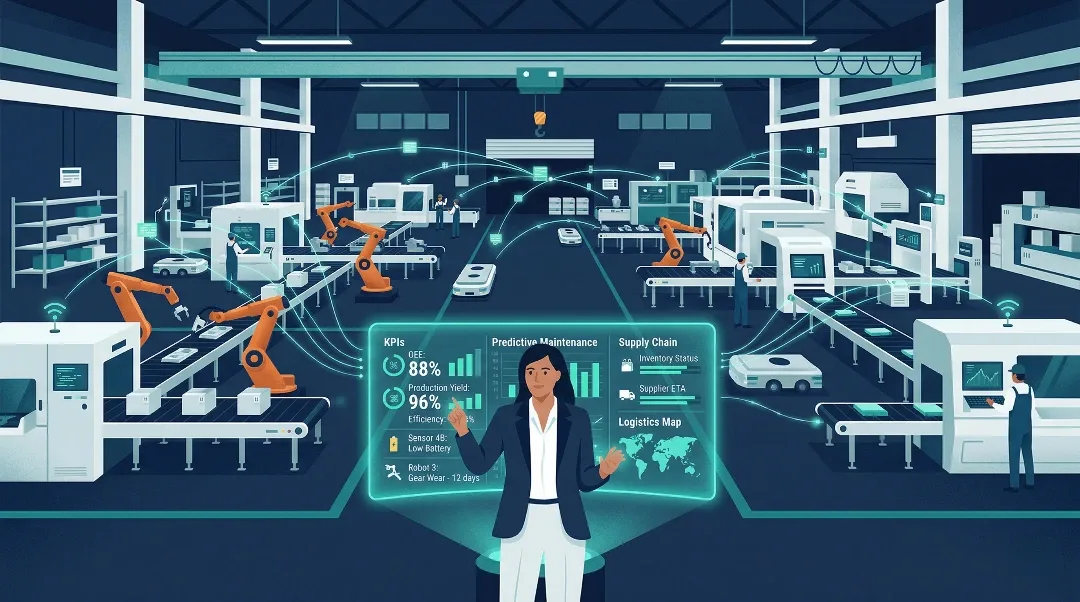
Manufacturing enterprises face relentless pressure to cut costs, reduce downtime, and improve product quality. AI and digital transformation are now the primary levers that industry leaders are pulling to stay competitive. From intelligent maintenance to demand-driven production, artificial intelligence is fundamentally reshaping how factories operate. This blog explores how manufacturing leaders can leverage AI-driven strategies to modernize legacy systems, unlock real-time operational insights, and build a scalable foundation for sustained competitive advantage in an Industry 4.0 environment.
Key Takeaways
AI and digital transformation are enabling manufacturers to shift from reactive to predictive operations.
Strong data engineering and cloud integration are foundational to scalable AI implementation in manufacturing.
Partnering with the right AI consulting services provider accelerates ROI and reduces implementation risk.
Why Manufacturing Leaders Cannot Afford to Delay Digital Transformation
Delayed adoption of digital transformation exposes manufacturers to competitive risk, rising operational costs, and mounting inefficiencies that compound over time.
Manufacturing enterprises running on legacy systems often deal with fragmented data, limited real-time visibility, and reactive maintenance practices. These constraints make it difficult to respond quickly to demand changes, supply disruptions, or equipment failures. Competitors who have embraced digital transformation can optimize throughput, reduce waste, and scale operations faster. According to McKinsey, manufacturers that adopt AI-driven operations can reduce supply chain costs by up to 15% and increase productivity by 20%. Every quarter without a transformation roadmap is a quarter of lost efficiency and margin.
The Role of Artificial Intelligence Services in Modernizing Manufacturing
Artificial intelligence services are transforming manufacturing by enabling smarter decisions across maintenance, quality control, and supply chain management.
AI applications in manufacturing span a wide range of functions. Predictive maintenance uses machine learning to forecast equipment failure before it happens, reducing unplanned downtime significantly. Computer vision systems detect product defects faster and more accurately than manual inspection. Demand forecasting models help production planners align inventory and capacity with actual market signals. At YlogX, we have delivered AI-driven solutions including computer vision applications for the automotive sector. These are not theoretical capabilities. They are practical implementations that manufacturers can begin piloting today with the right artificial intelligence services partner supporting them.
Building the Data Foundation That Makes AI Work
AI in manufacturing only delivers results when it is built on clean, connected, and well-architected data infrastructure.
The biggest barrier to successful AI adoption in manufacturing is not the algorithm. It is the data. Siloed systems, inconsistent data formats, and lack of integration between shop floor and enterprise systems create blind spots that undermine AI models. Effective digital transformation begins with a robust data engineering layer that consolidates data from IoT sensors, ERP systems, and operational tools into a unified architecture. Cloud integration enables real-time data availability at scale. With a well-designed data platform in place, manufacturers can unlock analytics, machine learning, and generative AI capabilities that deliver measurable business outcomes.
How AI Consulting Services Accelerate Your Industry 4.0 Journey
The right AI consulting services partner helps manufacturers design, pilot, and scale AI initiatives without the cost and delay of trial-and-error approaches.
Implementing AI in a manufacturing context involves navigating complex decisions around architecture, tooling, data governance, and change management. An experienced AI consulting services provider brings structured methodology to this process. At YlogX, our approach starts with discovery and assessment to understand your business goals, followed by proof-of-concept development to validate AI solutions in your specific environment. We then support full-scale implementation with a focus on scalability and ROI. Our AI consulting services are designed for manufacturing enterprises that want to move from experimentation to operational impact without unnecessary risk or delay. Learn more about how leading firms are approaching AI in manufacturing to benchmark your strategy.
Supply Chain Resilience and Quality Control Through AI
AI-powered supply chain and quality management tools give manufacturing leaders the visibility and control they need to respond to disruption with confidence.
Manufacturing supply chains face constant volatility from geopolitical shifts, raw material shortages, and logistics disruptions. AI-driven supply chain tools provide real-time visibility across vendors, inventory, and logistics networks, enabling faster and more informed responses. On the quality side, AI-powered inspection systems reduce defect rates and rework costs by identifying issues at the source rather than at the end of the production line. Together, these capabilities create a more resilient and efficient manufacturing operation. Building them effectively requires domain expertise alongside strong AI implementation skills, which is why partnering with a transformation-focused team like YlogX is a strategic decision.
Conclusion
AI and digital transformation are no longer future ambitions for manufacturing leaders. They are present-day imperatives. From predictive maintenance and quality control to supply chain visibility and data-driven decision-making, AI is enabling manufacturers to operate faster, leaner, and smarter. The path forward requires a solid data foundation, a well-structured AI strategy, and the right implementation partner. YlogX helps manufacturing enterprises navigate this journey from discovery to deployment. If you are ready to explore how AI and digital transformation can create real impact in your operations, reach out to our team to start the conversation.
FAQs
1: What is AI and digital transformation in manufacturing?
AI and digital transformation in manufacturing refers to the integration of artificial intelligence, data engineering, and cloud technologies to modernize factory operations, improve efficiency, and enable data-driven decision-making across the production lifecycle.
2: How does AI improve operational efficiency in manufacturing?
AI improves operational efficiency by enabling predictive maintenance, automating quality inspection, and optimizing production scheduling. These capabilities reduce downtime, cut waste, and increase throughput without proportional increases in cost or workforce.
3: What is predictive maintenance and why does it matter?
Predictive maintenance uses machine learning models to forecast equipment failures before they occur. It helps manufacturers avoid costly unplanned downtime, extend machine lifespan, and allocate maintenance resources more efficiently based on actual equipment condition data.
4: What role does data engineering play in AI for manufacturing?
Data engineering creates the infrastructure that connects IoT sensors, ERP systems, and operational tools into a unified data layer. Without clean, integrated data pipelines, AI models cannot function reliably. Manufacturers exploring industry case studies and implementation guides often find that data readiness is the first critical milestone.
5: What are AI consulting services and how do they benefit manufacturers?
AI consulting services provide manufacturers with strategic guidance, architecture design, and implementation support for AI initiatives. They reduce risk by combining industry knowledge with technical expertise, helping organizations validate use cases through POCs before committing to full-scale deployment.
6: How can AI improve supply chain resilience in manufacturing?
AI-powered supply chain tools analyze real-time data from vendors, logistics networks, and inventory systems to predict disruptions and recommend responses. This visibility allows manufacturers to act proactively rather than reactively, reducing the impact of volatility on production timelines.
7: How long does it take to implement an AI solution in a manufacturing plant?
Implementation timelines vary by complexity. A focused proof-of-concept can be completed in four to eight weeks. A full-scale AI deployment typically takes three to six months, depending on data readiness, integration requirements, and the number of processes being transformed.
8: Is digital transformation suitable for mid-size manufacturers or only large enterprises?
Digital transformation is viable for mid-size manufacturers as well as large enterprises. Cloud-based AI tools and scalable architectures allow smaller operations to adopt AI incrementally. Starting with one high-impact use case, such as predictive maintenance, often delivers quick and measurable returns.
9: How does computer vision improve quality control in manufacturing?
Computer vision systems use trained AI models to inspect products at speed and scale, identifying defects that human inspectors might miss. They reduce rework, lower scrap rates, and improve consistency across production runs, especially in high-volume or precision manufacturing environments.
10: How do I choose the right AI partner for my manufacturing transformation?
Look for a partner with expertise in data engineering, AI implementation, and your specific industry context. Evaluate their discovery methodology, POC approach, and post-deployment support model. Meeting the YlogX team is a good first step for manufacturers seeking an AI-first transformation partner.